
Homework Answers
Add Answer to:
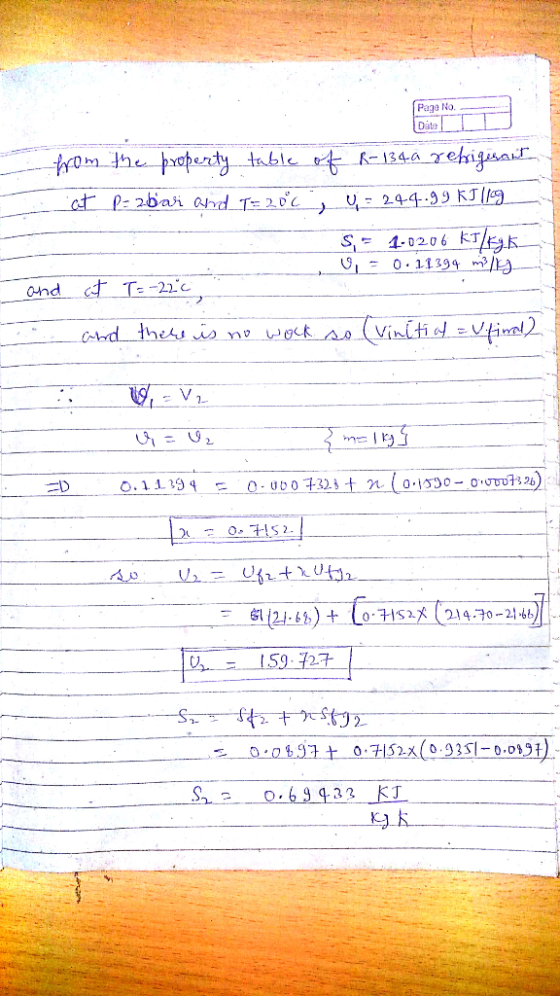
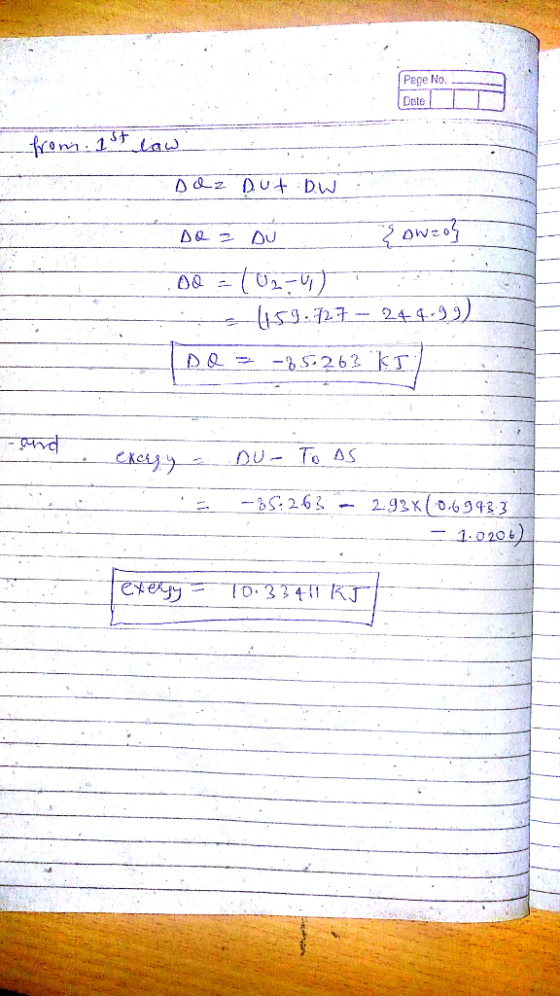
One kilogram of Refrigerant 134a vapor initially at 2 bar and 20°C fills a rigid vessel....
An insulated rigid vessel contains 5kg of saturated liquid-vapor mixture of Refrigerant- 134a at 200kPa. At...
 An insulated rigid vessel contains 5kg of saturated liquid-vapor mixture of Refrigerant- 134a at 200kPa. At this stage, one-fifth of the mass is in vapor phase and rest is in liquid. Now using an electrical resistance heater, heat is supplied to the contents of the vessel until all of the refrigerant is converted to saturated vapor. Show this process on a P v diagram with respect to saturation lines and determine, 1. volume of the rigid vessel 2. temperature, in...
A closed, rigid tank contains R-134a, initially at 100°C. The refrigerant is cooled until it has...
A closed, rigid tank contains R-134a, initially at 100°C. The refrigerant is cooled until it has a quality of 98.26% at 20°C. For the refrigerant, determine: a. (3) A T-v diagram labeling state 1 and 2 b. (12) The initial and final pressures, in bar c. (10) The heat transfer and work for the process, each in kJ/kg
2.Water, initially saturated vapor at 14.6 bar, fills a closed, rigid container. The water is heated...
2.Water, initially saturated vapor at 14.6 bar, fills a closed, rigid container. The water is heated until its temperature is 200°C. For the water, determine the heat transfer, in kJ/kg. Kinetic and potential energy effects can be ignored. 3.A piston-cylinder assembly contains 4 kg of water at 211.4oC and 3 bar. The water is compressed to a saturated vapor state where the pressure is 50.8 bar. During compression, there is a heat transfer of energy from the water to its...
A 0.6 m3 rigid tank initially contains refrigerant-134a in saturated vapor form at 0.9 MPa ....
A 0.6 m3 rigid tank initially contains refrigerant-134a in saturated vapor form at 0.9 MPa . As a result of heat transfer from the refrigerant, the pressure drops to 240 kPa. Use TESTCalc to answer the following questions. a) Determine the final temperature (T2). b) Determine the amount of refrigerant that condenses. c) Determine the heat transfer (Q).
Problem 7.023 SI As shown in the figure below, 1.25 kg of refrigerant R-134a is contained...
 Problem 7.023 SI As shown in the figure below, 1.25 kg of refrigerant R-134a is contained in a well-insulated piston-cylinder assembly fitted with an electrical resistor of negligible mass. The refrigerant is initially at 2 bar and a quality of 50%. The resistor is activated until the volume of the refrigerant doubles, while its pressure varies negligibly. Determine, in kJ (a) the amount of energy transfer by work to the piston and (b) the accompanying exergy transfer. (c) the amount...
Problem 4.040 SI Refrigerant 134a enters an air conditioner compressor at 4 bar, 20°C, and is...
 Problem 4.040 SI Refrigerant 134a enters an air conditioner compressor at 4 bar, 20°C, and is compressed at steady state to 12 bar, 80°C. The volumetric flow rate of the refrigerant entering is 8.5 m3/min. The work input to the compressor is 127.5 kJ per kg of refrigerant flowing Neglecting kinetic and potential energy effects, determine the magnitude of the heat transfer rate from the compressor, in kw kW the tolerance is +/-596 Click if you would like to Show...
2) A) Water, initially saturated vapor at 10.8 bar, fills a closed, rigid container. The water...
2) A) Water, initially saturated vapor at 10.8 bar, fills a closed, rigid container. The water is heated until its temperature is 200°C. For the water, determine the heat transfer, in kJ/kg. Kinetic and potential energy effects can be ignored. B) A piston-cylinder assembly contains 2 kg of water at 210.6oC and 3 bar. The water is compressed to a saturated vapor state where the pressure is 50.7 bar. During compression, there is a heat transfer of energy from the...
Water, initially saturated vapor at 2 bar, fills a closed, rigid container. The water is heated...
Water, initially saturated vapor at 2 bar, fills a closed, rigid container. The water is heated until its temperature is 400°C. For the water, determine the heat transfer, in kJ per kg of water.
3) A vapor-compression refrigerator uses refrigerant-134a. Superheated vapor enters the compressor at 100 kPa and -20°...
 3) A vapor-compression refrigerator uses refrigerant-134a. Superheated vapor enters the compressor at 100 kPa and -20° C, and exits at 1 MPa and 60° C. The refrigerant is cooled to 35° C in the condenser and then expands back to 100 kPa through an expansion valve. Neglect pressure losses within the condenser and evaporator. The refrigerant flow rate is 0.10 kg/s. Calculate the following a) the rate of heat removal from the cooled space, in kw, b) the rate of...
One kilogram of R-134a fills a 0.090-m3 rigid container at an initial temperature of -38°C. The...
 One kilogram of R-134a fills a 0.090-m3 rigid container at an initial temperature of -38°C. The container is then heated until the pressure is 280 kPa. Determine the initial pressure and final temperature. Use data from the steam tables. The initial pressure is kPa. The final temperature is 50 °C.
 An insulated rigid vessel contains 5kg of saturated liquid-vapor mixture of Refrigerant- 134a at 200kPa. At this stage, one-fifth of the mass is in vapor phase and rest is in liquid. Now using an electrical resistance heater, heat is supplied to the contents of the vessel until all of the refrigerant is converted to saturated vapor. Show this process on a P v diagram with respect to saturation lines and determine, 1. volume of the rigid vessel 2. temperature, in...
 Problem 7.023 SI As shown in the figure below, 1.25 kg of refrigerant R-134a is contained in a well-insulated piston-cylinder assembly fitted with an electrical resistor of negligible mass. The refrigerant is initially at 2 bar and a quality of 50%. The resistor is activated until the volume of the refrigerant doubles, while its pressure varies negligibly. Determine, in kJ (a) the amount of energy transfer by work to the piston and (b) the accompanying exergy transfer. (c) the amount...
 Problem 4.040 SI Refrigerant 134a enters an air conditioner compressor at 4 bar, 20°C, and is compressed at steady state to 12 bar, 80°C. The volumetric flow rate of the refrigerant entering is 8.5 m3/min. The work input to the compressor is 127.5 kJ per kg of refrigerant flowing Neglecting kinetic and potential energy effects, determine the magnitude of the heat transfer rate from the compressor, in kw kW the tolerance is +/-596 Click if you would like to Show...
 3) A vapor-compression refrigerator uses refrigerant-134a. Superheated vapor enters the compressor at 100 kPa and -20° C, and exits at 1 MPa and 60° C. The refrigerant is cooled to 35° C in the condenser and then expands back to 100 kPa through an expansion valve. Neglect pressure losses within the condenser and evaporator. The refrigerant flow rate is 0.10 kg/s. Calculate the following a) the rate of heat removal from the cooled space, in kw, b) the rate of...
 One kilogram of R-134a fills a 0.090-m3 rigid container at an initial temperature of -38°C. The container is then heated until the pressure is 280 kPa. Determine the initial pressure and final temperature. Use data from the steam tables. The initial pressure is kPa. The final temperature is 50 °C.
Most questions answered within 3 hours.
-
Where is the error in this code sequence?
String s1 = "Hello";
String s2 = "ello";...
asked 11 months ago -
Financial data for Joel de Paris, Inc., for last year
follow:
Joel de Paris, Inc.
Balance...
asked 11 months ago -
Consider this reaction:
Al2(SO4)3 (aq)+ BaCl3
(aq) Al2Cl6 (aq)- +
3BaSO4(s) . What is the...
asked 11 months ago -
Suppose that Savneet is considering increasing her
recent random sample from 20 car rentals to 40...
asked 11 months ago -
Trucks arrive at an unloading terminal at an average rate of 120
per hour.
Trucks arrive...
asked 11 months ago -
Why are methanol and ethanol completely soluble in water while
octanol is not very little soluble....
asked 11 months ago -
A facilities manager at a university reads in a research report
that the mean amount of...
asked 11 months ago -
When the CuSO4 is rehydrated by adding water to the anhydrous
compound, is this an endothermic...
asked 11 months ago -
A ray of sunlight is passing from diamond into crown glass; the
angle of incidence is...
asked 11 months ago -
A block of mass 0.249 kg is placed on top of a light, vertical
spring of...
asked 11 months ago -
how do the kidneys compensate in the presences of acidosis
a) trigger hyperventilate
b) reserve acid...
asked 11 months ago -
Question 501 pts
The rental rate of capital to the firm increases. Which of the
following...
asked 11 months ago