
Homework Answers

Add Answer to:
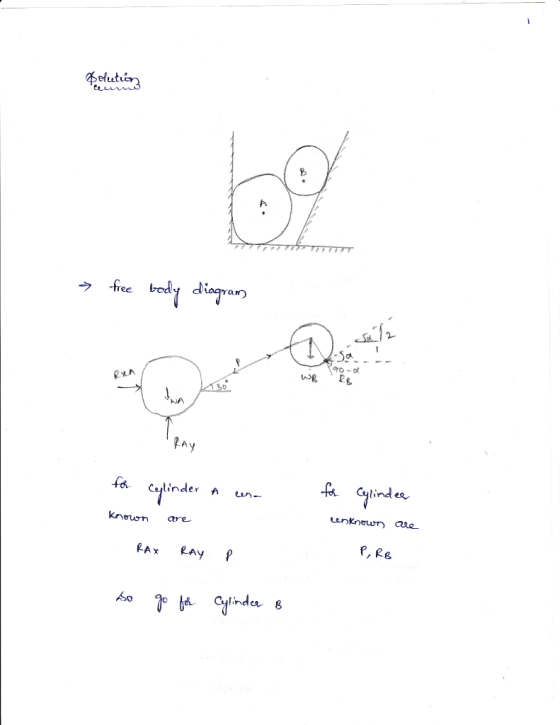
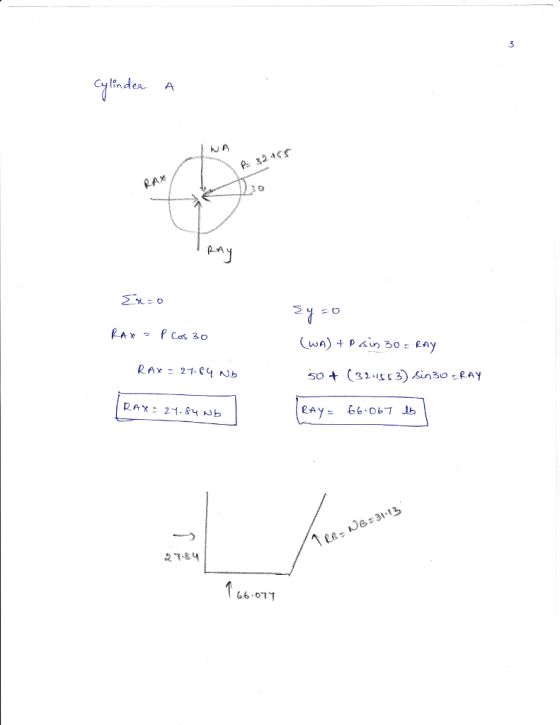
Draw a Cylinder A weighs 50 lb and B weighs 30 1b Fig. P 3-3 Also,...
the body shown in fig 15-17 weighs 50 lb. if p is 70lb and f is...
 the body shown in fig 15-17 weighs 50 lb. if p is 70lb and f is
0.2, what acceleration will be given to the body?
Please show me each step and be as simple and clear as possible
thank you
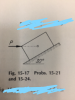
1: 30。 Fig. 15-17 Probs. 15-21 and 15-24.
the body shown in fig 15-17 weighs 50 lb. if p is 70lb and f is
0.2, what acceleration will be given to the body?
Please show me each step and be as simple and clear as possible
thank you
1: 30。 Fig. 15-17 Probs. 15-21 and 15-24.
Prob Block A weighs 10 lb and block B weighs 3 1b. B is moving downward...
 Prob Block A weighs 10 lb and block B weighs 3 1b. B is moving downward with a vclocity ( 3 fis at t- 0s. The coefficient of points)- show detailed steps kinetic friction between the horizontal plane and block A is μ-0.15. a) On the drawing, use dots to mark two particles (representing blocks A and B, respectively) that perform absolute dependent motion, draw position coordinates (including datum and direction) for the two particles b) Draw the free body...
Each of the sandbags piled weighs 100 – 1b. They rest on the 150 - lb...
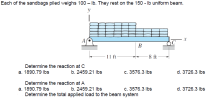 Each of the sandbags piled weighs 100 – 1b. They rest on the 150 - lb uniform beam. - 11 ft— 8 ft — Determine the reaction at C a. 1890.79 lbs b. 2459.21 lbs c. 3576.3 lbs d. 3726.3 lbs Determine the reaction at A a. 1890.79 lbs b. 2459.21 lbs c. 3576.3 lbs Determine the total applied load to the beam system d. 3726.3 lbs
A bucket that weighs 6 lb and a rope of negligible weight are used to draw water from a well that is 50 ft deep. The bu...
 A bucket that weighs 6 lb and a rope of negligible weight are used to draw water from a well that is 50 ft deep. The bucket is filled with 36 lb of water and is pulled up at a rate of 2.5 ft/s, but water leaks out of a hole in the bucket at a rate of 0.25 lb/s. Find the work done in pulling the bucket to the top of the well. Show how to approximate the required...
Block A weighs 10 lb and block B weighs 3 lb. If B is moving downward...
 Block A weighs 10 lb and block B weighs 3 lb. If B is moving downward with a velocity (UB), = 3 ft/s att = 0. The coefficient of kinetic friction between the horizontal plane and block A is A = 0.15. (Figure 1) Part A Determine the velocity of A when t = 1 s. Express your answer to three significant figures and include the appropriate units. (vs) = Value Units Submit Request Answer Provide Feedback Figure 1 of...
How to solve? The uniform steel boom in Fig. 4-22a weighs 500 lb. It is supported by two cables CE and CD, and a...
 How to solve?
The uniform steel boom in Fig. 4-22a weighs 500 lb. It is supported by two cables CE and CD, and a ball-and-socket joint at A. The cable supporting the 1000-lb load passes over a small pulley at B. Find the tension in cable CE and in cabl-e CD 4 ft 12 ft 12 ft 6 ft ft 18 ft rted by cables .r
The uniform steel boom in Fig. 4-22a weighs 500 lb. It is supported by...
How to solve?
The uniform steel boom in Fig. 4-22a weighs 500 lb. It is supported by two cables CE and CD, and a ball-and-socket joint at A. The cable supporting the 1000-lb load passes over a small pulley at B. Find the tension in cable CE and in cabl-e CD 4 ft 12 ft 12 ft 6 ft ft 18 ft rted by cables .r
The uniform steel boom in Fig. 4-22a weighs 500 lb. It is supported by...
E = 50 lb D = 60 lb C = 20 lb B = 30 lb...
 E = 50 lb
D = 60 lb
C = 20 lb
B = 30 lb
Using Method of sections determine the forces in members DC, HC, and HI. (Don't forget to say whether they're in tension or compression (25 pts) Ib Ib 3 ft 3 ft 3 ft EN D 2 ft. lb G H 2 ft B Ib 2 ft А. I
E = 50 lb
D = 60 lb
C = 20 lb
B = 30 lb
Using Method of sections determine the forces in members DC, HC, and HI. (Don't forget to say whether they're in tension or compression (25 pts) Ib Ib 3 ft 3 ft 3 ft EN D 2 ft. lb G H 2 ft B Ib 2 ft А. I
In Figure P6.18 block B weighs 50 lb. Determine the range of values of the weight...
 In Figure P6.18 block B weighs 50 lb. Determine the range of values of the weight of A that will maintain equilibrium of the system. (Be sure to check all cases!) Pulley leg is massless 10 in. u=0.3
202b 3b。 0.25 ve the tiny Cable (b) What if A weighs 20 lb, and B...
 202b 3b。 0.25 ve the tiny Cable (b) What if A weighs 20 lb, and B weighs 21 lb? Hint: I would assume static equilibrium first to see if the friction can hold it. If so, there is no acceleration at all. If that is the case, find the friction force. If there is indeed a motion, find the accelerations of A and B. (c) What if A weighs 20 lb, and B weighs 7 lb? Find the accelerations of...
A 50-kg solid circular cylinder A rests on a 35-kg block B as shown in Fig....
 A 50-kg solid circular cylinder A rests on a 35-kg block B as
shown in Fig. P16-112. When a force F is applied to the block, the
block accelerates at a rate of 5 m/s2. If the coefficients of
friction between the block and the cylinder and between the block
and the horizontal surface are both μs = μk = 0.25, determine the
magnitude of F and the frictional force exerted by the block on the
cylinder.
Fig. P16-112 150...
A 50-kg solid circular cylinder A rests on a 35-kg block B as
shown in Fig. P16-112. When a force F is applied to the block, the
block accelerates at a rate of 5 m/s2. If the coefficients of
friction between the block and the cylinder and between the block
and the horizontal surface are both μs = μk = 0.25, determine the
magnitude of F and the frictional force exerted by the block on the
cylinder.
Fig. P16-112 150...
 the body shown in fig 15-17 weighs 50 lb. if p is 70lb and f is
0.2, what acceleration will be given to the body?
Please show me each step and be as simple and clear as possible
thank you
1: 30。 Fig. 15-17 Probs. 15-21 and 15-24.
the body shown in fig 15-17 weighs 50 lb. if p is 70lb and f is
0.2, what acceleration will be given to the body?
Please show me each step and be as simple and clear as possible
thank you
1: 30。 Fig. 15-17 Probs. 15-21 and 15-24.
 Prob Block A weighs 10 lb and block B weighs 3 1b. B is moving downward with a vclocity ( 3 fis at t- 0s. The coefficient of points)- show detailed steps kinetic friction between the horizontal plane and block A is μ-0.15. a) On the drawing, use dots to mark two particles (representing blocks A and B, respectively) that perform absolute dependent motion, draw position coordinates (including datum and direction) for the two particles b) Draw the free body...
 Each of the sandbags piled weighs 100 – 1b. They rest on the 150 - lb uniform beam. - 11 ft— 8 ft — Determine the reaction at C a. 1890.79 lbs b. 2459.21 lbs c. 3576.3 lbs d. 3726.3 lbs Determine the reaction at A a. 1890.79 lbs b. 2459.21 lbs c. 3576.3 lbs Determine the total applied load to the beam system d. 3726.3 lbs
 A bucket that weighs 6 lb and a rope of negligible weight are used to draw water from a well that is 50 ft deep. The bucket is filled with 36 lb of water and is pulled up at a rate of 2.5 ft/s, but water leaks out of a hole in the bucket at a rate of 0.25 lb/s. Find the work done in pulling the bucket to the top of the well. Show how to approximate the required...
 Block A weighs 10 lb and block B weighs 3 lb. If B is moving downward with a velocity (UB), = 3 ft/s att = 0. The coefficient of kinetic friction between the horizontal plane and block A is A = 0.15. (Figure 1) Part A Determine the velocity of A when t = 1 s. Express your answer to three significant figures and include the appropriate units. (vs) = Value Units Submit Request Answer Provide Feedback Figure 1 of...
 How to solve?
The uniform steel boom in Fig. 4-22a weighs 500 lb. It is supported by two cables CE and CD, and a ball-and-socket joint at A. The cable supporting the 1000-lb load passes over a small pulley at B. Find the tension in cable CE and in cabl-e CD 4 ft 12 ft 12 ft 6 ft ft 18 ft rted by cables .r
The uniform steel boom in Fig. 4-22a weighs 500 lb. It is supported by...
How to solve?
The uniform steel boom in Fig. 4-22a weighs 500 lb. It is supported by two cables CE and CD, and a ball-and-socket joint at A. The cable supporting the 1000-lb load passes over a small pulley at B. Find the tension in cable CE and in cabl-e CD 4 ft 12 ft 12 ft 6 ft ft 18 ft rted by cables .r
The uniform steel boom in Fig. 4-22a weighs 500 lb. It is supported by...
 E = 50 lb
D = 60 lb
C = 20 lb
B = 30 lb
Using Method of sections determine the forces in members DC, HC, and HI. (Don't forget to say whether they're in tension or compression (25 pts) Ib Ib 3 ft 3 ft 3 ft EN D 2 ft. lb G H 2 ft B Ib 2 ft А. I
E = 50 lb
D = 60 lb
C = 20 lb
B = 30 lb
Using Method of sections determine the forces in members DC, HC, and HI. (Don't forget to say whether they're in tension or compression (25 pts) Ib Ib 3 ft 3 ft 3 ft EN D 2 ft. lb G H 2 ft B Ib 2 ft А. I
 In Figure P6.18 block B weighs 50 lb. Determine the range of values of the weight of A that will maintain equilibrium of the system. (Be sure to check all cases!) Pulley leg is massless 10 in. u=0.3
 202b 3b。 0.25 ve the tiny Cable (b) What if A weighs 20 lb, and B weighs 21 lb? Hint: I would assume static equilibrium first to see if the friction can hold it. If so, there is no acceleration at all. If that is the case, find the friction force. If there is indeed a motion, find the accelerations of A and B. (c) What if A weighs 20 lb, and B weighs 7 lb? Find the accelerations of...
 A 50-kg solid circular cylinder A rests on a 35-kg block B as
shown in Fig. P16-112. When a force F is applied to the block, the
block accelerates at a rate of 5 m/s2. If the coefficients of
friction between the block and the cylinder and between the block
and the horizontal surface are both μs = μk = 0.25, determine the
magnitude of F and the frictional force exerted by the block on the
cylinder.
Fig. P16-112 150...
A 50-kg solid circular cylinder A rests on a 35-kg block B as
shown in Fig. P16-112. When a force F is applied to the block, the
block accelerates at a rate of 5 m/s2. If the coefficients of
friction between the block and the cylinder and between the block
and the horizontal surface are both μs = μk = 0.25, determine the
magnitude of F and the frictional force exerted by the block on the
cylinder.
Fig. P16-112 150...
Most questions answered within 3 hours.
-
Where is the error in this code sequence?
String s1 = "Hello";
String s2 = "ello";...
asked 11 months ago -
Financial data for Joel de Paris, Inc., for last year
follow:
Joel de Paris, Inc.
Balance...
asked 11 months ago -
Consider this reaction:
Al2(SO4)3 (aq)+ BaCl3
(aq) Al2Cl6 (aq)- +
3BaSO4(s) . What is the...
asked 11 months ago -
Suppose that Savneet is considering increasing her
recent random sample from 20 car rentals to 40...
asked 11 months ago -
Trucks arrive at an unloading terminal at an average rate of 120
per hour.
Trucks arrive...
asked 11 months ago -
Why are methanol and ethanol completely soluble in water while
octanol is not very little soluble....
asked 11 months ago -
A facilities manager at a university reads in a research report
that the mean amount of...
asked 11 months ago -
When the CuSO4 is rehydrated by adding water to the anhydrous
compound, is this an endothermic...
asked 11 months ago -
A ray of sunlight is passing from diamond into crown glass; the
angle of incidence is...
asked 11 months ago -
A block of mass 0.249 kg is placed on top of a light, vertical
spring of...
asked 11 months ago -
how do the kidneys compensate in the presences of acidosis
a) trigger hyperventilate
b) reserve acid...
asked 11 months ago -
Question 501 pts
The rental rate of capital to the firm increases. Which of the
following...
asked 11 months ago