
Homework Answers

Add Answer to:
For a series RLC load, derive the following equations for P and Q Z-R+ joL+-(series RLC)...
In order to prove this proposition: (P (x)-+ Q (z)) <-(R (z) Л Q (z))you must prove which of the following propositi...
 In order to prove this proposition: (P (x)-+ Q (z)) <-(R (z) Л Q (z))you must prove which of the following propositions? Select all (if any) that apply. B) (Q (z) л P(x)) (R (z) Q (z)) F) All of the Above G) None of The Above
In order to prove this proposition: (P (x)-+ Q (z))
In order to prove this proposition: (P (x)-+ Q (z)) <-(R (z) Л Q (z))you must prove which of the following propositions? Select all (if any) that apply. B) (Q (z) л P(x)) (R (z) Q (z)) F) All of the Above G) None of The Above
In order to prove this proposition: (P (x)-+ Q (z))
Derive the equations for: a) q (the charge) b) I (the current) and c) V (the...
Derive the equations for: a) q (the charge) b) I (the current) and c) V (the voltage) for (1) charging AND (2) discharging a capacitor in series with a resistor.
RLC circuit in series A resistor R is connected in series to an inductor L and...
RLC circuit in series A resistor R is connected in series to an inductor L and a capacitor C, without any external emf sources. (a) Using the fact that the energy stored in both the capacitor and the inductor is being dissipated in the resistor, show that the charge on the capacitor q(t) satisfies the differential equation d^2 q/ dt^2 + Rdq/Ldt + q/LC = 0. This is the equation of a damped oscillator and it has a solution of...
5. In an RLC series circuit R = 10.0 Ω, C = 8.00 μF, L =...
 5. In an RLC series circuit R = 10.0 Ω, C = 8.00 μF, L = 0.200 H, ω,-800 rads, -200 v a. Find ms b. Find the impedance Z of this circuit and the steady-state current amplitude I in the circuit. c. Find the phase φ of the steady-state current and the power factor for this circuit. Is the load of this circuit resistive, inductive or capacitive? d. Find the average rate at which power is dissipated in the...
9. Here is a system of differential equations tracking three quantities P, Q, and R: P'...
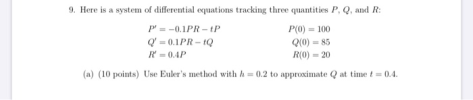 9. Here is a system of differential equations tracking three quantities P, Q, and R: P' = -0.1PR-P P(0) = 100 Q = 0.1PR-Q Q(0) = 85 R = 0.4P R(0) = 20 (a) (10 points) Use Euler's method with h = 0.2 to approximate Q at time t = 0.4.
In a series RLC resonance circuit, the resonance frequency f0 = 700 kHz. The resistor R...
In a series RLC resonance circuit, the resonance frequency f0 = 700 kHz. The resistor R = 10 Ohm. The specified bandwidth (BW) should be 10 kHz. Please calculate the quality factor (Q) and the values of inductor and capacitor.
Derive the Bernoulli equation, and derive the equations for reading the Volume flow rate (Q) using...
Derive the Bernoulli equation, and derive the equations for reading the Volume flow rate (Q) using the following. - orifice - venturi - pitot - coriolis
Let p(x) = 1 + r, q(z) = 1 + 2-4r', r(z)--3r + 4r2 Is β...
 Let p(x) = 1 + r, q(z) = 1 + 2-4r', r(z)--3r + 4r2 Is β a basis for P2(R) or not? Hint: Just check that they are linearly independent so, use Theorem 2.1.9 and let β = p(x), q(x), r( z). if 1.
2-a)-RLC components connected in series in a circuit supplied by a variable dc voltage can be described by the following differential equations: di(t) wherei@ is the loop current and V1(t) İs the vol...
 2-a)-RLC components connected in series in a circuit supplied by a variable dc voltage can be described by the following differential equations: di(t) wherei@ is the loop current and V1(t) İs the voltage drop across the inductor.+' The voltage drop across the resistor is given by Ohm's law vR(t) R i(t) and the voltage drop across the capacitor vc(t) is given by i(t) dt For a series circuit ye)t vit)t velt) v(t) where v(t) is applied voltage: Figure 3: RLC...
(P(x),Q(y), R(z)), where P depends only 2. Let S be any surface with boundary curve C, and let F(x,y, z) on r, where Q...
 (P(x),Q(y), R(z)), where P depends only 2. Let S be any surface with boundary curve C, and let F(x,y, z) on r, where Q depends only on y, and where R depends only on z. Show that F.dr 0 C
(P(x),Q(y), R(z)), where P depends only 2. Let S be any surface with boundary curve C, and let F(x,y, z) on r, where Q depends only on y, and where R depends only on z. Show that F.dr 0 C
(P(x),Q(y), R(z)), where P depends only 2. Let S be any surface with boundary curve C, and let F(x,y, z) on r, where Q depends only on y, and where R depends only on z. Show that F.dr 0 C
 In order to prove this proposition: (P (x)-+ Q (z)) <-(R (z) Л Q (z))you must prove which of the following propositions? Select all (if any) that apply. B) (Q (z) л P(x)) (R (z) Q (z)) F) All of the Above G) None of The Above
In order to prove this proposition: (P (x)-+ Q (z))
In order to prove this proposition: (P (x)-+ Q (z)) <-(R (z) Л Q (z))you must prove which of the following propositions? Select all (if any) that apply. B) (Q (z) л P(x)) (R (z) Q (z)) F) All of the Above G) None of The Above
In order to prove this proposition: (P (x)-+ Q (z))
 5. In an RLC series circuit R = 10.0 Ω, C = 8.00 μF, L = 0.200 H, ω,-800 rads, -200 v a. Find ms b. Find the impedance Z of this circuit and the steady-state current amplitude I in the circuit. c. Find the phase φ of the steady-state current and the power factor for this circuit. Is the load of this circuit resistive, inductive or capacitive? d. Find the average rate at which power is dissipated in the...
 9. Here is a system of differential equations tracking three quantities P, Q, and R: P' = -0.1PR-P P(0) = 100 Q = 0.1PR-Q Q(0) = 85 R = 0.4P R(0) = 20 (a) (10 points) Use Euler's method with h = 0.2 to approximate Q at time t = 0.4.
 Let p(x) = 1 + r, q(z) = 1 + 2-4r', r(z)--3r + 4r2 Is β a basis for P2(R) or not? Hint: Just check that they are linearly independent so, use Theorem 2.1.9 and let β = p(x), q(x), r( z). if 1.
 2-a)-RLC components connected in series in a circuit supplied by a variable dc voltage can be described by the following differential equations: di(t) wherei@ is the loop current and V1(t) İs the voltage drop across the inductor.+' The voltage drop across the resistor is given by Ohm's law vR(t) R i(t) and the voltage drop across the capacitor vc(t) is given by i(t) dt For a series circuit ye)t vit)t velt) v(t) where v(t) is applied voltage: Figure 3: RLC...
 (P(x),Q(y), R(z)), where P depends only 2. Let S be any surface with boundary curve C, and let F(x,y, z) on r, where Q depends only on y, and where R depends only on z. Show that F.dr 0 C
(P(x),Q(y), R(z)), where P depends only 2. Let S be any surface with boundary curve C, and let F(x,y, z) on r, where Q depends only on y, and where R depends only on z. Show that F.dr 0 C
(P(x),Q(y), R(z)), where P depends only 2. Let S be any surface with boundary curve C, and let F(x,y, z) on r, where Q depends only on y, and where R depends only on z. Show that F.dr 0 C
Most questions answered within 3 hours.
-
Where is the error in this code sequence?
String s1 = "Hello";
String s2 = "ello";...
asked 10 months ago -
Financial data for Joel de Paris, Inc., for last year
follow:
Joel de Paris, Inc.
Balance...
asked 10 months ago -
Consider this reaction:
Al2(SO4)3 (aq)+ BaCl3
(aq) Al2Cl6 (aq)- +
3BaSO4(s) . What is the...
asked 10 months ago -
Suppose that Savneet is considering increasing her
recent random sample from 20 car rentals to 40...
asked 10 months ago -
Trucks arrive at an unloading terminal at an average rate of 120
per hour.
Trucks arrive...
asked 10 months ago -
Why are methanol and ethanol completely soluble in water while
octanol is not very little soluble....
asked 10 months ago -
A facilities manager at a university reads in a research report
that the mean amount of...
asked 10 months ago -
When the CuSO4 is rehydrated by adding water to the anhydrous
compound, is this an endothermic...
asked 10 months ago -
A ray of sunlight is passing from diamond into crown glass; the
angle of incidence is...
asked 10 months ago -
A block of mass 0.249 kg is placed on top of a light, vertical
spring of...
asked 10 months ago -
how do the kidneys compensate in the presences of acidosis
a) trigger hyperventilate
b) reserve acid...
asked 10 months ago -
Question 501 pts
The rental rate of capital to the firm increases. Which of the
following...
asked 10 months ago