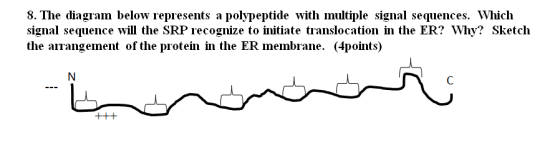
The diagram below represents a polypeptide with multiple signal sequences. Which signal sequence will the SRP recognize to initiate translocation in the ER? Why? Sketch the arrangement of the protein in the ER membrane.
Homework Answers
The SRP will recognize the first signal sequence present at the N terminal , as its function is to direct the insertion of thee nascent polypeptide in to the transmembrane channel. proteins are synthesised fro N terminal to C terminal.so nascent polypeptide will bind the SRP towards the signal sequence present near N terminal.
Add Answer to:
The diagram below represents a polypeptide with multiple
signal sequences. Which signal sequence will the SRP...
The ER signal sequence on a growing polypeptide chain is recognized by a signal-recognition particle (SRP)...
 The ER signal sequence on a growing polypeptide chain is recognized by a signal-recognition particle (SRP) in the cytosol. What does this interaction accomplish? It cleaves the ER signal sequence from the polypeptide chain. It cleaves the ER signal sequence from the polypeptide chain. It guides the ribosome and its polypeptide to the ER. It releases the polypeptide chain from the ribosome. It speeds the synthesis of the polypeptide chain. Which of the following choices reflects the appropriate order of...
The role of the signal recognition particle (SRP) in sorting proteins that contain an ER signal...
The role of the signal recognition particle (SRP) in sorting proteins that contain an ER signal sequence is A. the SRP must be associated with a cytosolic ribosome before the ribosome can attach to the ER membrane and initiate translation of an mRNA encoding a protein with an ER signal B. the SRP binds the signal sequence in the cytosol after synthesis of the protein has begun on a ribosome, and escorts the ribosome/mRNA complex to the ER membrane C....
1. Where is the ER targeting sequence located in the polypeptide chain (N-terminal, interior, or C-terminal)...
 1. Where is the ER targeting sequence located in the polypeptide chain (N-terminal, interior, or C-terminal) 2. Name 4 organelles that require organelle specific targeting sequences in polypeptide 3. Name 3 final locations for proteins with ER signal sequence 4. Satranslational translocation: (a) Name the protein that the signal sequence binds to (b) Name the protein SRP binds to 5. State the function of signal peptidase 6. Name a membrane protein that is not a single pass membrane protein 7....
What is the correct order for the following steps in co-translating a soluble protein into the...
 What is the correct order for the following steps in co-translating a soluble protein into the ER lumen? #1 Choose... Translocation of the protein through the translocator begins. Signal sequence is cleaved by signal peptidase. ER Signal sequence binds to the translocator channel. SRP binds SRP Receptor. Translation begins. SRP binds ER signal sequence. Ribosome dissociates from ER membrane. Translation of the polypeptide finishes. Ribosome binds mRNA. Translation pauses. Choose.. Choose... Choose... #9 Choose... #10 Choose...
Drag the terms on the left to the appropriate blanks on the right to complete the...
 Drag the terms on the left to the appropriate blanks on the right to complete the sentences. Terms can be used once, more than once, or not at all. Reset Help transport vesicle(s) Soon after initiation of translation of an mRNA coding for a secretory protein, the of the secretory protein is synthesized and is exposed on the surface of the ribosome. The signal recognition particle (SRP) contains the that marks this protein for into the endoplasmic reticulum cotranslational translocation...
Problem 4.1.3 (tags: #protein targeting, #protein topology, #transfer sequence) a) Make a map showing the location...
 Problem 4.1.3 (tags: #protein targeting, #protein topology, #transfer sequence) a) Make a map showing the location of signal sequences, start transfer sequences and stop transfer sequences in protein A and protein B below that end up inserted in the membrane as shown. Protein A NH, Cytosol NA J B Scoot & Membrane Protein B COOH HAN Ν - FC ER Cisterna b) Make a map for the arrangement of signal sequences, start transfer sequences and stop transfer sequences for a...
Your lab assistant put together DNA sequences to create a modified polypeptide sequence, then exp...
your lab assistant put together DNA sequences to create a modified polypeptide sequence, then expressed these constructs in some brain cells. For each of the following constructs, predict the intracellular (or extracellular) location, and a brief description of why. Assume a start codon is present. a) a protein normally targetted to the chloroplast stroma, with N-terminal targeting sequence deleted. b) a C-terminal peroxisomal targeting sequence has been asses to the C-terminus of a normally secreted protein, still with its usual...
1. (14pts) A. What are the functions of the signal recognition particle (SRP) and translocon in p...
 PLEASE ANSWER ALL THE QUESTIONS IN EACH PART. THANK YOU!
1. (14pts) A. What are the functions of the signal recognition particle (SRP) and translocon in protein transport to the ER? SRP Translocon B. How does the translocon determine which orientation to insert membrane proteins? C. How do budding & fusion affect the orientation of integral membrane proteins during vesicle transport? D. Consider a ligand-gated ion channel at the plasma membrane that binds to ligands in the cytoplasm. From a...
PLEASE ANSWER ALL THE QUESTIONS IN EACH PART. THANK YOU!
1. (14pts) A. What are the functions of the signal recognition particle (SRP) and translocon in protein transport to the ER? SRP Translocon B. How does the translocon determine which orientation to insert membrane proteins? C. How do budding & fusion affect the orientation of integral membrane proteins during vesicle transport? D. Consider a ligand-gated ion channel at the plasma membrane that binds to ligands in the cytoplasm. From a...
The picture below schematically depicts proteins containing various types of signals and topogenic sequences. Predict the...
 The picture below schematically depicts proteins containing
various types of signals and topogenic sequences. Predict the
arrangement of each type of protein shown in the figure with
respect to the endoplasmic reticulum membrane and
lumen. Provide the drawings.
Cleavable signal sequence (a) N Noncleavable = signal-anchor sequence Stop-transfer sequence (b) N4 DNA - C (d) NHH (e) N-
The picture below schematically depicts proteins containing
various types of signals and topogenic sequences. Predict the
arrangement of each type of protein shown in the figure with
respect to the endoplasmic reticulum membrane and
lumen. Provide the drawings.
Cleavable signal sequence (a) N Noncleavable = signal-anchor sequence Stop-transfer sequence (b) N4 DNA - C (d) NHH (e) N-
5. (8 pts) The figure below depicts recombinant proteins with various types of signal sequences. A....
 5. (8 pts) The figure below depicts recombinant proteins with various types of signal sequences. A. NH2 COO H B. NH2 COOH ER import sequence mitochondria import sequence C. NH2 ER retention sequence nucleus import sequence COOH .NH2 COO H D. What is the final cellular destination of each protein? A. B. C. D.
 The ER signal sequence on a growing polypeptide chain is recognized by a signal-recognition particle (SRP) in the cytosol. What does this interaction accomplish? It cleaves the ER signal sequence from the polypeptide chain. It cleaves the ER signal sequence from the polypeptide chain. It guides the ribosome and its polypeptide to the ER. It releases the polypeptide chain from the ribosome. It speeds the synthesis of the polypeptide chain. Which of the following choices reflects the appropriate order of...
 1. Where is the ER targeting sequence located in the polypeptide chain (N-terminal, interior, or C-terminal) 2. Name 4 organelles that require organelle specific targeting sequences in polypeptide 3. Name 3 final locations for proteins with ER signal sequence 4. Satranslational translocation: (a) Name the protein that the signal sequence binds to (b) Name the protein SRP binds to 5. State the function of signal peptidase 6. Name a membrane protein that is not a single pass membrane protein 7....
 What is the correct order for the following steps in co-translating a soluble protein into the ER lumen? #1 Choose... Translocation of the protein through the translocator begins. Signal sequence is cleaved by signal peptidase. ER Signal sequence binds to the translocator channel. SRP binds SRP Receptor. Translation begins. SRP binds ER signal sequence. Ribosome dissociates from ER membrane. Translation of the polypeptide finishes. Ribosome binds mRNA. Translation pauses. Choose.. Choose... Choose... #9 Choose... #10 Choose...
 Drag the terms on the left to the appropriate blanks on the right to complete the sentences. Terms can be used once, more than once, or not at all. Reset Help transport vesicle(s) Soon after initiation of translation of an mRNA coding for a secretory protein, the of the secretory protein is synthesized and is exposed on the surface of the ribosome. The signal recognition particle (SRP) contains the that marks this protein for into the endoplasmic reticulum cotranslational translocation...
 Problem 4.1.3 (tags: #protein targeting, #protein topology, #transfer sequence) a) Make a map showing the location of signal sequences, start transfer sequences and stop transfer sequences in protein A and protein B below that end up inserted in the membrane as shown. Protein A NH, Cytosol NA J B Scoot & Membrane Protein B COOH HAN Ν - FC ER Cisterna b) Make a map for the arrangement of signal sequences, start transfer sequences and stop transfer sequences for a...
 PLEASE ANSWER ALL THE QUESTIONS IN EACH PART. THANK YOU!
1. (14pts) A. What are the functions of the signal recognition particle (SRP) and translocon in protein transport to the ER? SRP Translocon B. How does the translocon determine which orientation to insert membrane proteins? C. How do budding & fusion affect the orientation of integral membrane proteins during vesicle transport? D. Consider a ligand-gated ion channel at the plasma membrane that binds to ligands in the cytoplasm. From a...
PLEASE ANSWER ALL THE QUESTIONS IN EACH PART. THANK YOU!
1. (14pts) A. What are the functions of the signal recognition particle (SRP) and translocon in protein transport to the ER? SRP Translocon B. How does the translocon determine which orientation to insert membrane proteins? C. How do budding & fusion affect the orientation of integral membrane proteins during vesicle transport? D. Consider a ligand-gated ion channel at the plasma membrane that binds to ligands in the cytoplasm. From a...
 The picture below schematically depicts proteins containing
various types of signals and topogenic sequences. Predict the
arrangement of each type of protein shown in the figure with
respect to the endoplasmic reticulum membrane and
lumen. Provide the drawings.
Cleavable signal sequence (a) N Noncleavable = signal-anchor sequence Stop-transfer sequence (b) N4 DNA - C (d) NHH (e) N-
The picture below schematically depicts proteins containing
various types of signals and topogenic sequences. Predict the
arrangement of each type of protein shown in the figure with
respect to the endoplasmic reticulum membrane and
lumen. Provide the drawings.
Cleavable signal sequence (a) N Noncleavable = signal-anchor sequence Stop-transfer sequence (b) N4 DNA - C (d) NHH (e) N-
 5. (8 pts) The figure below depicts recombinant proteins with various types of signal sequences. A. NH2 COO H B. NH2 COOH ER import sequence mitochondria import sequence C. NH2 ER retention sequence nucleus import sequence COOH .NH2 COO H D. What is the final cellular destination of each protein? A. B. C. D.
Most questions answered within 3 hours.
-
Where is the error in this code sequence?
String s1 = "Hello";
String s2 = "ello";...
asked 10 months ago -
Financial data for Joel de Paris, Inc., for last year
follow:
Joel de Paris, Inc.
Balance...
asked 10 months ago -
Consider this reaction:
Al2(SO4)3 (aq)+ BaCl3
(aq) Al2Cl6 (aq)- +
3BaSO4(s) . What is the...
asked 10 months ago -
Suppose that Savneet is considering increasing her
recent random sample from 20 car rentals to 40...
asked 10 months ago -
Trucks arrive at an unloading terminal at an average rate of 120
per hour.
Trucks arrive...
asked 10 months ago -
Why are methanol and ethanol completely soluble in water while
octanol is not very little soluble....
asked 10 months ago -
A facilities manager at a university reads in a research report
that the mean amount of...
asked 10 months ago -
When the CuSO4 is rehydrated by adding water to the anhydrous
compound, is this an endothermic...
asked 10 months ago -
A ray of sunlight is passing from diamond into crown glass; the
angle of incidence is...
asked 10 months ago -
A block of mass 0.249 kg is placed on top of a light, vertical
spring of...
asked 10 months ago -
how do the kidneys compensate in the presences of acidosis
a) trigger hyperventilate
b) reserve acid...
asked 10 months ago -
Question 501 pts
The rental rate of capital to the firm increases. Which of the
following...
asked 10 months ago