A thermally insulated vessel contains one mole of copper. The initial state is at 700 K...
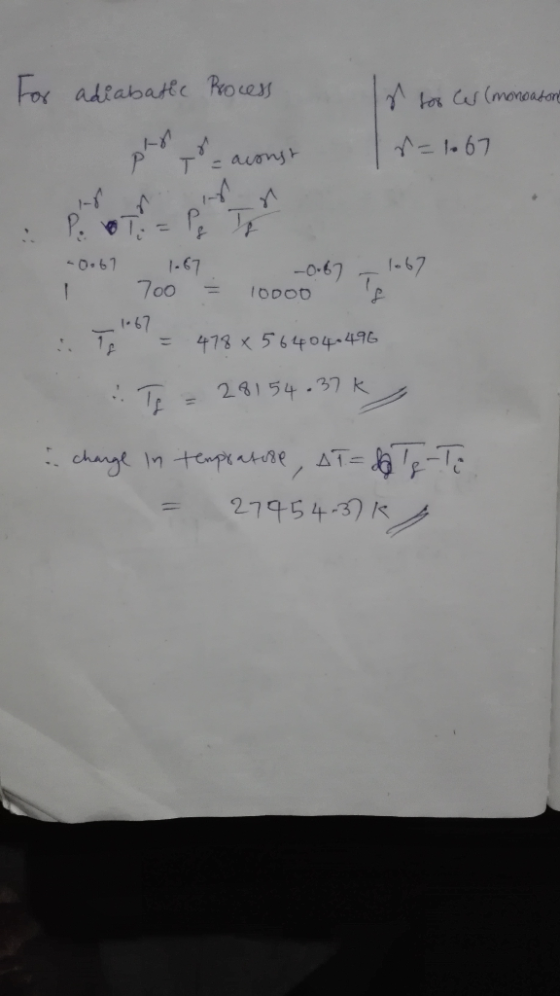
A thermally insulated vessel contains one mole of copper. The initial state is at 700 K and 1.0 atm. The system is compressed reversibly to a pressure 10000 atm. How much temperature change is produced by this reversible adiabatic process? Assume the volume V, α (5.1x10⁻⁶ /K) and cp (27.3 J/mol-K) do not change significantly with T and P.
Homework Answers
Add Answer to:
A thermally insulated vessel contains one mole of copper. The
initial state is at 700 K...
plz 7. Consider the following piston-cylinder arrangement which is thermally insulated. Initially, the same 1 mole...
 plz
7. Consider the following piston-cylinder arrangement which is thermally insulated. Initially, the same 1 mole of ideal gas are confined in the cylinder A, B and C, respectively which are partitioned by a adiabatic piston and a diathermic piston as shown in Figure 1. The initial volume and absolute temperature (K) of three partitions are the same as Vand T, respectively and the pressure of the cylinder is given by P, as shown in Figure 1. When heat (q)...
plz
7. Consider the following piston-cylinder arrangement which is thermally insulated. Initially, the same 1 mole of ideal gas are confined in the cylinder A, B and C, respectively which are partitioned by a adiabatic piston and a diathermic piston as shown in Figure 1. The initial volume and absolute temperature (K) of three partitions are the same as Vand T, respectively and the pressure of the cylinder is given by P, as shown in Figure 1. When heat (q)...
) One mole of a monoatomic ideal gas at initial pressure of 30 atm and 600...
) One mole of a monoatomic ideal gas at initial pressure of 30 atm and 600 K undergoes a rapid adiabatic free expansion from a vessel to another 50 times larger in volume. Find the change in temperature and the increase in entropy.
Q1) solve part A,B,C and D A)Magnesium carbonate thermally decomposes to magnesium oxide and carbon dioxide...
Q1) solve part A,B,C and D A)Magnesium carbonate thermally decomposes to magnesium oxide and carbon dioxide gas: MgCO3(s) → MgO(s) + CO2(g) Determine the volume of carbon dioxide in liters that would form if 4.22 g of magnesium carbonate decomposes completely at 355oC and 1.05 atm. B) A 6.00 L vessel contains 10.5 g of O2, 2.12 g of CO2 and 1.12 g of He. Determine the partial pressure in atm of each gas and the total pressure in atm...
8) A block of copper (Cp,m = 24.44 J K-1 mol-1 ) of mass 2.00 kg...
8) A block of copper (Cp,m = 24.44 J K-1 mol-1 ) of mass 2.00 kg at 0 ℃ is introduced into an insulated container in which there is 1.00 mol H2O(g) at 100 ℃ and 1.00 atm. Assuming that all the vapour is condensed to liquid water, determine: (a) the final temperature of the system; (b) the heat transferred to the copper block; and (c) the entropy change of the water, the copper block, and the total system. >>...
I. (30 pts.) One mole of an ideal gas with constant heat capacities and ? 5/3...
 I. (30 pts.) One mole of an ideal gas with constant heat capacities and ? 5/3 is compressed adiabatically in a piston-cylinder device from T1-300 K, pi = 1 bar to p2 = 10 bar at a constant external pressure Pext"- P2 -10 bar. Calculate the final temperature, T2, and W, Q. AU, AH for this process. 2. (20 pts.) Repeat problem 1 for an adiabatic and reversible compression. 3. (20 pts.) A rigid, insulated tank is divided into two...
Question 11: (1 point) One mole of N2(g) undergoes the following change in state. N2(g, 309...
Question 11: (1 point) One mole of N2(g) undergoes the following change in state. N2(g, 309 K, 4.03 bar) ⟶ N2(g, 259 K, 6.57 bar) What is ΔS for the gas? Assume ideal gas behaviour. The constant pressure molar heat capacity for N2(g) is Cp,m = 29.10 J K−1 mol−1. Enter your answers in the specified units with three or more significant figures . Do not include units as part of your answer. ΔS = ____________ J K−1 Question 12: (1...
NA 6.022 x 10³ molecules/mole k 1.381 x 10²³ J/K c 2.997 x 10⁸ m/s 1...
 NA 6.022 x 10³ molecules/mole k 1.381 x 10²³ J/K c 2.997 x 10⁸ m/s 1 cal 4.186 J mp 1.673 x 1027 kg 1 atm 1.013 bar h 6.626 x 10⁻³⁴ Js R 8.315 J/(mol K) 1 bar 10% Pa 1. (15 points) 2.0 moles of a monatomic ideal gas undergo a 3 step cyclic process. The process begins in state A at 1.00 atm, 297 K. The gas is heated slowly at constant pressure until it reaches state...
Answer all Parts Please 4) (Conceptual question) Consider a well-insulated container of total volume V0. (a)...
Answer all Parts Please 4) (Conceptual question) Consider a well-insulated container of total volume V0. (a) Initially, the container is divided into two equal parts, using a very thin partition of negligible thickness. One side is filled with a mole of argon at temperature T0 and pressure P0 whereas the other side is under vacuum. The partition is then suddenly removed and the system is allowed to reach equilibrium. Write an expression for: a. Final T and P b. Change...
Please answer all, this is for physical chemistry. Thank you T-Mobile 11:14 AM X Problem Set...
 Please answer all, this is for physical chemistry. Thank you
T-Mobile 11:14 AM X Problem Set 2_Spring 2018.pdf 1- One gram of liquid bemzene (CH)is bumed in a bomb calorimeter. The temperature before ignition was 20826 C,and the temperature afher the combustion was 25.000 "C. This was an adiabatic calorimeter (constant volame). The heat capacity of the bomb, the water around it, and the contents of the bomb before the combustion was 10,000 JK. Calculate the ??-foe C.H.1) at 298...
Please answer all, this is for physical chemistry. Thank you
T-Mobile 11:14 AM X Problem Set 2_Spring 2018.pdf 1- One gram of liquid bemzene (CH)is bumed in a bomb calorimeter. The temperature before ignition was 20826 C,and the temperature afher the combustion was 25.000 "C. This was an adiabatic calorimeter (constant volame). The heat capacity of the bomb, the water around it, and the contents of the bomb before the combustion was 10,000 JK. Calculate the ??-foe C.H.1) at 298...
1. Name three characteristics of the atoms in a gas that are essential for the gas...
1. Name three characteristics of the atoms in a gas that are essential for the gas to be ideal. Explain why these three qualities of the atoms or molecules make the gas ideal. 2. Considering the Boltzmann distribution of atomic/molecular speeds for an ideal gas at temperature T (in K) , order the following speeds from smallest to largest: average speed, most probable speed, and root mean squared speed. Why are they different speeds? 3. What is the most important...
 plz
7. Consider the following piston-cylinder arrangement which is thermally insulated. Initially, the same 1 mole of ideal gas are confined in the cylinder A, B and C, respectively which are partitioned by a adiabatic piston and a diathermic piston as shown in Figure 1. The initial volume and absolute temperature (K) of three partitions are the same as Vand T, respectively and the pressure of the cylinder is given by P, as shown in Figure 1. When heat (q)...
plz
7. Consider the following piston-cylinder arrangement which is thermally insulated. Initially, the same 1 mole of ideal gas are confined in the cylinder A, B and C, respectively which are partitioned by a adiabatic piston and a diathermic piston as shown in Figure 1. The initial volume and absolute temperature (K) of three partitions are the same as Vand T, respectively and the pressure of the cylinder is given by P, as shown in Figure 1. When heat (q)...
 I. (30 pts.) One mole of an ideal gas with constant heat capacities and ? 5/3 is compressed adiabatically in a piston-cylinder device from T1-300 K, pi = 1 bar to p2 = 10 bar at a constant external pressure Pext"- P2 -10 bar. Calculate the final temperature, T2, and W, Q. AU, AH for this process. 2. (20 pts.) Repeat problem 1 for an adiabatic and reversible compression. 3. (20 pts.) A rigid, insulated tank is divided into two...
 NA 6.022 x 10³ molecules/mole k 1.381 x 10²³ J/K c 2.997 x 10⁸ m/s 1 cal 4.186 J mp 1.673 x 1027 kg 1 atm 1.013 bar h 6.626 x 10⁻³⁴ Js R 8.315 J/(mol K) 1 bar 10% Pa 1. (15 points) 2.0 moles of a monatomic ideal gas undergo a 3 step cyclic process. The process begins in state A at 1.00 atm, 297 K. The gas is heated slowly at constant pressure until it reaches state...
 Please answer all, this is for physical chemistry. Thank you
T-Mobile 11:14 AM X Problem Set 2_Spring 2018.pdf 1- One gram of liquid bemzene (CH)is bumed in a bomb calorimeter. The temperature before ignition was 20826 C,and the temperature afher the combustion was 25.000 "C. This was an adiabatic calorimeter (constant volame). The heat capacity of the bomb, the water around it, and the contents of the bomb before the combustion was 10,000 JK. Calculate the ??-foe C.H.1) at 298...
Please answer all, this is for physical chemistry. Thank you
T-Mobile 11:14 AM X Problem Set 2_Spring 2018.pdf 1- One gram of liquid bemzene (CH)is bumed in a bomb calorimeter. The temperature before ignition was 20826 C,and the temperature afher the combustion was 25.000 "C. This was an adiabatic calorimeter (constant volame). The heat capacity of the bomb, the water around it, and the contents of the bomb before the combustion was 10,000 JK. Calculate the ??-foe C.H.1) at 298...
Most questions answered within 3 hours.
-
Where is the error in this code sequence?
String s1 = "Hello";
String s2 = "ello";...
asked 11 months ago -
Financial data for Joel de Paris, Inc., for last year
follow:
Joel de Paris, Inc.
Balance...
asked 11 months ago -
Consider this reaction:
Al2(SO4)3 (aq)+ BaCl3
(aq) Al2Cl6 (aq)- +
3BaSO4(s) . What is the...
asked 11 months ago -
Suppose that Savneet is considering increasing her
recent random sample from 20 car rentals to 40...
asked 11 months ago -
Trucks arrive at an unloading terminal at an average rate of 120
per hour.
Trucks arrive...
asked 11 months ago -
Why are methanol and ethanol completely soluble in water while
octanol is not very little soluble....
asked 11 months ago -
A facilities manager at a university reads in a research report
that the mean amount of...
asked 11 months ago -
When the CuSO4 is rehydrated by adding water to the anhydrous
compound, is this an endothermic...
asked 11 months ago -
A ray of sunlight is passing from diamond into crown glass; the
angle of incidence is...
asked 11 months ago -
A block of mass 0.249 kg is placed on top of a light, vertical
spring of...
asked 11 months ago -
how do the kidneys compensate in the presences of acidosis
a) trigger hyperventilate
b) reserve acid...
asked 11 months ago -
Question 501 pts
The rental rate of capital to the firm increases. Which of the
following...
asked 11 months ago