
Homework Answers
Hello!
For Question 6: The Mechanism may be outer sphere electron transfer, the event that occurs between chemical species remain separate and intact before, during, and after the ET event. In contrast, for inner sphere electron transfer the participating redox sites undergoing ET become connected by a chemical bridge. Because the ET in outer sphere electron transfer occurs between two non-connected species, the electron is forced to move through space from one redox center to the other.
other example of OSET:
[MnO4]? + [Mn*O4]2? ? [MnO4]2? + [Mn*O4]?
example of ISET:
[CoCl(NH3)5]2+ + [Cr(H2O)6]2+ ? [Co(NH3)5(H2O)]2+ + [CrCl(H2O)5]2+
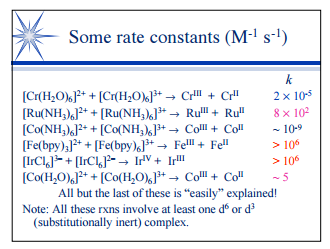
About the rate of the reaction, If you look for the rate constants you find that for Co complexes the constant is small (10E-9), this complex may be predominant in the rate law of this reaction and therefore occurs slow.
Add Answer to:
6, 7 a and 7b
Discuss the probable mechanisms of the following reaction and also speculate...
(i) Name the two mechanisms by which electron transfer reactions can occur and explain how they differ. (ii)Explain how the following reaction was used to deduce the mechanism of inner sphere electron...
(i) Name the two mechanisms by which electron transfer reactions can occur and explain how they differ. (ii)Explain how the following reaction was used to deduce the mechanism of inner sphere electron transfer. [Co(NH3)5Cl]2+ + [Cr(H2O)6]2+ + 5H2O = [Co(H2O)6]2+ + [Cr(H2O)5Cl]2+ + 5NH3
(i) Name the two mechanisms by which electron transfer reactions can occur and explain how they...
(i) Name the two mechanisms by which electron transfer reactions can occur and explain how they differ. (ii)Explain how the following reaction was used to deduce the mechanism of inner sphere electron transfer. [Co(NH3)5Cl]2+ + [Cr(H2O)6]2+ + 5H2O = [Co(H2O)6]2+ + [Cr(H2O)5Cl]2+ + 5NH3
a) Explain how electron transfer takes place between the complexes in oxidation-reduction reactions related to inner-sphere...
a) Explain how electron transfer takes place between the complexes in oxidation-reduction reactions related to inner-sphere and outer-sphere mechanisms, respectively. b) You are told that the oxidation-reduction reaction between [Co(NH3)6]^3+ and Ru(NH3)6^2+ takes place via outer sphere electron transfer and the rate constant is 1.1 x 10^–2. However, if instead of Ru(NH3)6^2+, [Cr(bipy)3]^2+ is the reductant then rate constant is much higher, 6.9 x 10^2. Explain the reason.
Question 6: Reaction Mechanisms (9 points) For the reaction: 2NO2 → 2NO + O2 Suppose there are two possible mechanisms t...
Question 6: Reaction Mechanisms (9 points) For the reaction: 2NO2 → 2NO + O2 Suppose there are two possible mechanisms to define a particular reaction. These two mechanisms are proposed below: 1. NO2 → NO + O (slow) O + NO2 → O2 + NO (fast) 2. 2NO2 → NO3 + NO (slow) NO3 → NO + O2 (fast) a) Identify the rate for each reaction and the order of each reaction. (4 points) b.) Identify the intermediate for each...
Please answer each part with work shown. Thank you. 6. The following three mechanisms have been proposed for a particular reaction. Mechanism II Mechanism III Mechanisml H2 +NO-H2O+N (slow) N +...
 Please answer each part with work shown. Thank you.
6. The following three mechanisms have been proposed for a particular reaction. Mechanism II Mechanism III Mechanisml H2 +NO-H2O+N (slow) N +NON2+0 (fast) O+H2-> H2O (fast) 2 NO-N202 (fast equilibrium) H2-N202-H20+ N3O (slow) H2+N20-H2O+N2 (fast) H2 + 2 NO- H2O+N2O (slow) N20+ H2N2+ H2O (fast) a) What is the overall reaction that each proposed mechanism supports? b) Calculate the ΔΗ'm for the overall reaction. c) For each mechanism, draw an energy...
Please answer each part with work shown. Thank you.
6. The following three mechanisms have been proposed for a particular reaction. Mechanism II Mechanism III Mechanisml H2 +NO-H2O+N (slow) N +NON2+0 (fast) O+H2-> H2O (fast) 2 NO-N202 (fast equilibrium) H2-N202-H20+ N3O (slow) H2+N20-H2O+N2 (fast) H2 + 2 NO- H2O+N2O (slow) N20+ H2N2+ H2O (fast) a) What is the overall reaction that each proposed mechanism supports? b) Calculate the ΔΗ'm for the overall reaction. c) For each mechanism, draw an energy...
Using appropriate mechanisms, explain formation of given products in the following reactions and discuss why reaction (...
 Using appropriate mechanisms, explain formation of given products in the following reactions and discuss why reaction (A) goes 670 times faster than reaction (B). ососни сн,со OCOCHE CHECO,H k = 670 OTS "OCOCH OCOCH, CH.COM CH3COH OCOCHE OTS k = 1 OCOCHE
Predict the product of the reaction mechanisms. Identify the electrophile and nucleophile in each reaction. Propose...
 Predict the product of the reaction mechanisms. Identify the electrophile and nucleophile in each reaction. Propose a mechanism for each reaction below. This means show curved arrows. You may want to fill in any nonbonding electrons. Show an example of each of the following types of reactions and explain why it is that type: Addition elimination Rearrangement Substitution
Question 3 (a) Arange the following compounds in order of decreasing reactivity with nucleophiles (ie. most...
 Question 3 (a) Arange the following compounds in order of decreasing reactivity with nucleophiles (ie. most reactive compound first). Explain your reasoning. (6 marks) C Me Me OMe OMe F C NMez Me Me Answer TWO parts from (i)-(iii) (7 marks each). (b) Give mechanisms for the following reactions and use them to explain the different (i) reaction outcomes. LIAIH он Me OMe Me LIAIH NMez Me NMeg Me (i) Give mechanisms for the following reactions and use them to...
SHORT ANSWER: 1.) Explain “Hard versus Soft” acid-base behavior. 2.) Explain, in terms of ΔS & ΔG, why imperfections occur in crystals & be able to describe at least two of the four main types...
SHORT ANSWER: 1.) Explain “Hard versus Soft” acid-base behavior. 2.) Explain, in terms of ΔS & ΔG, why imperfections occur in crystals & be able to describe at least two of the four main types of defects, with a drawing of each. 3.) Describe how electron transfer occurs in either the outer sphere or the inner sphere redox reaction mechanism (choose one OR the other). 4.) Explain how to synthesize the cis and trans isomer of a square planar complex,...
SHORT ANSWER: 1.) Explain “Hard versus Soft” acid-base behavior. 2.) Explain, in terms of ΔS &...
SHORT ANSWER: 1.) Explain “Hard versus Soft” acid-base behavior. 2.) Explain, in terms of ΔS & ΔG, why imperfections occur in crystals & be able to describe at least two of the four main types of defects, with a drawing of each. 3.) Describe how electron transfer occurs in either the outer sphere or the inner sphere redox reaction mechanism (choose one OR the other). 4.) Explain how to synthesize the cis and trans isomer of a square planar complex,...
 Please answer each part with work shown. Thank you.
6. The following three mechanisms have been proposed for a particular reaction. Mechanism II Mechanism III Mechanisml H2 +NO-H2O+N (slow) N +NON2+0 (fast) O+H2-> H2O (fast) 2 NO-N202 (fast equilibrium) H2-N202-H20+ N3O (slow) H2+N20-H2O+N2 (fast) H2 + 2 NO- H2O+N2O (slow) N20+ H2N2+ H2O (fast) a) What is the overall reaction that each proposed mechanism supports? b) Calculate the ΔΗ'm for the overall reaction. c) For each mechanism, draw an energy...
Please answer each part with work shown. Thank you.
6. The following three mechanisms have been proposed for a particular reaction. Mechanism II Mechanism III Mechanisml H2 +NO-H2O+N (slow) N +NON2+0 (fast) O+H2-> H2O (fast) 2 NO-N202 (fast equilibrium) H2-N202-H20+ N3O (slow) H2+N20-H2O+N2 (fast) H2 + 2 NO- H2O+N2O (slow) N20+ H2N2+ H2O (fast) a) What is the overall reaction that each proposed mechanism supports? b) Calculate the ΔΗ'm for the overall reaction. c) For each mechanism, draw an energy...
 Using appropriate mechanisms, explain formation of given products in the following reactions and discuss why reaction (A) goes 670 times faster than reaction (B). ососни сн,со OCOCHE CHECO,H k = 670 OTS "OCOCH OCOCH, CH.COM CH3COH OCOCHE OTS k = 1 OCOCHE
 Predict the product of the reaction mechanisms. Identify the electrophile and nucleophile in each reaction. Propose a mechanism for each reaction below. This means show curved arrows. You may want to fill in any nonbonding electrons. Show an example of each of the following types of reactions and explain why it is that type: Addition elimination Rearrangement Substitution
 Question 3 (a) Arange the following compounds in order of decreasing reactivity with nucleophiles (ie. most reactive compound first). Explain your reasoning. (6 marks) C Me Me OMe OMe F C NMez Me Me Answer TWO parts from (i)-(iii) (7 marks each). (b) Give mechanisms for the following reactions and use them to explain the different (i) reaction outcomes. LIAIH он Me OMe Me LIAIH NMez Me NMeg Me (i) Give mechanisms for the following reactions and use them to...
Most questions answered within 3 hours.
-
Where is the error in this code sequence?
String s1 = "Hello";
String s2 = "ello";...
asked 11 months ago -
Financial data for Joel de Paris, Inc., for last year
follow:
Joel de Paris, Inc.
Balance...
asked 11 months ago -
Consider this reaction:
Al2(SO4)3 (aq)+ BaCl3
(aq) Al2Cl6 (aq)- +
3BaSO4(s) . What is the...
asked 11 months ago -
Suppose that Savneet is considering increasing her
recent random sample from 20 car rentals to 40...
asked 11 months ago -
Trucks arrive at an unloading terminal at an average rate of 120
per hour.
Trucks arrive...
asked 11 months ago -
Why are methanol and ethanol completely soluble in water while
octanol is not very little soluble....
asked 11 months ago -
A facilities manager at a university reads in a research report
that the mean amount of...
asked 11 months ago -
When the CuSO4 is rehydrated by adding water to the anhydrous
compound, is this an endothermic...
asked 11 months ago -
A ray of sunlight is passing from diamond into crown glass; the
angle of incidence is...
asked 11 months ago -
A block of mass 0.249 kg is placed on top of a light, vertical
spring of...
asked 11 months ago -
how do the kidneys compensate in the presences of acidosis
a) trigger hyperventilate
b) reserve acid...
asked 11 months ago -
Question 501 pts
The rental rate of capital to the firm increases. Which of the
following...
asked 11 months ago