(i) Name the two mechanisms by which electron transfer reactions can occur and explain how they...
(i) Name the two mechanisms by which electron transfer reactions
can occur and
explain how they differ.
(ii)Explain how the following reaction was used to deduce the mechanism of inner sphere electron transfer.
[Co(NH3)5Cl]2+ + [Cr(H2O)6]2+ + 5H2O = [Co(H2O)6]2+ + [Cr(H2O)5Cl]2+ + 5NH3
Homework Answers
Request Answer!
We need at least 10 more requests to produce the answer.
0 / 10 have requested this problem solution
The more requests, the faster the answer.
Add Answer to:
(i) Name the two mechanisms by which electron transfer reactions
can occur and
explain how they...
(i) Name the two mechanisms by which electron transfer reactions can occur and explain how they differ. (ii)Explain how the following reaction was used to deduce the mechanism of inner sphere electron...
(i) Name the two mechanisms by which electron transfer reactions can occur and explain how they differ. (ii)Explain how the following reaction was used to deduce the mechanism of inner sphere electron transfer. [Co(NH3)5Cl]2+ + [Cr(H2O)6]2+ + 5H2O = [Co(H2O)6]2+ + [Cr(H2O)5Cl]2+ + 5NH3
a) Explain how electron transfer takes place between the complexes in oxidation-reduction reactions related to inner-sphere...
a) Explain how electron transfer takes place between the complexes in oxidation-reduction reactions related to inner-sphere and outer-sphere mechanisms, respectively. b) You are told that the oxidation-reduction reaction between [Co(NH3)6]^3+ and Ru(NH3)6^2+ takes place via outer sphere electron transfer and the rate constant is 1.1 x 10^–2. However, if instead of Ru(NH3)6^2+, [Cr(bipy)3]^2+ is the reductant then rate constant is much higher, 6.9 x 10^2. Explain the reason.
(i) explain how they differ. b. (ii) Explain how the following reaction was used to deduce the mechanism of inner sphere electron transfer. [Co(NH,),Cl]Cr(Hd+SH,OCo(H,O)+ [Cr(HO),ci+5NH 8 marks]...
 (i) explain how they differ. b. (ii) Explain how the following reaction was used to deduce the mechanism of inner sphere electron transfer. [Co(NH,),Cl]Cr(Hd+SH,OCo(H,O)+ [Cr(HO),ci+5NH 8 marks] (i) Given the following ligands, suggest which one you would use as a chelating agent to treat an excess of Fe(III). Explain your choice. c. HS SH он HS NH2 Ci) Assuming an octahedral geometry, draw the strueture (inecluding any possible isomers) of the neutral Fe(III) complex that would be formed if it...
4. Predict all possible six-coordinate products for the following inner-sphere electron transfer reactions. Assume that...
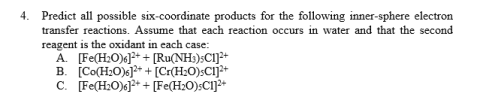 4. Predict all possible six-coordinate products for the following inner-sphere electron transfer reactions. Assume that each reaction occurs in water and that the second reagent is the oxidant in each case: A. [Fe(H20)6]2+ + [Ru(NH3)5Cl]2+ B. [Co(H2O)6]2+ + [Cr(H2O)sC1]2+ C. [Fe(H20)6]2+ + [Fe(H2O)sC1]2+
Which of the following is most likely not an outer-sphere electron transfer process? A.[Cu(NH3)5Cl] + [Co(NH3)6]3+...
Which of the following is most likely not an outer-sphere electron transfer process? A.[Cu(NH3)5Cl] + [Co(NH3)6]3+ --> [Cu(NH3)5Cl]+ + [Co(NH3)6]2+ B.[Cu(NH3)5Cl] + [Co(NH3)5Cl]2+ --> [Cu(NH3)4Cl2] + [Co(NH3)6]3+ C.[Fe(CN)6]4- + [RhCl6]2- --> [Fe(CN)6]3- + [RhCl6]3- D.[Ni(NH3)5Cl]+ + [Co(NH3)5Cl]2+ --> [Ni(NH3)5Cl]2+ + [Co(NH3)5Cl]+
6, 7 a and 7b Discuss the probable mechanisms of the following reaction and also speculate...
 6, 7 a and 7b
Discuss the probable mechanisms of the following reaction and also speculate on why this reaction is rather slow. For each of the following electron transfer reactions, speculate whether the mechanism is outer-sphere or inner sphere. Explain your reasoning.
6, 7 a and 7b
Discuss the probable mechanisms of the following reaction and also speculate on why this reaction is rather slow. For each of the following electron transfer reactions, speculate whether the mechanism is outer-sphere or inner sphere. Explain your reasoning.
Below are two mechanisms, please identify by which mechanisms these reactions are following (a-i mechanisms listed...
 Below are two mechanisms, please identify by which mechanisms
these reactions are following (a-i mechanisms listed
below).
Identify the mechanism by which each of the reactions above
proceeds from among the mechanisms listed. Use the letters
a - i for your answers
[Review Topics] [References) 1 HỌCho , L – H3C-o-Li 2. OX + HCI + H2O a = Proton transfer b = Lewis acid base c= Radical chain substitution d = Radical chain addition e = Electrophilic addition f=E1...
Below are two mechanisms, please identify by which mechanisms
these reactions are following (a-i mechanisms listed
below).
Identify the mechanism by which each of the reactions above
proceeds from among the mechanisms listed. Use the letters
a - i for your answers
[Review Topics] [References) 1 HỌCho , L – H3C-o-Li 2. OX + HCI + H2O a = Proton transfer b = Lewis acid base c= Radical chain substitution d = Radical chain addition e = Electrophilic addition f=E1...
7. Write balance chemical equations that illustrate the following types of reactions. For reactants choose only from the...
 7. Write balance chemical
equations that illustrate the following types of reactions. For
reactants choose only from the following lists of reactants. Please
limit yourselves to only reactants in the following lists. Use each
reactant in only one of the reactions you write. You must identify
the appropriate products. List of reactants: Ir(CO)Cl(PPh3)2, C2H6,
CN-, [NiBr4]2-, CH3I, [Cr(H2O)6]2+, CH3CH2Re(CO)5, [Fe(CN)6]3-,
PPh3, [PtBr6]2-, [(C2H4)PtCl3]-,[Co(NH3)5N3]2+, a) Migratory
Insertion.b) Ligand Substitution. c) Oxidative Addition. d)
Inner-Sphere Electron Transfer.
7. Write balance chemical equations...
7. Write balance chemical
equations that illustrate the following types of reactions. For
reactants choose only from the following lists of reactants. Please
limit yourselves to only reactants in the following lists. Use each
reactant in only one of the reactions you write. You must identify
the appropriate products. List of reactants: Ir(CO)Cl(PPh3)2, C2H6,
CN-, [NiBr4]2-, CH3I, [Cr(H2O)6]2+, CH3CH2Re(CO)5, [Fe(CN)6]3-,
PPh3, [PtBr6]2-, [(C2H4)PtCl3]-,[Co(NH3)5N3]2+, a) Migratory
Insertion.b) Ligand Substitution. c) Oxidative Addition. d)
Inner-Sphere Electron Transfer.
7. Write balance chemical equations...
Correct Answer is C but I need detailed explanation 30. The intermediate [Fe(SCN)(H20)5]2+ is detected in...
 Correct Answer is C but I need detailed explanation
30. The intermediate [Fe(SCN)(H20)5]2+ is detected in the reaction of [Co(NCS) (NH3)5]2+ with Fe(H20)6]2+ in aqueous medium to produce [Co(H20)6]2+and [Fe(H20)6]3+ a. Interchange dissociative b. Interchange associative c. Inner sphere electron transfer d. Outer sphere electron transfer
Correct Answer is C but I need detailed explanation
30. The intermediate [Fe(SCN)(H20)5]2+ is detected in the reaction of [Co(NCS) (NH3)5]2+ with Fe(H20)6]2+ in aqueous medium to produce [Co(H20)6]2+and [Fe(H20)6]3+ a. Interchange dissociative b. Interchange associative c. Inner sphere electron transfer d. Outer sphere electron transfer
Identify the mechanism by which each of the reactions above proceeds from among the mechanisms listed....
 Identify the mechanism by which each of the reactions above
proceeds from among the mechanisms listed. Use the letters
a - i for your answers.
ΝΗ Η H... U S penicillanase HMS X + H2O 06 T 02C HN N. CO, K. což k This is the way penicillin-resistant bacteria destroy penicillins. NH2 sob. I - NH; CI a Objetos Nis ci a = Proton transfer b = Lewis acid/base c=E2 elimination d=Sn2 Nucleophilic substitution e= Electrophilic aromatic substitution f=...
Identify the mechanism by which each of the reactions above
proceeds from among the mechanisms listed. Use the letters
a - i for your answers.
ΝΗ Η H... U S penicillanase HMS X + H2O 06 T 02C HN N. CO, K. což k This is the way penicillin-resistant bacteria destroy penicillins. NH2 sob. I - NH; CI a Objetos Nis ci a = Proton transfer b = Lewis acid/base c=E2 elimination d=Sn2 Nucleophilic substitution e= Electrophilic aromatic substitution f=...
 (i) explain how they differ. b. (ii) Explain how the following reaction was used to deduce the mechanism of inner sphere electron transfer. [Co(NH,),Cl]Cr(Hd+SH,OCo(H,O)+ [Cr(HO),ci+5NH 8 marks] (i) Given the following ligands, suggest which one you would use as a chelating agent to treat an excess of Fe(III). Explain your choice. c. HS SH он HS NH2 Ci) Assuming an octahedral geometry, draw the strueture (inecluding any possible isomers) of the neutral Fe(III) complex that would be formed if it...
 4. Predict all possible six-coordinate products for the following inner-sphere electron transfer reactions. Assume that each reaction occurs in water and that the second reagent is the oxidant in each case: A. [Fe(H20)6]2+ + [Ru(NH3)5Cl]2+ B. [Co(H2O)6]2+ + [Cr(H2O)sC1]2+ C. [Fe(H20)6]2+ + [Fe(H2O)sC1]2+
 6, 7 a and 7b
Discuss the probable mechanisms of the following reaction and also speculate on why this reaction is rather slow. For each of the following electron transfer reactions, speculate whether the mechanism is outer-sphere or inner sphere. Explain your reasoning.
6, 7 a and 7b
Discuss the probable mechanisms of the following reaction and also speculate on why this reaction is rather slow. For each of the following electron transfer reactions, speculate whether the mechanism is outer-sphere or inner sphere. Explain your reasoning.
 Below are two mechanisms, please identify by which mechanisms
these reactions are following (a-i mechanisms listed
below).
Identify the mechanism by which each of the reactions above
proceeds from among the mechanisms listed. Use the letters
a - i for your answers
[Review Topics] [References) 1 HỌCho , L – H3C-o-Li 2. OX + HCI + H2O a = Proton transfer b = Lewis acid base c= Radical chain substitution d = Radical chain addition e = Electrophilic addition f=E1...
Below are two mechanisms, please identify by which mechanisms
these reactions are following (a-i mechanisms listed
below).
Identify the mechanism by which each of the reactions above
proceeds from among the mechanisms listed. Use the letters
a - i for your answers
[Review Topics] [References) 1 HỌCho , L – H3C-o-Li 2. OX + HCI + H2O a = Proton transfer b = Lewis acid base c= Radical chain substitution d = Radical chain addition e = Electrophilic addition f=E1...
 7. Write balance chemical
equations that illustrate the following types of reactions. For
reactants choose only from the following lists of reactants. Please
limit yourselves to only reactants in the following lists. Use each
reactant in only one of the reactions you write. You must identify
the appropriate products. List of reactants: Ir(CO)Cl(PPh3)2, C2H6,
CN-, [NiBr4]2-, CH3I, [Cr(H2O)6]2+, CH3CH2Re(CO)5, [Fe(CN)6]3-,
PPh3, [PtBr6]2-, [(C2H4)PtCl3]-,[Co(NH3)5N3]2+, a) Migratory
Insertion.b) Ligand Substitution. c) Oxidative Addition. d)
Inner-Sphere Electron Transfer.
7. Write balance chemical equations...
7. Write balance chemical
equations that illustrate the following types of reactions. For
reactants choose only from the following lists of reactants. Please
limit yourselves to only reactants in the following lists. Use each
reactant in only one of the reactions you write. You must identify
the appropriate products. List of reactants: Ir(CO)Cl(PPh3)2, C2H6,
CN-, [NiBr4]2-, CH3I, [Cr(H2O)6]2+, CH3CH2Re(CO)5, [Fe(CN)6]3-,
PPh3, [PtBr6]2-, [(C2H4)PtCl3]-,[Co(NH3)5N3]2+, a) Migratory
Insertion.b) Ligand Substitution. c) Oxidative Addition. d)
Inner-Sphere Electron Transfer.
7. Write balance chemical equations...
 Correct Answer is C but I need detailed explanation
30. The intermediate [Fe(SCN)(H20)5]2+ is detected in the reaction of [Co(NCS) (NH3)5]2+ with Fe(H20)6]2+ in aqueous medium to produce [Co(H20)6]2+and [Fe(H20)6]3+ a. Interchange dissociative b. Interchange associative c. Inner sphere electron transfer d. Outer sphere electron transfer
Correct Answer is C but I need detailed explanation
30. The intermediate [Fe(SCN)(H20)5]2+ is detected in the reaction of [Co(NCS) (NH3)5]2+ with Fe(H20)6]2+ in aqueous medium to produce [Co(H20)6]2+and [Fe(H20)6]3+ a. Interchange dissociative b. Interchange associative c. Inner sphere electron transfer d. Outer sphere electron transfer
 Identify the mechanism by which each of the reactions above
proceeds from among the mechanisms listed. Use the letters
a - i for your answers.
ΝΗ Η H... U S penicillanase HMS X + H2O 06 T 02C HN N. CO, K. což k This is the way penicillin-resistant bacteria destroy penicillins. NH2 sob. I - NH; CI a Objetos Nis ci a = Proton transfer b = Lewis acid/base c=E2 elimination d=Sn2 Nucleophilic substitution e= Electrophilic aromatic substitution f=...
Identify the mechanism by which each of the reactions above
proceeds from among the mechanisms listed. Use the letters
a - i for your answers.
ΝΗ Η H... U S penicillanase HMS X + H2O 06 T 02C HN N. CO, K. což k This is the way penicillin-resistant bacteria destroy penicillins. NH2 sob. I - NH; CI a Objetos Nis ci a = Proton transfer b = Lewis acid/base c=E2 elimination d=Sn2 Nucleophilic substitution e= Electrophilic aromatic substitution f=...
Most questions answered within 3 hours.
-
Where is the error in this code sequence?
String s1 = "Hello";
String s2 = "ello";...
asked 10 months ago -
Financial data for Joel de Paris, Inc., for last year
follow:
Joel de Paris, Inc.
Balance...
asked 10 months ago -
Consider this reaction:
Al2(SO4)3 (aq)+ BaCl3
(aq) Al2Cl6 (aq)- +
3BaSO4(s) . What is the...
asked 10 months ago -
Suppose that Savneet is considering increasing her
recent random sample from 20 car rentals to 40...
asked 10 months ago -
Trucks arrive at an unloading terminal at an average rate of 120
per hour.
Trucks arrive...
asked 10 months ago -
Why are methanol and ethanol completely soluble in water while
octanol is not very little soluble....
asked 10 months ago -
A facilities manager at a university reads in a research report
that the mean amount of...
asked 10 months ago -
When the CuSO4 is rehydrated by adding water to the anhydrous
compound, is this an endothermic...
asked 10 months ago -
A ray of sunlight is passing from diamond into crown glass; the
angle of incidence is...
asked 10 months ago -
A block of mass 0.249 kg is placed on top of a light, vertical
spring of...
asked 10 months ago -
how do the kidneys compensate in the presences of acidosis
a) trigger hyperventilate
b) reserve acid...
asked 10 months ago -
Question 501 pts
The rental rate of capital to the firm increases. Which of the
following...
asked 10 months ago