Yolk fuels early development. Yolk also influences the processes by which early development occurs and ultimately,...
Yolk fuels early development. Yolk also influences the processes by which early development occurs and ultimately, helps shape the early embryo’s body plan. Using specific examples, describe the effect of yolk on cleavage patterns (5 pts) and gastrulation (5 pts). In animals with telolecithal eggs, the large amount of yolk continues to influence development well after gastrulation is completed. Using specific examples, explain how development is modified in animals with telolecithal eggs (e.g., relative to animals with small, isolecithal eggs) (5 pts).
This is an essay question that I am answering (about 1 page). I would like to check my answer with someone else. Can someone answer this so I can see if I have covered all the necessary points?
Homework Answers
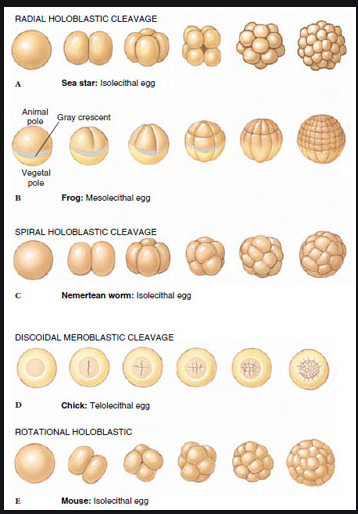
Fig. 1 - Amount and Distribution of Yolk Affecting Cleavage
It is obvious that any considerable amount of yolk will retard the division, or prevent the complete division, of the fertilized ovum. The amount and distribution of the yolk will therefore determine the type of segmentation. The cleavage can be holoblastic (total or entire cleavage) or meroblastic (partial cleavage). Yolk is always present in the egg at the beginning of cleavage in lesser (microlecithal egg) or greater (mesolecithal or macrolecithal egg) amounts. It remains evenly (isolecithal egg) or unevenly (Teleolecithal egg) distributed in the ooplasm of the eggs. The cell division (cleavage) occurs more rapidly in the active cytoplasm than the yolk laden cytoplasm of the egg.
The inert yolk granules or platelets behave entirely passively. Yolk exerts an intense influence on the process of cleavage and the mechanics of moving the germ layers in their final positions. It delays the process of mitosis, and even deters it from extending into the over dense regions. The amount of yolk influences the course of cleavage by the following ways:
1. When the amount of stored yolk increases, the amount of active cytoplasm gradually decreases and the position of nucleus is variously affected. In Teleolecithal eggs (mesolecithal and polylecithal eggs), such displacement of zygotic nucleus from the geometrical centre of the egg to the less yolky cytoplasm is very common. The mitotic divisions of such a displaced nucleus result in unequal sized blastomeres.
2. Every mitosis of cleavage involves movements of the cell components, the chromosomes, parts of cytoplasm constituting the achromatic figure the mitochondria, and the surface layer of the cell, the activity of which along the equator of the maternal cell leads to the eventual separation of the daughter cells. During these movements, the yolk granules or yolk platelets behave entirely passively and are passively distributed between the daughter blastomeres. The yolk in the uncleaved egg is more concentrated towards the vegetal pole of the egg.
It is, therefore, the vegetal pole of the egg where due to presence of yolk the cleavage is most retarded and where the resulting blastomeres remain larger than those which have less yolk. The abundance of yolk, tend to retard or even inhibit the process of cleavage.
Thus, on the basis of amount and distribution of yolk, cleavage is of the following types:
[I]Total or holoblastic cleavage:
In total, holoblastic or complete cleavage, the entire egg divides by each cleavage furrow. It may be:
1. Equal holoblastic: In microlecithal or isolecithal eggs, it produces blastomeres of approximately equal size. Examples are found in Amphioxus, marsupials and placental mammals (Fig. 2).
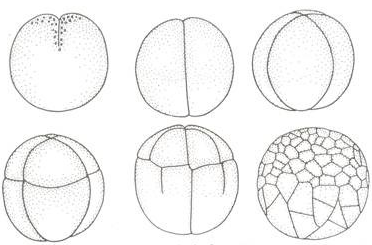
Fig. 2 - Cleavage in the Frog Egg
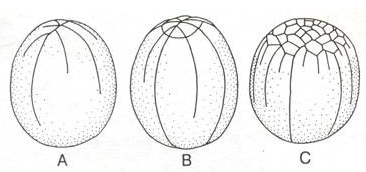
Fig.3 - Cleavage in Ganoid Fish
2. Unequal holoblastic:
In mesolecithal and moderately Teleolecithal eggs, unequal sized blastomeres are produced, which includes many small-sized blastomeres called micromeres, and a few large-sized, yolk laden blastomeres called macromeres. Examples are lower fishes and amphibians (Fig.3).
[II] Meroblastic cleavage:
This type of cleavage occurs in polylecithal and centrolecithal eggs, where there is a clear patch of yolk free cytoplasm. This patch is called the blastodisc. The first two or three cleavage furrows cut the blastodisc vertically but they do not reach the bottom of the blastodisc. Such cleavages are called meroblastic because the furrows do no cut the yolky part of the ovum. The meroblastic cleavage may be of the following two types:
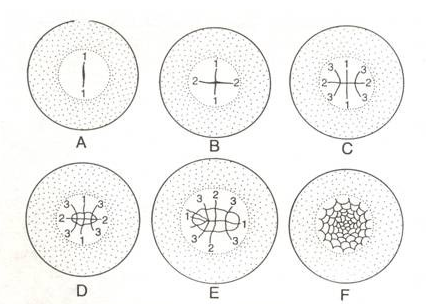
Fig.4 - Discoidal Meroblastic Cleavage in a Highly Telolecithal Egg of Hen
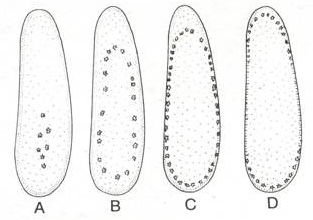
Fig.5 - Superficial Cleavage of Beetle (Hydrophilus)
1. Discoidal:
In the macrolecithal and highly Teleolecithal egg, the cleavage remains restricted to the disc-shaped active cytoplasm of animal pole and is called Discoidal meroblastic cleavage. Examples are elasmobranch fishes, bony fishes, and reptiles, birds and monotremes eggs (Fig.4).
2. Superficial:
In centrolecithal eggs, the cleavage remains restricted to the peripheral cytoplasm of the egg, e.g. arthropods (beetle) (Fig.5).
Effect of yolk on Gastrulation
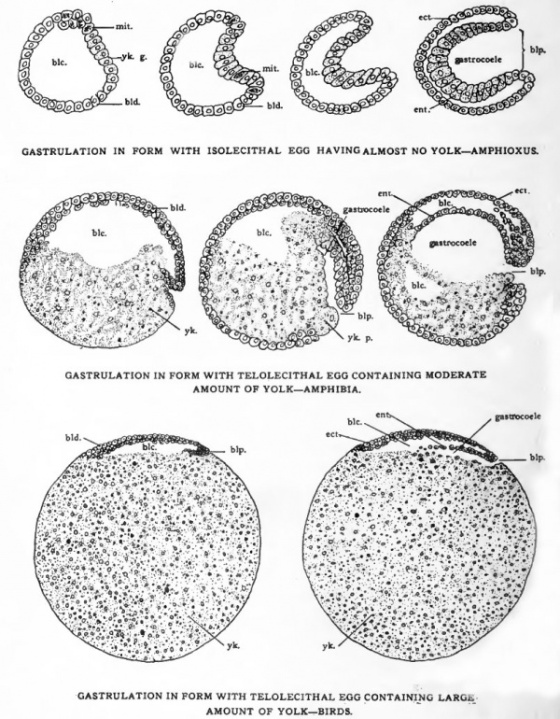
Fig.6 - Effect of Yolk on Gastrulation (blc, blastocoele; bid., blastoderm; blp., blastopore; ect., ectoderm; ent., entoderm; mit., cell undergoing mitosis; yk., yolk; yk.g., yolk granules; yk.p., yolk plug)
The process of gastrulation begins as soon as blastulation is accomplished. Gastrulation as it occurs in birds is not difiicult to understand if one grasps its fundamental similarity to the corresponding process in forms with scanty yolk. In Amphioxus, gastrulation is an inpocketing of the blastula. A double layered cup is formed from a single layered hollow sphere much as one might push in a hollow rubber ball with the thumb. The new cavity in the double walled cup is termed the gastrocoele. The opening from the outside into the gastrocoele is called the blastopore. The amount of yolk affects the process of gastrulation, the formation of the three germ layers.
In gastrulation the single cell layer of the blastula is doubled upon itself to form two layers. The outer cell layer is known as the ectoderm and the inner layer as the entoderm. These layers differ from each other in their positional relationship to the embryo and to the surrounding environment. Each has different functional potentialities and each will in the course of development give rise to quite different types of structures and organs. It is the importance of their later history rather than any complexity or veiled significance about the way in which they arise that attaches such importance in embryology to the estabhshment of these two layers.
In the gastrulation of Amphibian embryos, the yolk forces the invagination of the blastoderm toward the animal pole, but the inpocketing takes place into the blastocoele and the interrelationships of ectoderm, entoderm, and gastrocoele are established in fundamentally the same way as in Amphioxus. Gastrulation in birds is greatly modified by the large amount of yolk present. Infolding must be effected in a disc of cells resting like a cap on a large yolk sphere. The smallness of the blastocoele sharply restricts the space into which the invagination can grow. Instead of arising as a relatively large circular opening the blastopore appears as a crescentic slit at the margin of the blastoderm. The crescentic blastopore may be regarded as a potentially circular opening which has been flattened as it develops between the growing disc of cells and the unyielding yolk which under lies them. The invaginated pocket of entoderm which grows in from this compressed blastopore is also flattened, conforming to the restrictions of the shape and size of the blastocoele. Moreover the floor of the invagination is represented only by a few widely scattered cells lying upon the yolk. It is as if the lower layer in its ingrowth was impeded and broken up by the yolk. The scattered cells representing the floor of the invagination soon disappear and the yolk itself comes to constitute the floor of the gastrocoele. Notwithstanding the great displacement of the blastopore and the gastrular invagination toward the animal pole and the restricted size and incomplete floor of the gastrocoele, the cell layers and the cavity established can be homologized with the corresponding features in forms where the course of development has not been so extensively modified by yolk.
Embryonic development in Telolecithal eggs vs isolecithal eggs
Isolecithal: The amount of yolk is small and scattered fairly and evely throughout the cytoplasm. E.g Amphioxus.
Telolecithal: The distribution of yolk is unequal. It is collected more at lower part (Vegetal pole) than at the upper part (Animal pole). refers to the uneven distribution of yolk in the cytoplasm of ovums found in birds, reptiles, fish, and monotremes. The yolk is concentrated at one pole of the egg separate from the developing embryo.
In fish eggs (telolecithal ), cleavage occurs only in the blastodisc, a thin region of yolk-free cytoplasm at the animal cap of the egg. Most of the egg cell is full of yolk. The cell divisions do not completely divide the egg, so this type of cleavage is called meroblastic (Greek, meros, “part”). Since only the cytoplasm of the blastodisc becomes the embryo, this type of meroblastic cleavage is called discoidal. The calcium waves initiated at fertilization stimulate the contraction of the actin cytoskeleton to squeeze non-yolky cytoplasm into the animal pole of the egg. This converts the spherical egg into a more pear-shaped structure, with an apical blastodisc. Early cleavage divisions follow a highly reproducible pattern of meridional and equatorial cleavages. These divisions are rapid, taking about 15 minutes each. The first 12 divisions occur synchronously, forming a mound of cells that sits at the animal pole of a large yolk cell. These cells constitute the blastoderm. Initially, all the cells maintain some open connection with one another and with the underlying yolk cell so that moderately sized (17-kDa) molecules can pass freely from one blastomere to the next. Beginning at about the tenth cell division, the onset of the midblastula transition can be detected: zygotic gene transcription begins, cell divisions slow, and cell movement becomes evident. At this time, three distinct cell populations can be distinguished. The first of these is the yolk syncytial layer (YSL). The YSL is formed at the ninth or tenth cell cycle, when the cells at the vegetal edge of the blastoderm fuse with the underlying yolk cell. This fusion produces a ring of nuclei within the part of the yolk cell cytoplasm that sits just beneath the blastoderm. Later, as the blastoderm expands vegetally to surround the yolk cell, some of the yolk syncytial nuclei will move under the blastoderm to form the internal YSL, and some of the nuclei will move vegetally, staying ahead of the blastoderm margin, to form external YSL. The YSL will be important for directing some of the cell movements of gastrulation. The second cell population distinguished at the midblastula transition is the enveloping layer (EVL). It is made up of the most superficial cells of the blastoderm, which form an epithelial sheet a single cell layer thick. The EVL eventually becomes the periderm, an extraembryonic protective covering that is sloughed off during later development. Between the EVL and the YSL are the deep cells. These are the cells that give rise to the embryo proper. The fates of the early blastoderm cells are not determined, and cell lineage studies (in which a nondiffusible fluorescent dye is injected into one of the cells so that the descendants of that cell can be followed) show that there is much cell mixing during cleavage. Moreover, any one of these cells can give rise to an unpredictable variety of tissue descendants. The fate of the blastoderm cells appears to be fixed shortly before gastrulation begins. At this time, cells in specific regions of the embryo give rise to certain tissues in a highly predictable manner, allowing a fate map to be made.
The early embryology of Amphioxus is simple and straightforward.The early development of Amphioxus is of great phylogenetic significance because it resembles with those of invertebrates like Echinodermates on one hand and vertebrates on other hand. Fertilization is external, taking place in the surrounding sea water where eggs and spermatozoa are shed. Before fertilization, the ovum has an outer thin vitelline membrane, enclosing a peripheral cytoplasmic layer, central yolky cytoplasm mainly towards the vegetal pole and a fluid filled germinal sac or nucleus towards the animal pole.During fertilization the sperm enters the egg near the vegetal pole.The cleavage of eggs is Holoblastic and is of Equal type.The first cleavage is Meridional, i.e. oriented along the median axis from animal to vegetal pole. The result of cleavage is the formation of two identical blastomeres establishing the bilateral symmetry of the adult animal. The Second cleavage is also oriented from animal to vegetal pole but at right angle to the first and divides the first two blastomeres into 4 equal sized cells. The third cleavage is horizontal (transverse) and slightly above the equatorial region. It divides each or four blastomeres into one micromere and one macromere. Thus a total of 4 micromeres on the top and 4 macromeres at the bottom. The fourth cleavage is vertical. It divides each of eight blastomere into two blastomeres, resulting in all 16 blastomeres. Out of these 16 blastomeres, eight are micromeres on the top and eight are macromeres at the bottom. Since the cleavage is not exactly through the middle, therefore the resulting blastomeres do not have equal sized partners.The cleaving zygote is not called Morula.
The Fifth cleavage is again horizontal (latitudinal) dividing the 16 blastomeres into 32 blastomeres arranged in four tiers of eight each, the upper two tiers consisting of micromeres and lower tow tiers of macromeres. The Sixth cleavage is vertical (longitudinal or meridional). It divides the 32 blastomere into 64 blastomeres. These blastomere are arranged in four tiers, one above the other and each tier is a ring of 16 blastomeres arranged side by side. Further cleavage are irregular, now the micromeres divide slightly faster than macromeres. This is probably because they have fewer yolk granules. A jelly filled cavity now appears in the center of morula to change it into blastula. It starts appearing at 16 blastomeres stage and becomes distinct by 64 blastomeres stage. The jelly starts absorbing water and enlarges in size. The blastomere become arranged in single layer all around the blastocoel. The single layer is called blastoderm. At the completion of cleavage, there are about 9000 cells it he blastula of Amphioxus.
At the beginning of gastrulation the blastula has micromeres in upper part and macromeres at the lower part. The slower dividing macromeres are pushed by faster dividing micromeres from near the equatorial region and then micromeres start moving downwards (Epiboly). Now blastula looks like half sphere with flattened plate at the bottom. The flattened macromere plate start bending upwards (invagination) . As invagination continues, the monoblastic blastula starts converting into diploblastic gastrula. Later the gastrula has appearance of a double walled inverted cup with the blastocoel as a compressed space between the two walls. • The newly formed cavity surrounded by diploblastic wall is called Archenteron or Gastrocoel. the transformation of single walled blastula into double walled gastrula is called GASTRULATION
Now the gastrula elongates in an antero-posterior direction.The wide mouth of the archenteron gradually narrows into a triangular hole which is now situated at the posterior end of gastrula • This hole is known as Blastopore. When the inner wall (hypoblast) of the gastrula touches the outer wall (epiblast), the original blastocoel disappears. As the gastrula elongates, the blastopore gradually becomes smaller. At this stage the gastrula is elongated structure with an uppr flat surface and a lower ventrally bulging surface and is slightly compressed.
Add Answer to:
Yolk fuels early development. Yolk also influences the processes
by which early development occurs and ultimately,...
I have this case study to solve. i want to ask which type of case study...
 I have this case study to solve. i want to ask which
type of case study in this like problem, evaluation or decision? if
its decision then what are the criterias and all?
Stardust Petroleum Sendirian Berhad: how to inculcate the pro-active safety culture? Farzana Quoquab, Nomahaza Mahadi, Taram Satiraksa Wan Abdullah and Jihad Mohammad Coming together is a beginning; keeping together is progress; working together is success. - Henry Ford The beginning Stardust was established in 2013 as a...
I have this case study to solve. i want to ask which
type of case study in this like problem, evaluation or decision? if
its decision then what are the criterias and all?
Stardust Petroleum Sendirian Berhad: how to inculcate the pro-active safety culture? Farzana Quoquab, Nomahaza Mahadi, Taram Satiraksa Wan Abdullah and Jihad Mohammad Coming together is a beginning; keeping together is progress; working together is success. - Henry Ford The beginning Stardust was established in 2013 as a...
And there was a buy-sell arrangement which laid out the conditions under which either shareholder could...
 And there was a buy-sell arrangement which laid out the
conditions under which either shareholder could buy out the other.
Paul knew that this offer would strengthen his financial
picture…but did he really want a partner?It was going to be a long
night.
read the case study above and answer this question
what would you do if you were Paul with regards to financing,
and why?
ntroductloh Paul McTaggart sat at his desk. Behind him, the computer screen flickered with...
And there was a buy-sell arrangement which laid out the
conditions under which either shareholder could buy out the other.
Paul knew that this offer would strengthen his financial
picture…but did he really want a partner?It was going to be a long
night.
read the case study above and answer this question
what would you do if you were Paul with regards to financing,
and why?
ntroductloh Paul McTaggart sat at his desk. Behind him, the computer screen flickered with...
Please read the article bellow and discuss the shift in the company's approach to genetic analysis....
 Please read the article bellow and discuss the shift in the
company's approach to genetic analysis. Please also discuss what
you think about personal genomic companies' approaches to research.
Feel free to compare 23andMe's polices on research with another
company's. Did you think the FDA was right in prohibiting 23andMe
from providing health information?
These are some sample talking points to get you thinking about
the ethics of genetic research in the context of Big Data. You
don't have to...
Please read the article bellow and discuss the shift in the
company's approach to genetic analysis. Please also discuss what
you think about personal genomic companies' approaches to research.
Feel free to compare 23andMe's polices on research with another
company's. Did you think the FDA was right in prohibiting 23andMe
from providing health information?
These are some sample talking points to get you thinking about
the ethics of genetic research in the context of Big Data. You
don't have to...
10. Write a one-page summary of the attached paper? INTRODUCTION Many problems can develop in activated...
10. Write a one-page summary of the attached paper? INTRODUCTION Many problems can develop in activated sludge operation that adversely affect effluent quality with origins in the engineering, hydraulic and microbiological components of the process. The real "heart" of the activated sludge system is the development and maintenance of a mixed microbial culture (activated sludge) that treats wastewater and which can be managed. One definition of a wastewater treatment plant operator is a "bug farmer", one who controls the aeration...
First, read the article on "The Delphi Method for Graduate Research." ------ Article is posted below...
First, read the article on "The Delphi Method for Graduate Research." ------ Article is posted below Include each of the following in your answer (if applicable – explain in a paragraph) Research problem: what do you want to solve using Delphi? Sample: who will participate and why? (answer in 5 -10 sentences) Round one questionnaire: include 5 hypothetical questions you would like to ask Discuss: what are possible outcomes of the findings from your study? Hint: this is the conclusion....
I need help with my very last assignment of this term PLEASE!!, and here are the instructions: After reading Chapter T...
 I need help with my very last assignment of this term
PLEASE!!, and here are the instructions: After reading Chapter Two,
“Keys to Successful IT Governance,” from Roger Kroft and Guy
Scalzi’s book entitled, IT Governance in Hospitals and Health
Systems, please refer to the following assignment instructions
below.
This chapter consists of interviews with executives
identifying mistakes that are made when governing healthcare
information technology (IT). The chapter is broken down into
subheadings listing areas of importance to understand...
I need help with my very last assignment of this term
PLEASE!!, and here are the instructions: After reading Chapter Two,
“Keys to Successful IT Governance,” from Roger Kroft and Guy
Scalzi’s book entitled, IT Governance in Hospitals and Health
Systems, please refer to the following assignment instructions
below.
This chapter consists of interviews with executives
identifying mistakes that are made when governing healthcare
information technology (IT). The chapter is broken down into
subheadings listing areas of importance to understand...
 I have this case study to solve. i want to ask which
type of case study in this like problem, evaluation or decision? if
its decision then what are the criterias and all?
Stardust Petroleum Sendirian Berhad: how to inculcate the pro-active safety culture? Farzana Quoquab, Nomahaza Mahadi, Taram Satiraksa Wan Abdullah and Jihad Mohammad Coming together is a beginning; keeping together is progress; working together is success. - Henry Ford The beginning Stardust was established in 2013 as a...
I have this case study to solve. i want to ask which
type of case study in this like problem, evaluation or decision? if
its decision then what are the criterias and all?
Stardust Petroleum Sendirian Berhad: how to inculcate the pro-active safety culture? Farzana Quoquab, Nomahaza Mahadi, Taram Satiraksa Wan Abdullah and Jihad Mohammad Coming together is a beginning; keeping together is progress; working together is success. - Henry Ford The beginning Stardust was established in 2013 as a...
 And there was a buy-sell arrangement which laid out the
conditions under which either shareholder could buy out the other.
Paul knew that this offer would strengthen his financial
picture…but did he really want a partner?It was going to be a long
night.
read the case study above and answer this question
what would you do if you were Paul with regards to financing,
and why?
ntroductloh Paul McTaggart sat at his desk. Behind him, the computer screen flickered with...
And there was a buy-sell arrangement which laid out the
conditions under which either shareholder could buy out the other.
Paul knew that this offer would strengthen his financial
picture…but did he really want a partner?It was going to be a long
night.
read the case study above and answer this question
what would you do if you were Paul with regards to financing,
and why?
ntroductloh Paul McTaggart sat at his desk. Behind him, the computer screen flickered with...
 Please read the article bellow and discuss the shift in the
company's approach to genetic analysis. Please also discuss what
you think about personal genomic companies' approaches to research.
Feel free to compare 23andMe's polices on research with another
company's. Did you think the FDA was right in prohibiting 23andMe
from providing health information?
These are some sample talking points to get you thinking about
the ethics of genetic research in the context of Big Data. You
don't have to...
Please read the article bellow and discuss the shift in the
company's approach to genetic analysis. Please also discuss what
you think about personal genomic companies' approaches to research.
Feel free to compare 23andMe's polices on research with another
company's. Did you think the FDA was right in prohibiting 23andMe
from providing health information?
These are some sample talking points to get you thinking about
the ethics of genetic research in the context of Big Data. You
don't have to...
 I need help with my very last assignment of this term
PLEASE!!, and here are the instructions: After reading Chapter Two,
“Keys to Successful IT Governance,” from Roger Kroft and Guy
Scalzi’s book entitled, IT Governance in Hospitals and Health
Systems, please refer to the following assignment instructions
below.
This chapter consists of interviews with executives
identifying mistakes that are made when governing healthcare
information technology (IT). The chapter is broken down into
subheadings listing areas of importance to understand...
I need help with my very last assignment of this term
PLEASE!!, and here are the instructions: After reading Chapter Two,
“Keys to Successful IT Governance,” from Roger Kroft and Guy
Scalzi’s book entitled, IT Governance in Hospitals and Health
Systems, please refer to the following assignment instructions
below.
This chapter consists of interviews with executives
identifying mistakes that are made when governing healthcare
information technology (IT). The chapter is broken down into
subheadings listing areas of importance to understand...
Most questions answered within 3 hours.
-
Where is the error in this code sequence?
String s1 = "Hello";
String s2 = "ello";...
asked 10 months ago -
Financial data for Joel de Paris, Inc., for last year
follow:
Joel de Paris, Inc.
Balance...
asked 10 months ago -
Consider this reaction:
Al2(SO4)3 (aq)+ BaCl3
(aq) Al2Cl6 (aq)- +
3BaSO4(s) . What is the...
asked 10 months ago -
Suppose that Savneet is considering increasing her
recent random sample from 20 car rentals to 40...
asked 10 months ago -
Trucks arrive at an unloading terminal at an average rate of 120
per hour.
Trucks arrive...
asked 10 months ago -
Why are methanol and ethanol completely soluble in water while
octanol is not very little soluble....
asked 10 months ago -
A facilities manager at a university reads in a research report
that the mean amount of...
asked 10 months ago -
When the CuSO4 is rehydrated by adding water to the anhydrous
compound, is this an endothermic...
asked 10 months ago -
A ray of sunlight is passing from diamond into crown glass; the
angle of incidence is...
asked 10 months ago -
A block of mass 0.249 kg is placed on top of a light, vertical
spring of...
asked 10 months ago -
how do the kidneys compensate in the presences of acidosis
a) trigger hyperventilate
b) reserve acid...
asked 10 months ago -
Question 501 pts
The rental rate of capital to the firm increases. Which of the
following...
asked 10 months ago