Calculate the value of ΔG for the movement of fructose from the portal vein circulation (where...
Calculate the value of ΔG for the movement of fructose from the portal vein circulation (where its concentration is 1 mM) to the inside of a liver cell (where its concentration is 0.1 mM) at 37°C. Express your answer in units of kJ mol-1 using 2 significant figures.
Homework Answers
The expression for the calculation of the free energy released or consumed when the fructose molecule moves from the membrane is:
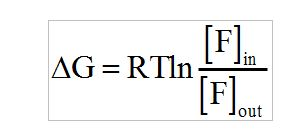
Where,
ΔG is the free energy change
[F]in is the concentration of the fructose inside the liver cell
[F]out is the concentration of the fructose outside the liver cell
R = 8.314 Jmol-1K-1
The conversion of kJ to J is shown below:
1 kJ = 10-3 J
So, R = 8.314* 10-3 kJmol-1K-1
T = 37 0C
The conversion of T(0C) to T(K) is shown below:
T(K) = T(0C) + 273.15
So, the temperature, T = (37 + 273.15) K = 310.15 K
Given,
[F]in = 0.1 mM
[F]out = 1 mM
So,
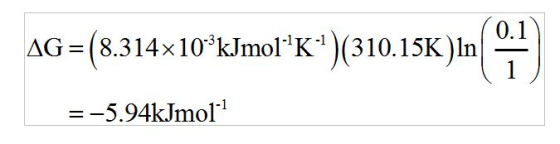
Where negative sign signifies spontaneous process.
Answer upto 2 significant digits= -5.9 kJ/mol
Add Answer to:
Calculate the value of ΔG for the movement of fructose
from the portal vein circulation (where...
The standard free energy (ΔG∘′)(ΔG∘′) of the creatine kinase reaction is −12.6 kJ⋅mol−1.−12.6 kJ⋅mol−1. The ΔGΔG...
The standard free energy (ΔG∘′)(ΔG∘′) of the creatine kinase reaction is −12.6 kJ⋅mol−1.−12.6 kJ⋅mol−1. The ΔGΔG value of an in vitro creatine kinase reaction is −0.1 kJ⋅mol−1.−0.1 kJ⋅mol−1. At the start of the reaction, the concentration of ATP is 6 mM,6 mM, the concentration of creatine is 12 mM,12 mM, and the concentration of creatine phosphate is 25 mM.25 mM. Using the values given, calculate the starting concentration of ADP in micromolar.
Consider the following isomerization reactions of some simple sugars and values for their standard Gibbs free energy ΔG...
Consider the following isomerization reactions of some simple sugars and values for their standard Gibbs free energy ΔG∘: reaction A:glucose-1-phosphate⟶ glucose-6-phosphate, ΔG∘=−7.28 kJ/mol Reaction B: fructose-6-phosphate⟶⟶glucose-6-phosphate,ΔG∘=−1.67 kJ/mol Calculate the equilibrium constant K for the isomerization of glucose-1-phosphate to fructose-6-phosphate at 298 K. Express your answer numerically using two significant figures.
The ΔG°′ for the conversion of glucose-1-phosphate (G1P) to glucose-6-phosphate is -7.1 kJ/mol. What is the...
The ΔG°′ for the conversion of glucose-1-phosphate (G1P) to glucose-6-phosphate is -7.1 kJ/mol. What is the ratio of the concentration of G6P to the concentration of G1P that provides a free energy change of –2.0 kJ · mol–1 at 37°C. [Express your answer in decimal form using 2 significant figures.]
A highly regulated reaction in glycolysis involves the addition of a second phosphate to fructose-6-phosphate, which...
 A highly regulated reaction in glycolysis involves the addition
of a second phosphate to fructose-6-phosphate, which could be be
written as:
Fructose-6-phostphate + Pi à Fructose-1,6-bisphosphate + H2O
The ∆Go’ for this reaction is +16.8 kJ/mol
In a muscle cell at 37 oC, assume the concentration of
Fructose-6phosphate is 0.014 mM and the concentration of phosphate
is 1 mM.
a. What would be the equilibrium concentration of
fructose-1,6bisphosphate under these conditions?
b. What is Keq for this reaction?
Show...
A highly regulated reaction in glycolysis involves the addition
of a second phosphate to fructose-6-phosphate, which could be be
written as:
Fructose-6-phostphate + Pi à Fructose-1,6-bisphosphate + H2O
The ∆Go’ for this reaction is +16.8 kJ/mol
In a muscle cell at 37 oC, assume the concentration of
Fructose-6phosphate is 0.014 mM and the concentration of phosphate
is 1 mM.
a. What would be the equilibrium concentration of
fructose-1,6bisphosphate under these conditions?
b. What is Keq for this reaction?
Show...
Consider the following isomerization reactions of some simple sugars and values for their standard Gibbs free energy Δ...
 Consider the following isomerization reactions of some simple
sugars and values for their standard Gibbs free energy
ΔG∘: reaction A:reaction
B:glucose-1-phosphatefructose-6-phosphate⟶⟶glucose-6-phosphate,glucose-6-phosphate, ΔG∘=−7.28
kJ/mol ΔG∘=−1.67 kJ/mol
Part A
Calculate ΔG∘ for the isomerization of
glucose-1-phosphate to fructose-6-phosphate.
ΔG∘ =
-5.61
kJ/mol
Part B
Calculate the equilibrium constant K for the
isomerization of glucose-1-phosphate to fructose-6-phosphate at 298
K.
Express your answer numerically using two significant
figures.
K =
9.6
Part C
Calculate ΔG when the concentration of
glucose-1-phosphate is 10 times greater than the
concentration...
Consider the following isomerization reactions of some simple
sugars and values for their standard Gibbs free energy
ΔG∘: reaction A:reaction
B:glucose-1-phosphatefructose-6-phosphate⟶⟶glucose-6-phosphate,glucose-6-phosphate, ΔG∘=−7.28
kJ/mol ΔG∘=−1.67 kJ/mol
Part A
Calculate ΔG∘ for the isomerization of
glucose-1-phosphate to fructose-6-phosphate.
ΔG∘ =
-5.61
kJ/mol
Part B
Calculate the equilibrium constant K for the
isomerization of glucose-1-phosphate to fructose-6-phosphate at 298
K.
Express your answer numerically using two significant
figures.
K =
9.6
Part C
Calculate ΔG when the concentration of
glucose-1-phosphate is 10 times greater than the
concentration...
Calculate ΔG∘rxn and E∘cell for a redox reaction with n = 2 that has an equilibrium...
Calculate ΔG∘rxn and E∘cell for a redox reaction with n = 2 that has an equilibrium constant of K = 4.9×10⁻². You may want to reference (Pages 861 - 865) Section 19.5 while completing this problem. Part A Express your answer using two significant figures. ΔG∘rxn = kJ Part B Express your answer using two significant figures. E∘cell = V
Part B: Calculate the formation constant for the formation of [Cu(NH3)4(H2O)2]2+ from [Cu(H2O)6]2+, given that ΔG∘...
Part B: Calculate the formation constant for the formation of [Cu(NH3)4(H2O)2]2+ from [Cu(H2O)6]2+, given that ΔG∘ is −74.2kJ⋅mol−1 at 298 K. Express your answer numerically to three significant figures. Part C: Consider the formation of [Ni(en)3]2+ from [Ni(H2O)6]2+. The stepwise ΔG∘ values at 298 Kare ΔG∘1 for first step=−42.9 kJ⋅mol−1 ΔG∘2 for second step=−35.8 kJ⋅mol−1 ΔG∘3 for third step=−24.3 kJ⋅mol−1Calculate the overall formation constant (Kf) for the complex [Ni(en)3]2+. Express your answer numerically to three significant figures.
Calculate free energy (ΔG) for transporting 3 moles of Ca2+ from inside to outside of a...
Calculate free energy (ΔG) for transporting 3 moles of Ca2+ from inside to outside of a typical cell. (Using Ca2+ = 1.5mM for outside the cell; [Ca2+] = 0.1 µM for inside the cell; T = 298k; R = 1.987x10^3 kcal/mol/deg; membrane potential (ΔV) = -50 mV (inside negative); Faraday constant = 23.1 kcal/V/mol).
Calculate the equilibrium partial pressure of manganese vapor above solid manganese at 25 ∘C if ΔG∘f...
Calculate the equilibrium partial pressure of manganese vapor above solid manganese at 25 ∘C if ΔG∘f for gaseous manganese is 238.5 kJ/mol at 25 ∘C. Express your answer to two significant figures and include the appropriate units. pMn=?
1. Use the data given to calculate the value of ΔG°rxn for the reaction at 25...
1. Use the data given to calculate the value of ΔG°rxn for the reaction at 25 °C. 2 C(graphite) + H2(g) <---> C2H2(g) C(graphite) H2(g) C2H2(g) S° (J/mol ⋅ K) 5.74 130.68 201.0 (kJ/mol) 0 0 −226.8 Report answer to four significant figures.
 A highly regulated reaction in glycolysis involves the addition
of a second phosphate to fructose-6-phosphate, which could be be
written as:
Fructose-6-phostphate + Pi à Fructose-1,6-bisphosphate + H2O
The ∆Go’ for this reaction is +16.8 kJ/mol
In a muscle cell at 37 oC, assume the concentration of
Fructose-6phosphate is 0.014 mM and the concentration of phosphate
is 1 mM.
a. What would be the equilibrium concentration of
fructose-1,6bisphosphate under these conditions?
b. What is Keq for this reaction?
Show...
A highly regulated reaction in glycolysis involves the addition
of a second phosphate to fructose-6-phosphate, which could be be
written as:
Fructose-6-phostphate + Pi à Fructose-1,6-bisphosphate + H2O
The ∆Go’ for this reaction is +16.8 kJ/mol
In a muscle cell at 37 oC, assume the concentration of
Fructose-6phosphate is 0.014 mM and the concentration of phosphate
is 1 mM.
a. What would be the equilibrium concentration of
fructose-1,6bisphosphate under these conditions?
b. What is Keq for this reaction?
Show...
 Consider the following isomerization reactions of some simple
sugars and values for their standard Gibbs free energy
ΔG∘: reaction A:reaction
B:glucose-1-phosphatefructose-6-phosphate⟶⟶glucose-6-phosphate,glucose-6-phosphate, ΔG∘=−7.28
kJ/mol ΔG∘=−1.67 kJ/mol
Part A
Calculate ΔG∘ for the isomerization of
glucose-1-phosphate to fructose-6-phosphate.
ΔG∘ =
-5.61
kJ/mol
Part B
Calculate the equilibrium constant K for the
isomerization of glucose-1-phosphate to fructose-6-phosphate at 298
K.
Express your answer numerically using two significant
figures.
K =
9.6
Part C
Calculate ΔG when the concentration of
glucose-1-phosphate is 10 times greater than the
concentration...
Consider the following isomerization reactions of some simple
sugars and values for their standard Gibbs free energy
ΔG∘: reaction A:reaction
B:glucose-1-phosphatefructose-6-phosphate⟶⟶glucose-6-phosphate,glucose-6-phosphate, ΔG∘=−7.28
kJ/mol ΔG∘=−1.67 kJ/mol
Part A
Calculate ΔG∘ for the isomerization of
glucose-1-phosphate to fructose-6-phosphate.
ΔG∘ =
-5.61
kJ/mol
Part B
Calculate the equilibrium constant K for the
isomerization of glucose-1-phosphate to fructose-6-phosphate at 298
K.
Express your answer numerically using two significant
figures.
K =
9.6
Part C
Calculate ΔG when the concentration of
glucose-1-phosphate is 10 times greater than the
concentration...
Most questions answered within 3 hours.
-
Where is the error in this code sequence?
String s1 = "Hello";
String s2 = "ello";...
asked 11 months ago -
Financial data for Joel de Paris, Inc., for last year
follow:
Joel de Paris, Inc.
Balance...
asked 11 months ago -
Consider this reaction:
Al2(SO4)3 (aq)+ BaCl3
(aq) Al2Cl6 (aq)- +
3BaSO4(s) . What is the...
asked 11 months ago -
Suppose that Savneet is considering increasing her
recent random sample from 20 car rentals to 40...
asked 11 months ago -
Trucks arrive at an unloading terminal at an average rate of 120
per hour.
Trucks arrive...
asked 11 months ago -
Why are methanol and ethanol completely soluble in water while
octanol is not very little soluble....
asked 11 months ago -
A facilities manager at a university reads in a research report
that the mean amount of...
asked 11 months ago -
When the CuSO4 is rehydrated by adding water to the anhydrous
compound, is this an endothermic...
asked 11 months ago -
A ray of sunlight is passing from diamond into crown glass; the
angle of incidence is...
asked 11 months ago -
A block of mass 0.249 kg is placed on top of a light, vertical
spring of...
asked 11 months ago -
how do the kidneys compensate in the presences of acidosis
a) trigger hyperventilate
b) reserve acid...
asked 11 months ago -
Question 501 pts
The rental rate of capital to the firm increases. Which of the
following...
asked 11 months ago