
Homework Answers
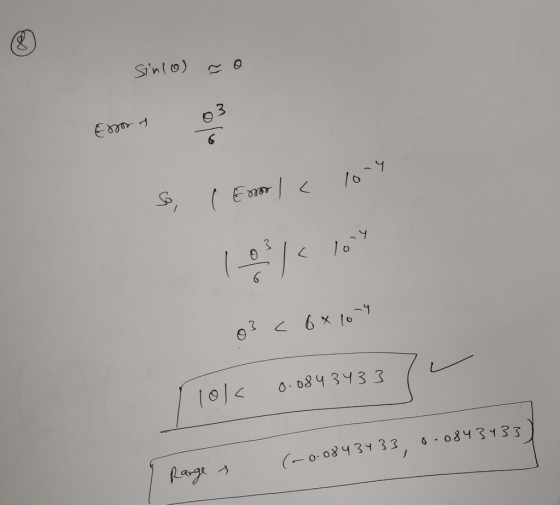
By rules and regulations we are allow to do only one question at a time...so i do question 8 only...
.
Please thumbs up for this solution...thanks...
.
Add Answer to:
7. In class we stated that relative error is often more meaningful. Explain why. However, there...
When angles are small |0| < 10° we often make the small angle approximation that sin Orad ñ Orad, where Orad is the...
 When angles are small |0| < 10° we often make the small angle approximation that sin Orad ñ Orad, where Orad is the angle measured in radians. Often, this approximation allows us to determine stability, or to more easily interpret solutions for these small angles; for example, the small angle approximation is what allows us to approximate the simple pendulum as a simple harmonic oscillator. Compute the difference sin Orad – Orad for the following angles: a) Odeg = 0°,...
5. Why do we want to know what the standard error of the sampling distribution equals? 6. When does a binomial distribu...
 5. Why do we want to know what the standard error of the sampling distribution equals? 6. When does a binomial distribution begin to approximate a Poisson distribution? As discussed in class, what is the main reason we need to understand the normal distribution? 7. 8. There is a pipe-making machine. On any given day it averages about 5 errors for about 10,000 feet of pipe; however, it ends to make more errors in the morning when the machine is...
1. (a) We need to calculate accurate values of the function for very large values of x. However, it is found that ju...
 1. (a) We need to calculate accurate values of the function for very large values of x. However, it is found that just programming this formula into a computer gives very poor accuracy for large x Explain why this happens, and show how to re-write the function so that it can be used reliably, even when x is large. [6 points] (b) In diffraction theory, it is sometimes necessary to evaluate the function sin θ f(x) for small to moderate...
Problem 2. In this problem we consider the question of whether a small value of the...
Problem 2. In this problem we consider the question of whether a small value of the residual kAz − bk means that z is a good approximation to the solution x of the linear system Ax = b. We showed in class that, kx − zk kxk ≤ kAkkA −1 k kAz − bk kbk . which implies that if the condition number kAkkA−1k of A is small, a small relative residual implies a small relative error in the solution....
1. What is often true about the relative rates of phenotypic evolution of sexually selected traits vs most other kinds of traits? 2. In the good genes model, why does a male trait have to be costly i...
1. What is often true about the relative rates of phenotypic evolution of sexually selected traits vs most other kinds of traits? 2. In the good genes model, why does a male trait have to be costly in order for the female preference to be maintained by natural selection? 3. Explain the Fisherian (runaway)model of sexual selection –what generates correlations between female preferences and male traits. What kind of experimental observation would support the model? 4. Explain the concept of...
Class Activity 150 Can More Than Half Be Above Average?! Det 000 00000 000000 On 00000...
 Class Activity 150 Can More Than Half Be Above Average?! Det 000 00000 000000 On 00000 poo Dotplot 2 ood- boooo WD0000 - Doooo Do 1 2 5 6 7 8 9 10 1. For each of the dot plots shown, decide which is greater the median or the mean of the data Explain how you can tell without calculating the mean 2 A teacher gives a test to a class of 20 students. a. Is it possible that 90%...
Mathematical models of physical phenomena are infinitely precise. However, we are not able to make measurements...
Mathematical models of physical phenomena are infinitely precise. However, we are not able to make measurements of physical phenomena with anywhere near that precision. Therefore, we often must “fit” the data we measure to a mathematical model we construct to describe the system. How well the data "fits" helps us understand how good our model is and how well our data collection systems perform. Using the velocity and position data for a falling object provided by the instructor, do the...
4. [14pts total] In class we solved a variation on the Atwood machine to find the...
 4. [14pts total] In class we solved a variation on the Atwood machine to find the mag- nitude of the acceleration of the masses, a, and the tension in the string connecting them, T. Now consider this arrangement: e me 02 / Figure 1 If we had solved the case shown in Figure 1, where the surfaces are frictionless and the pulley is massless and frictionless, we would have found: (_ (m2 sin 02 – mj sin 01)g (mi +...
Q1 2016 a) We want to develop a method for calculating the function f(x) = sin(t)/t...
 Q1 2016
a) We want to develop a method for calculating the function f(x)
= sin(t)/t
dt
for small or moderately small values of x. this is a special
function called the sine integral, and it is related to another
special function called the exponential integral. it rises in
diffraction problems.
Derive a Taylor-series expression for f(x), and give an upper
bound for the error when the series is terminated after the n-th
order term. sint = see image
b)we...
Q1 2016
a) We want to develop a method for calculating the function f(x)
= sin(t)/t
dt
for small or moderately small values of x. this is a special
function called the sine integral, and it is related to another
special function called the exponential integral. it rises in
diffraction problems.
Derive a Taylor-series expression for f(x), and give an upper
bound for the error when the series is terminated after the n-th
order term. sint = see image
b)we...
 When angles are small |0| < 10° we often make the small angle approximation that sin Orad ñ Orad, where Orad is the angle measured in radians. Often, this approximation allows us to determine stability, or to more easily interpret solutions for these small angles; for example, the small angle approximation is what allows us to approximate the simple pendulum as a simple harmonic oscillator. Compute the difference sin Orad – Orad for the following angles: a) Odeg = 0°,...
 5. Why do we want to know what the standard error of the sampling distribution equals? 6. When does a binomial distribution begin to approximate a Poisson distribution? As discussed in class, what is the main reason we need to understand the normal distribution? 7. 8. There is a pipe-making machine. On any given day it averages about 5 errors for about 10,000 feet of pipe; however, it ends to make more errors in the morning when the machine is...
 1. (a) We need to calculate accurate values of the function for very large values of x. However, it is found that just programming this formula into a computer gives very poor accuracy for large x Explain why this happens, and show how to re-write the function so that it can be used reliably, even when x is large. [6 points] (b) In diffraction theory, it is sometimes necessary to evaluate the function sin θ f(x) for small to moderate...
 Class Activity 150 Can More Than Half Be Above Average?! Det 000 00000 000000 On 00000 poo Dotplot 2 ood- boooo WD0000 - Doooo Do 1 2 5 6 7 8 9 10 1. For each of the dot plots shown, decide which is greater the median or the mean of the data Explain how you can tell without calculating the mean 2 A teacher gives a test to a class of 20 students. a. Is it possible that 90%...
 4. [14pts total] In class we solved a variation on the Atwood machine to find the mag- nitude of the acceleration of the masses, a, and the tension in the string connecting them, T. Now consider this arrangement: e me 02 / Figure 1 If we had solved the case shown in Figure 1, where the surfaces are frictionless and the pulley is massless and frictionless, we would have found: (_ (m2 sin 02 – mj sin 01)g (mi +...
 Q1 2016
a) We want to develop a method for calculating the function f(x)
= sin(t)/t
dt
for small or moderately small values of x. this is a special
function called the sine integral, and it is related to another
special function called the exponential integral. it rises in
diffraction problems.
Derive a Taylor-series expression for f(x), and give an upper
bound for the error when the series is terminated after the n-th
order term. sint = see image
b)we...
Q1 2016
a) We want to develop a method for calculating the function f(x)
= sin(t)/t
dt
for small or moderately small values of x. this is a special
function called the sine integral, and it is related to another
special function called the exponential integral. it rises in
diffraction problems.
Derive a Taylor-series expression for f(x), and give an upper
bound for the error when the series is terminated after the n-th
order term. sint = see image
b)we...
Most questions answered within 3 hours.
-
Where is the error in this code sequence?
String s1 = "Hello";
String s2 = "ello";...
asked 10 months ago -
Financial data for Joel de Paris, Inc., for last year
follow:
Joel de Paris, Inc.
Balance...
asked 10 months ago -
Consider this reaction:
Al2(SO4)3 (aq)+ BaCl3
(aq) Al2Cl6 (aq)- +
3BaSO4(s) . What is the...
asked 10 months ago -
Suppose that Savneet is considering increasing her
recent random sample from 20 car rentals to 40...
asked 10 months ago -
Trucks arrive at an unloading terminal at an average rate of 120
per hour.
Trucks arrive...
asked 10 months ago -
Why are methanol and ethanol completely soluble in water while
octanol is not very little soluble....
asked 10 months ago -
A facilities manager at a university reads in a research report
that the mean amount of...
asked 10 months ago -
When the CuSO4 is rehydrated by adding water to the anhydrous
compound, is this an endothermic...
asked 10 months ago -
A ray of sunlight is passing from diamond into crown glass; the
angle of incidence is...
asked 10 months ago -
A block of mass 0.249 kg is placed on top of a light, vertical
spring of...
asked 10 months ago -
how do the kidneys compensate in the presences of acidosis
a) trigger hyperventilate
b) reserve acid...
asked 10 months ago -
Question 501 pts
The rental rate of capital to the firm increases. Which of the
following...
asked 10 months ago