Describe the function of Aminoacyl-tRNA synthetases and the role of ATP in the process
Describe the function of Aminoacyl-tRNA synthetases and the role of ATP in the process
Homework Answers
Q. Describe the function of Aminoacy-tRNA synthetases and the role of ATP in the process
answer: Function of Aminoacy-tRNA syntheases and the role of ATP in the process
1. charging or loading of tRNA : Aminoacy-tRNA synthetases hydrolyzes ATP and add amino acid to CCA sequences at the 3' end of tRNA. This process is called as Charging and tRNA is consider as charged tRNA.
2. Amino acid activation: synthetase bind to ATP and adding specific amino acid to tRNA and formation aminoacy-tRNA is formed along with inorganic phosphate is also formed
Amino acid + tRNA + ATP -------> Aminoacyl-tRNA + AMP + PPi
3. editing: To ensure high fidelity of tRNA charging
Add Answer to:
Describe the function of Aminoacyl-tRNA synthetases and the role
of ATP in the process
Which of the following statements about aminoacyl tRNA synthetases is NOT true? There are at least...
Which of the following statements about aminoacyl tRNA synthetases is NOT true? There are at least as many aminoacyl tRNA synthetases as there are mRNAs. They participate in the “charging” of all of the tRNAs. They support the specificity of protein-nucleic acid interactions. There are at least as many aminoacyl tRNA synthetases as there are amino acids.
Part A Which of the following statements is NOT true of aminoacyl-tRNA synthetases? They activate the...
 Part A Which of the following statements is NOT true of aminoacyl-tRNA synthetases? They activate the amino acid and covalently bond it to the mature tRNA. They attach the amino acid to the CCA at the 3'-end of the mature tRNA. They attach the amino acid to the elongating peptide and catalyze translocation. Each member of this protein family is dedicated to one particular amino acid. They are primarily responsible for the accuracy of mRNA translation Submit Request Answer Provide...
15. The different tRNAs are produced by: A. Different aminoacyl-tRNA synthetases that produce tRNAs from ribonucleotides...
15. The different tRNAs are produced by: A. Different aminoacyl-tRNA synthetases that produce tRNAs from ribonucleotides in the cytoplasm B. RNA editing of transcripts of a single tRNA gene C. Alternatively spliced of a single tRNA gene D. Transcription of different tRNA genes in the genome.
Amino acyl tRNA synthetases use editing sites to increase specificity of the synthetases for their cognate...
 Amino acyl tRNA synthetases use editing sites to increase specificity of the synthetases for their cognate amino acids. What makes this "editing site" mechanism energy expensive?
12. If an aminoacyl-tRNA synthetase attaches the wrong amino acid to a tRNA, what will happen?...
 12. If an aminoacyl-tRNA synthetase attaches the wrong amino acid to a tRNA, what will happen? O The tRNA won't fold into the correct secondary structure. O The tRNA will be rejected by the ribosome. O The wrong amino acid will be added to the polypeptide, but it will be removed during proofreading. O The wrong amino acid will be added to the polypeptide.
Class I tRNA synthetases recognize their cognate tRNAs through the anticodon or the acceptor stem?
Class I tRNA synthetases recognize their cognate tRNAs through the anticodon or the acceptor stem?
Which of the following aminoacyl tRNA syntheses is MOST likely to rely primarily on the acceptor...
Which of the following aminoacyl tRNA syntheses is MOST likely to rely primarily on the acceptor stem instead of the anticodon to recognize its target tRNA(s)? Explain. a. tryptophanyl tRNA synthetase b. cysteinyl tRNA synthetase c. argininyl tRNA synthetase g. glycinyl tRNA synthetase
the codons for arginine are provided. what is the number of argingl-tRNA synthetases that a cell...
the codons for arginine are provided. what is the number of argingl-tRNA synthetases that a cell would need to have in its genome to enable translation of all codons fror arginine? a. 1 b. 2 c. 4 d. 5 e. 6
What is an aminoacyl tRNA synthetase? How does it attach amino acids? How is it specific?
What is an aminoacyl tRNA synthetase? How does it attach amino acids? How is it specific?
13. a. (2pt) If the amino acid shown were used to "charge" a tRNA molecule, circle...
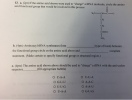 13. a. (2pt) If the amino acid shown were used to "charge" a tRNA molecule, circle the amino acid functional group that would be involved in this process CH2 CH2 NH2 b. (4pts) Aminoacyl tRNA synthetases form the functional group circle on the amino acid above and statement. (Make certain to specify functional group or structural region.) (type of bond) betweern complete c. (4pts) The amino acid shown above should be used to "charge" a tRNA with the anti-codon sequence...
 Part A Which of the following statements is NOT true of aminoacyl-tRNA synthetases? They activate the amino acid and covalently bond it to the mature tRNA. They attach the amino acid to the CCA at the 3'-end of the mature tRNA. They attach the amino acid to the elongating peptide and catalyze translocation. Each member of this protein family is dedicated to one particular amino acid. They are primarily responsible for the accuracy of mRNA translation Submit Request Answer Provide...
 Amino acyl tRNA synthetases use editing sites to increase specificity of the synthetases for their cognate amino acids. What makes this "editing site" mechanism energy expensive?
 12. If an aminoacyl-tRNA synthetase attaches the wrong amino acid to a tRNA, what will happen? O The tRNA won't fold into the correct secondary structure. O The tRNA will be rejected by the ribosome. O The wrong amino acid will be added to the polypeptide, but it will be removed during proofreading. O The wrong amino acid will be added to the polypeptide.
 13. a. (2pt) If the amino acid shown were used to "charge" a tRNA molecule, circle the amino acid functional group that would be involved in this process CH2 CH2 NH2 b. (4pts) Aminoacyl tRNA synthetases form the functional group circle on the amino acid above and statement. (Make certain to specify functional group or structural region.) (type of bond) betweern complete c. (4pts) The amino acid shown above should be used to "charge" a tRNA with the anti-codon sequence...
Most questions answered within 3 hours.
-
Where is the error in this code sequence?
String s1 = "Hello";
String s2 = "ello";...
asked 10 months ago -
Financial data for Joel de Paris, Inc., for last year
follow:
Joel de Paris, Inc.
Balance...
asked 10 months ago -
Consider this reaction:
Al2(SO4)3 (aq)+ BaCl3
(aq) Al2Cl6 (aq)- +
3BaSO4(s) . What is the...
asked 10 months ago -
Suppose that Savneet is considering increasing her
recent random sample from 20 car rentals to 40...
asked 10 months ago -
Trucks arrive at an unloading terminal at an average rate of 120
per hour.
Trucks arrive...
asked 10 months ago -
Why are methanol and ethanol completely soluble in water while
octanol is not very little soluble....
asked 10 months ago -
A facilities manager at a university reads in a research report
that the mean amount of...
asked 10 months ago -
When the CuSO4 is rehydrated by adding water to the anhydrous
compound, is this an endothermic...
asked 10 months ago -
A ray of sunlight is passing from diamond into crown glass; the
angle of incidence is...
asked 10 months ago -
A block of mass 0.249 kg is placed on top of a light, vertical
spring of...
asked 10 months ago -
how do the kidneys compensate in the presences of acidosis
a) trigger hyperventilate
b) reserve acid...
asked 10 months ago -
Question 501 pts
The rental rate of capital to the firm increases. Which of the
following...
asked 10 months ago