
Homework Answers
Add Answer to:
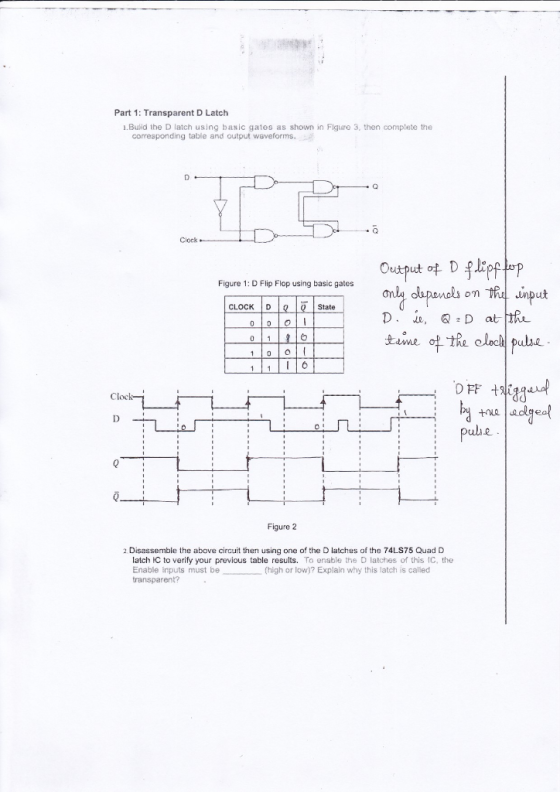
Part 1: Transparent D Latch .Build the D latch using basic gates as shown in Figure...
Part 4: Master-slave D Flip-flop 1. Build the master-slave D flip-flop shown in Figure 6, then...
 Part 4: Master-slave D Flip-flop 1. Build the master-slave D flip-flop shown in Figure 6, then complete the corresponding table and output waveforms. Clock Figure 6: Master-Slave Flip Flop from basic gates Clock lē State 1 Figure 7 3. Disassemble the above circuit then using one of the D flip flops of the 74L$74 dual D positive edge-triggered IC to fill the following table. PR CLR Clock D e e State X 10XX о то x x 11 O
1- A) The SR latch is different from combinational circuits because it preserves state. That is,...
1- A) The SR latch is different from combinational circuits because it preserves state. That is, unlike combinational circuits, if the inputs change, the circuit keeps its present state. Say that the present state of the SR latch is “set”. We change the values on the two input pins, and the state does not change. What is the value on those input pins? 1- B) Assume that you have a D flip-flop module available to you. Treat it like a...
a) (5 marks) Explain the difference between a latch, a gated latch and a flip flop....
 a) (5 marks) Explain the difference between a latch, a gated latch and a flip flop. b) (5 marks) A gated SR latch has the following schematic diagram CLK a) Draw a timing diagram showing the Q and Q outputs for the following sequence of inputs: CLK R Assume that the initial state of the outputs is Q 0 and Q 1 c) (5 marks) Draw a schematic diagram for a rising edge-triggered master-slave D flip- flop built using two...
Design D Flip Flop show internal circuits using basic gates and 3 inputs data, enable, clock,...
Design D Flip Flop show internal circuits using basic gates and 3 inputs data, enable, clock, and one output Q. Show all steps in design.
a) Draw SR latch impeltation in NOR gates provied function table b) Show how D latch...
a) Draw SR latch impeltation in NOR gates provied function table b) Show how D latch (transprent) can be made from NOR gate. SR latch is transprent when it comes to storing data. c) What is limitation of D latch in terms of storing data ? what does it achive for digital terms d) Design a D flip flop that is -ve edge trigged using master slave combination of D latches designed in b) Inverters may be needed.
-Design a gated SR latch using NAND or NOR gates. -Design a negative edge D master-slave...
-Design a gated SR latch using NAND or NOR gates. -Design a negative edge D master-slave flip-flop using the SR latch designed above -Design the D-flip-flop using the “truly” edge-triggered approach using NOR gates
2. Determine the output of a gated D latch for the inputs waveform in figure. Assume...
 2. Determine the output of a gated D latch for the inputs waveform in figure. Assume Q starts LOW. EN _பபபபபப 3. Draw the Qoutput if the following inputs are applied to the flip-flop shown. Assume Q is initially low. - * பபபபபபப
We have designed a 2NAND and 3NAND. 1. Use the cells you have already constructed to...
 We have designed a 2NAND and 3NAND.
1. Use the cells you have already constructed to design a latech, and use two latches to build a CMOS D flip-flop schematic in Cadence. Assume the flip-flop is clocked, and that clock, iclock synchronous load and synchronous load are inputs to your design. You must include asynchronous reset signals in your circuit. Load is active iugh. The flip-flop should be positive edge triggered. The clock signal should not be gated (in other...
We have designed a 2NAND and 3NAND.
1. Use the cells you have already constructed to design a latech, and use two latches to build a CMOS D flip-flop schematic in Cadence. Assume the flip-flop is clocked, and that clock, iclock synchronous load and synchronous load are inputs to your design. You must include asynchronous reset signals in your circuit. Load is active iugh. The flip-flop should be positive edge triggered. The clock signal should not be gated (in other...
Answers are at the end of the chapter 1. If an S-R latch has a 1...
 Answers are at the end of the chapter 1. If an S-R latch has a 1 on the S input and a 0 on the R input and then the S input goes to 0, the latch will be (a) set (b) reset (c) invalid (d) clear 2. The invalid state of an S-R latch occurs when (c) S 1,R-1 (d) S-0, R-O 3. For a gated D latch, the output always equals the D input (a) before the enable...
Show how a D flip-flop can be constructed using a T flip-flop and other logic gates....
Show how a D flip-flop can be constructed using a T flip-flop and other logic gates. Provide the circuit, characteristic table and a timing diagram to demonstrate the operation (generate your own inputs).
 Part 4: Master-slave D Flip-flop 1. Build the master-slave D flip-flop shown in Figure 6, then complete the corresponding table and output waveforms. Clock Figure 6: Master-Slave Flip Flop from basic gates Clock lē State 1 Figure 7 3. Disassemble the above circuit then using one of the D flip flops of the 74L$74 dual D positive edge-triggered IC to fill the following table. PR CLR Clock D e e State X 10XX о то x x 11 O
 a) (5 marks) Explain the difference between a latch, a gated latch and a flip flop. b) (5 marks) A gated SR latch has the following schematic diagram CLK a) Draw a timing diagram showing the Q and Q outputs for the following sequence of inputs: CLK R Assume that the initial state of the outputs is Q 0 and Q 1 c) (5 marks) Draw a schematic diagram for a rising edge-triggered master-slave D flip- flop built using two...
 2. Determine the output of a gated D latch for the inputs waveform in figure. Assume Q starts LOW. EN _பபபபபப 3. Draw the Qoutput if the following inputs are applied to the flip-flop shown. Assume Q is initially low. - * பபபபபபப
 We have designed a 2NAND and 3NAND.
1. Use the cells you have already constructed to design a latech, and use two latches to build a CMOS D flip-flop schematic in Cadence. Assume the flip-flop is clocked, and that clock, iclock synchronous load and synchronous load are inputs to your design. You must include asynchronous reset signals in your circuit. Load is active iugh. The flip-flop should be positive edge triggered. The clock signal should not be gated (in other...
We have designed a 2NAND and 3NAND.
1. Use the cells you have already constructed to design a latech, and use two latches to build a CMOS D flip-flop schematic in Cadence. Assume the flip-flop is clocked, and that clock, iclock synchronous load and synchronous load are inputs to your design. You must include asynchronous reset signals in your circuit. Load is active iugh. The flip-flop should be positive edge triggered. The clock signal should not be gated (in other...
 Answers are at the end of the chapter 1. If an S-R latch has a 1 on the S input and a 0 on the R input and then the S input goes to 0, the latch will be (a) set (b) reset (c) invalid (d) clear 2. The invalid state of an S-R latch occurs when (c) S 1,R-1 (d) S-0, R-O 3. For a gated D latch, the output always equals the D input (a) before the enable...
Most questions answered within 3 hours.
-
Where is the error in this code sequence?
String s1 = "Hello";
String s2 = "ello";...
asked 10 months ago -
Financial data for Joel de Paris, Inc., for last year
follow:
Joel de Paris, Inc.
Balance...
asked 10 months ago -
Consider this reaction:
Al2(SO4)3 (aq)+ BaCl3
(aq) Al2Cl6 (aq)- +
3BaSO4(s) . What is the...
asked 10 months ago -
Suppose that Savneet is considering increasing her
recent random sample from 20 car rentals to 40...
asked 10 months ago -
Trucks arrive at an unloading terminal at an average rate of 120
per hour.
Trucks arrive...
asked 10 months ago -
Why are methanol and ethanol completely soluble in water while
octanol is not very little soluble....
asked 10 months ago -
A facilities manager at a university reads in a research report
that the mean amount of...
asked 10 months ago -
When the CuSO4 is rehydrated by adding water to the anhydrous
compound, is this an endothermic...
asked 10 months ago -
A ray of sunlight is passing from diamond into crown glass; the
angle of incidence is...
asked 10 months ago -
A block of mass 0.249 kg is placed on top of a light, vertical
spring of...
asked 10 months ago -
how do the kidneys compensate in the presences of acidosis
a) trigger hyperventilate
b) reserve acid...
asked 10 months ago -
Question 501 pts
The rental rate of capital to the firm increases. Which of the
following...
asked 10 months ago