![4. [15 points] Show that if a curve C on a surface S is both a line of curvature and a geodesic, then C is a plane curve. Giv](http://img.homeworklib.com/questions/717ecb70-a41e-11eb-98a1-8fba0689c3e8.png?x-oss-process=image/resize,w_560)
Homework Answers
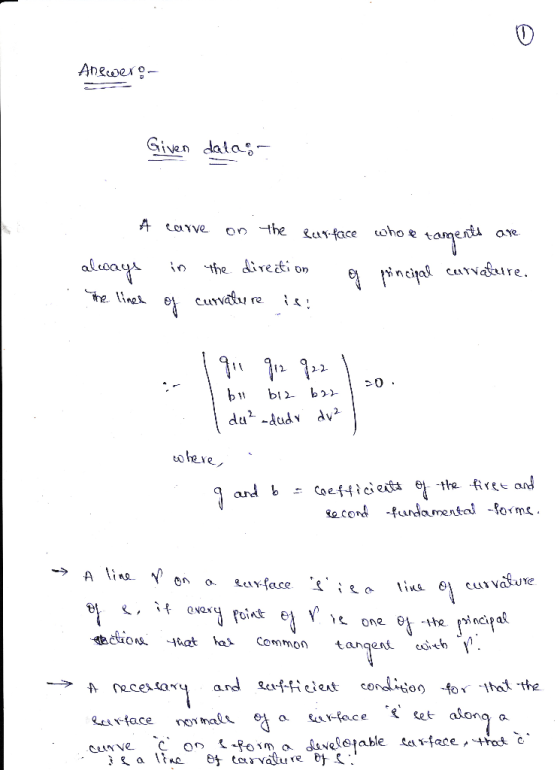
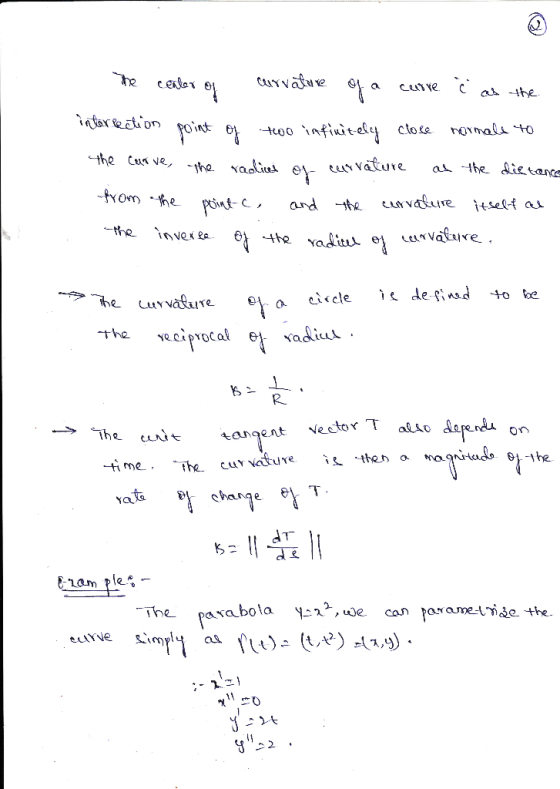
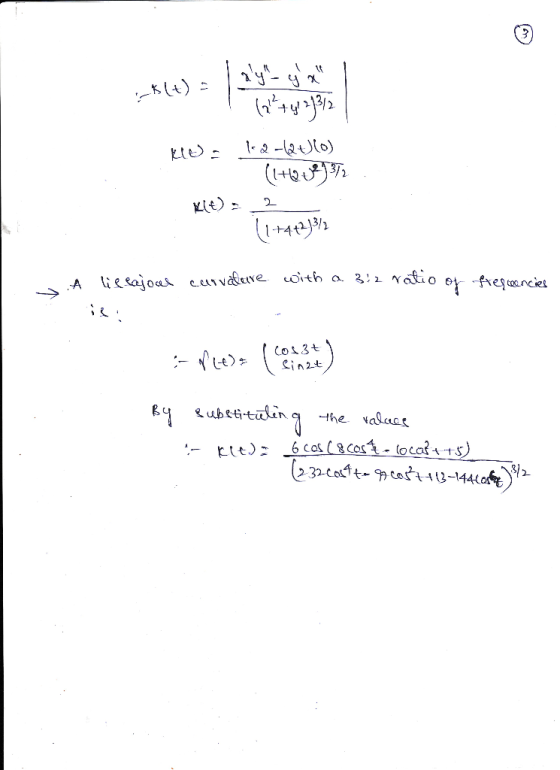
Let M be a surface and 11 a plane that intersects M in a curve γ. Show that y is a geodesic if II is a plane of symmetr...
 Let M be a surface and 11 a plane that intersects M in a curve γ. Show that y is a geodesic if II is a plane of symmetry of M, i.e., the two sides are mirror images.
Let M be a surface and 11 a plane that intersects M in a curve γ. Show that y is a geodesic if II is a plane of symmetry of M, i.e., the two sides are mirror images.
Let M be a surface and 11 a plane that intersects M in a curve γ. Show that y is a geodesic if II is a plane of symmetry of M, i.e., the two sides are mirror images.
5.1. Show that a meridian of a surface of revolution is a geodesic without solving the...
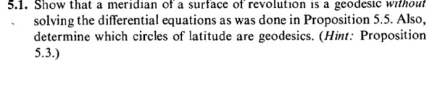 5.1. Show that a meridian of a surface of revolution is a geodesic without solving the differential equations as was done in Proposition 5.5. Also, determine which circles of latitude are geodesics. (Hin Proposition 5.3.) PROPOSITION 5.3. A unit speed curve 7(s) on a surface M is a geodesic if and only if y" is everywhere normal to the surface (i.e., is a multiple of the normal to M)
5.1. Show that a meridian of a surface of revolution is...
5.1. Show that a meridian of a surface of revolution is a geodesic without solving the differential equations as was done in Proposition 5.5. Also, determine which circles of latitude are geodesics. (Hin Proposition 5.3.) PROPOSITION 5.3. A unit speed curve 7(s) on a surface M is a geodesic if and only if y" is everywhere normal to the surface (i.e., is a multiple of the normal to M)
5.1. Show that a meridian of a surface of revolution is...
Question 4 (Geodesics on surfaces of revolution) Let S be a surface of revolution and consider...
 Question 4 (Geodesics on surfaces of revolution) Let S be a surface of revolution and consider for it the parametrization x(u, v) ((v) cos u, p(v) sin u, ^(v) Assume in addition that (a)2 +()21 (a) Prove that a curve a(t) = x(u(t), v(t)) is a geodesic of S if and only if it satisfies dip 1 ü2 dv p dip p(u)2 0, dv where here and in what follows the dot denotes derivative with respect to t 5 marks...
Verify that the line integral and the surface integral of Stokes Theorem are equal far the following vector field, surface S, and closed curve C. Assume that C has counterlockwise orientation and S h...
 Verify that the line integral and the surface integral of Stokes Theorem are equal far the following vector field, surface S, and closed curve C. Assume that C has counterlockwise orientation and S has a consistentorientation F = 〈y,-x, 11), s is the upper half of the sphere x2 + y2 +22-1 and C is the circle x2 + y2-1 in the xy-plane Construct the line integral of Stokes' Theorem using the parameterization r(t)= 〈cost, sint, O. for 0 sts2r...
4. Consider the surface of revolution o(u, v) (f(u)cosv, f(u) sin v, g(u)) where uf(u), 0,...
 4. Consider the surface of revolution o(u, v) (f(u)cosv, f(u) sin v, g(u)) where uf(u), 0, g(u)) is the unit-speed regular curve in R3, Find the normal curvature of meridian v constant and geodesic curvatures of a parallel u=constant.
4. Consider the surface of revolution o(u, v) (f(u)cosv, f(u) sin v, g(u)) where uf(u), 0, g(u)) is the unit-speed regular curve in R3, Find the normal curvature of meridian v constant and geodesic curvatures of a parallel u=constant.
4. Consider the surface of revolution o(u, v) (f(u)cosv, f(u) sin v, g(u)) where uf(u), 0, g(u)) is the unit-speed regular curve in R3, Find the normal curvature of meridian v constant and geodesic curvatures of a parallel u=constant.
Given ω_yzdr-xzdv +.ndt and C(t)-(2cost2sint,4),0g1s2n a) Let S be the piece of the surface-x* +y...
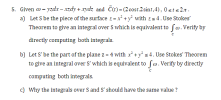 Given ω_yzdr-xzdv +.ndt and C(t)-(2cost2sint,4),0g1s2n a) Let S be the piece of the surface-x* +y* with z s 4. Use Stokes' 5. Theorem to give an integral over S which is equivalent to . Verify by directly computing both integrals. b) Let S' be the part of the plane z 4 with x*+y* s4. Use Stokes' Theorem fo. Verify by directly to give an integral over S' which is equivalent to computing both integrals Why the integrals over S and...
Please help me with these questions, show working. thankyou A space curve is defined by C: T(s) 2si+(5s2+4)j+(s+7)k. De...
 Please help me with these questions, show working. thankyou
A space curve is defined by C: T(s) 2si+(5s2+4)j+(s+7)k. Determine parametric equations for the tangent line to the space curve C at the point P: (2, 9, 8) Your answer should consist of three expressions for the Cartesian variables x, y and z in terms of the parameter t, using the correct syntax. For example: x 2+4*t, y 7-3*t, z 15+2*t Do not use decimal approximations all numbers should be entered...
Please help me with these questions, show working. thankyou
A space curve is defined by C: T(s) 2si+(5s2+4)j+(s+7)k. Determine parametric equations for the tangent line to the space curve C at the point P: (2, 9, 8) Your answer should consist of three expressions for the Cartesian variables x, y and z in terms of the parameter t, using the correct syntax. For example: x 2+4*t, y 7-3*t, z 15+2*t Do not use decimal approximations all numbers should be entered...
7. Let a be a unit-speed curve in M CR?. Instead of the Frenet frame field...
 7. Let a be a unit-speed curve in M CR?. Instead of the Frenet frame field on a, consider the Darboux frame field T, V, U—where T is the unit tangent of a, U is the surface normal restricted to a, and V = U * T (Fig. 5.34). (a) Show that T' = gV + kU V' =-gT + tU, U' = -KT - tv, 263/518 where k = S(T) · T is the normal curvature k(T) of M...
(4) Consider the surface z = x2+4y2+1. Suppose you are walking on this surface directly above a curve C in the xy-plane, where the parameterized curve is given by C (t)cost, y(t) sin t. Find the valu...
 (4) Consider the surface z = x2+4y2+1. Suppose you are walking on this surface directly above a curve C in the xy-plane, where the parameterized curve is given by C (t)cost, y(t) sin t. Find the values of t for which you are walking uphil increasing z (Assume you are walking above the curve C in the direction of positive orientation The direction of positive orientation for the plane curve C is indicated by its tangent vectors.)
(4) Consider the...
(4) Consider the surface z = x2+4y2+1. Suppose you are walking on this surface directly above a curve C in the xy-plane, where the parameterized curve is given by C (t)cost, y(t) sin t. Find the values of t for which you are walking uphil increasing z (Assume you are walking above the curve C in the direction of positive orientation The direction of positive orientation for the plane curve C is indicated by its tangent vectors.)
(4) Consider the...
Please answer all parts with full, clear solutions so i can understand :) :) Q2 (6 points) If C is a smooth plane curve...
 Please answer all parts with full, clear solutions so i can
understand :) :)
Q2 (6 points) If C is a smooth plane curve with parametrization r r(t),t E [a, b], then the curvature K(t) of C at the point r(t) is defined to be the magnitude of the rate of change -ll dT of the unit tangent vector with respect to the arc length. That is, = ds () [2p] Show that K(t) = ||F (C) xr" (t)|| r...
Please answer all parts with full, clear solutions so i can
understand :) :)
Q2 (6 points) If C is a smooth plane curve with parametrization r r(t),t E [a, b], then the curvature K(t) of C at the point r(t) is defined to be the magnitude of the rate of change -ll dT of the unit tangent vector with respect to the arc length. That is, = ds () [2p] Show that K(t) = ||F (C) xr" (t)|| r...
 Let M be a surface and 11 a plane that intersects M in a curve γ. Show that y is a geodesic if II is a plane of symmetry of M, i.e., the two sides are mirror images.
Let M be a surface and 11 a plane that intersects M in a curve γ. Show that y is a geodesic if II is a plane of symmetry of M, i.e., the two sides are mirror images.
Let M be a surface and 11 a plane that intersects M in a curve γ. Show that y is a geodesic if II is a plane of symmetry of M, i.e., the two sides are mirror images.
 5.1. Show that a meridian of a surface of revolution is a geodesic without solving the differential equations as was done in Proposition 5.5. Also, determine which circles of latitude are geodesics. (Hin Proposition 5.3.) PROPOSITION 5.3. A unit speed curve 7(s) on a surface M is a geodesic if and only if y" is everywhere normal to the surface (i.e., is a multiple of the normal to M)
5.1. Show that a meridian of a surface of revolution is...
5.1. Show that a meridian of a surface of revolution is a geodesic without solving the differential equations as was done in Proposition 5.5. Also, determine which circles of latitude are geodesics. (Hin Proposition 5.3.) PROPOSITION 5.3. A unit speed curve 7(s) on a surface M is a geodesic if and only if y" is everywhere normal to the surface (i.e., is a multiple of the normal to M)
5.1. Show that a meridian of a surface of revolution is...
 Question 4 (Geodesics on surfaces of revolution) Let S be a surface of revolution and consider for it the parametrization x(u, v) ((v) cos u, p(v) sin u, ^(v) Assume in addition that (a)2 +()21 (a) Prove that a curve a(t) = x(u(t), v(t)) is a geodesic of S if and only if it satisfies dip 1 ü2 dv p dip p(u)2 0, dv where here and in what follows the dot denotes derivative with respect to t 5 marks...
 Verify that the line integral and the surface integral of Stokes Theorem are equal far the following vector field, surface S, and closed curve C. Assume that C has counterlockwise orientation and S has a consistentorientation F = 〈y,-x, 11), s is the upper half of the sphere x2 + y2 +22-1 and C is the circle x2 + y2-1 in the xy-plane Construct the line integral of Stokes' Theorem using the parameterization r(t)= 〈cost, sint, O. for 0 sts2r...
 4. Consider the surface of revolution o(u, v) (f(u)cosv, f(u) sin v, g(u)) where uf(u), 0, g(u)) is the unit-speed regular curve in R3, Find the normal curvature of meridian v constant and geodesic curvatures of a parallel u=constant.
4. Consider the surface of revolution o(u, v) (f(u)cosv, f(u) sin v, g(u)) where uf(u), 0, g(u)) is the unit-speed regular curve in R3, Find the normal curvature of meridian v constant and geodesic curvatures of a parallel u=constant.
4. Consider the surface of revolution o(u, v) (f(u)cosv, f(u) sin v, g(u)) where uf(u), 0, g(u)) is the unit-speed regular curve in R3, Find the normal curvature of meridian v constant and geodesic curvatures of a parallel u=constant.
 Given ω_yzdr-xzdv +.ndt and C(t)-(2cost2sint,4),0g1s2n a) Let S be the piece of the surface-x* +y* with z s 4. Use Stokes' 5. Theorem to give an integral over S which is equivalent to . Verify by directly computing both integrals. b) Let S' be the part of the plane z 4 with x*+y* s4. Use Stokes' Theorem fo. Verify by directly to give an integral over S' which is equivalent to computing both integrals Why the integrals over S and...
 Please help me with these questions, show working. thankyou
A space curve is defined by C: T(s) 2si+(5s2+4)j+(s+7)k. Determine parametric equations for the tangent line to the space curve C at the point P: (2, 9, 8) Your answer should consist of three expressions for the Cartesian variables x, y and z in terms of the parameter t, using the correct syntax. For example: x 2+4*t, y 7-3*t, z 15+2*t Do not use decimal approximations all numbers should be entered...
Please help me with these questions, show working. thankyou
A space curve is defined by C: T(s) 2si+(5s2+4)j+(s+7)k. Determine parametric equations for the tangent line to the space curve C at the point P: (2, 9, 8) Your answer should consist of three expressions for the Cartesian variables x, y and z in terms of the parameter t, using the correct syntax. For example: x 2+4*t, y 7-3*t, z 15+2*t Do not use decimal approximations all numbers should be entered...
 7. Let a be a unit-speed curve in M CR?. Instead of the Frenet frame field on a, consider the Darboux frame field T, V, U—where T is the unit tangent of a, U is the surface normal restricted to a, and V = U * T (Fig. 5.34). (a) Show that T' = gV + kU V' =-gT + tU, U' = -KT - tv, 263/518 where k = S(T) · T is the normal curvature k(T) of M...
 (4) Consider the surface z = x2+4y2+1. Suppose you are walking on this surface directly above a curve C in the xy-plane, where the parameterized curve is given by C (t)cost, y(t) sin t. Find the values of t for which you are walking uphil increasing z (Assume you are walking above the curve C in the direction of positive orientation The direction of positive orientation for the plane curve C is indicated by its tangent vectors.)
(4) Consider the...
(4) Consider the surface z = x2+4y2+1. Suppose you are walking on this surface directly above a curve C in the xy-plane, where the parameterized curve is given by C (t)cost, y(t) sin t. Find the values of t for which you are walking uphil increasing z (Assume you are walking above the curve C in the direction of positive orientation The direction of positive orientation for the plane curve C is indicated by its tangent vectors.)
(4) Consider the...
 Please answer all parts with full, clear solutions so i can
understand :) :)
Q2 (6 points) If C is a smooth plane curve with parametrization r r(t),t E [a, b], then the curvature K(t) of C at the point r(t) is defined to be the magnitude of the rate of change -ll dT of the unit tangent vector with respect to the arc length. That is, = ds () [2p] Show that K(t) = ||F (C) xr" (t)|| r...
Please answer all parts with full, clear solutions so i can
understand :) :)
Q2 (6 points) If C is a smooth plane curve with parametrization r r(t),t E [a, b], then the curvature K(t) of C at the point r(t) is defined to be the magnitude of the rate of change -ll dT of the unit tangent vector with respect to the arc length. That is, = ds () [2p] Show that K(t) = ||F (C) xr" (t)|| r...
Most questions answered within 3 hours.
-
Where is the error in this code sequence?
String s1 = "Hello";
String s2 = "ello";...
asked 10 months ago -
Financial data for Joel de Paris, Inc., for last year
follow:
Joel de Paris, Inc.
Balance...
asked 10 months ago -
Consider this reaction:
Al2(SO4)3 (aq)+ BaCl3
(aq) Al2Cl6 (aq)- +
3BaSO4(s) . What is the...
asked 10 months ago -
Suppose that Savneet is considering increasing her
recent random sample from 20 car rentals to 40...
asked 10 months ago -
Trucks arrive at an unloading terminal at an average rate of 120
per hour.
Trucks arrive...
asked 10 months ago -
Why are methanol and ethanol completely soluble in water while
octanol is not very little soluble....
asked 10 months ago -
A facilities manager at a university reads in a research report
that the mean amount of...
asked 10 months ago -
When the CuSO4 is rehydrated by adding water to the anhydrous
compound, is this an endothermic...
asked 10 months ago -
A ray of sunlight is passing from diamond into crown glass; the
angle of incidence is...
asked 10 months ago -
A block of mass 0.249 kg is placed on top of a light, vertical
spring of...
asked 10 months ago -
how do the kidneys compensate in the presences of acidosis
a) trigger hyperventilate
b) reserve acid...
asked 10 months ago -
Question 501 pts
The rental rate of capital to the firm increases. Which of the
following...
asked 10 months ago