
Homework Answers
Add Answer to:
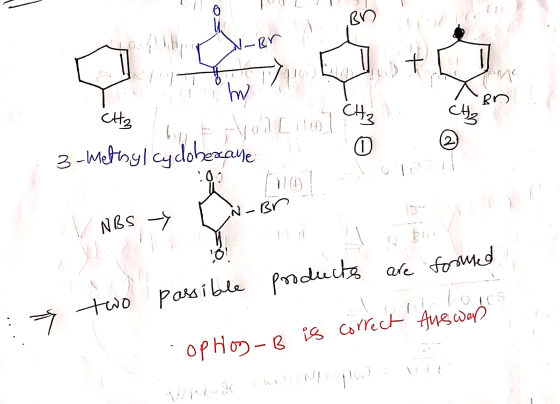
How many allylic halides can be formed when 3-methycyclohexene undergoes allylic halogenation with one equivalent of...
How many alkene products can be formed when the alkyl iodide shown below undergoes E1 elimination?...
 How many alkene products can be formed when the alkyl iodide
shown below undergoes E1 elimination?
9. How many alkene products can be formed when the alkyl iodide shown below undergoes El elimination? CH3 CH CH A) 1 B) 2 C) 3 D) 4 E) 5
How many alkene products can be formed when the alkyl iodide
shown below undergoes E1 elimination?
9. How many alkene products can be formed when the alkyl iodide shown below undergoes El elimination? CH3 CH CH A) 1 B) 2 C) 3 D) 4 E) 5
This is a question on free radical halogenation. How and why does the bromoethane bond form...
 This is a question on free radical halogenation.
How and why does the bromoethane bond form for the 2nd resonance
structure?
3. The allylic bromination of the alkene below with NBS gives four different products. Draw the two initially formed free radical intermediates with any applicable resonance structures, then draw the four products. Indicate which product will be the major product and which you would predict to have the lowest yield. Br, hv ® Ýsa Ś Br sminor 3 &+Br....
This is a question on free radical halogenation.
How and why does the bromoethane bond form for the 2nd resonance
structure?
3. The allylic bromination of the alkene below with NBS gives four different products. Draw the two initially formed free radical intermediates with any applicable resonance structures, then draw the four products. Indicate which product will be the major product and which you would predict to have the lowest yield. Br, hv ® Ýsa Ś Br sminor 3 &+Br....
Need help with: d) propagation steps for the radical formation 3a) 3 other products for allylic...
 Need help with:
d) propagation steps for the radical formation
3a) 3 other products for allylic bromination
3b) explanation of exactly why low conc. of Br2 is important
in the allylic bromination reaction above.
Thank you!!
d. 1,3 butadiene can undergo radical polymerization. Give the propagation for the formation of the radical shown. ROOR RO light 3. a. The reaction can produce a number of allylic bromination products besides the one shown. Draw three of these other products. NBS ROOR...
Need help with:
d) propagation steps for the radical formation
3a) 3 other products for allylic bromination
3b) explanation of exactly why low conc. of Br2 is important
in the allylic bromination reaction above.
Thank you!!
d. 1,3 butadiene can undergo radical polymerization. Give the propagation for the formation of the radical shown. ROOR RO light 3. a. The reaction can produce a number of allylic bromination products besides the one shown. Draw three of these other products. NBS ROOR...
Predict the dehydrohalogenation product(s) that result when the following alkyl halides are heated in alcoholic KOH...
 Predict the dehydrohalogenation product(s) that result when the following alkyl halides are heated in alcoholic KOH When more than one product is formed, predict the major and minor products. (a) (CH)2CH-C(CH)2 7-46 (b) (CH),CH—ҪH-СH, T (c) (CH)C-CH-CH, Br Br (e) (f) Br (d) (CH) C CH3 Br Н HD Br
7-46 Predict the dehydrohalogenation product(s) that result when the following alkyl halides are beated in asshole...
 7-46 Predict the dehydrohalogenation product(s) that result when the following alkyl halides are beated in asshole KOH When more than one product is formed, predict the major and minor products. (a) (CH3)2CH-C(CH3)2 (b) (CH3)-CH-CH-CH (e) (CH3)2C-CH-CH Br Br Br CH | (CHDC CI HD CI
1. a) Draw the structure of 3-hexene, circling all allylic hydrogens. b) Draw the structure of...
 1. a) Draw the structure of 3-hexene, circling all allylic hydrogens. b) Draw the structure of 3-hexene again, this time circling all vinylic hydrogens. 2. a) Draw the structure of chlorofornm b) What do you imagine the structure of bromoform might be? 3. Show the steps necessary to convert propyne into cis 6-methyl-2-heptene. 4. Write in the product(s). Include stereochemistry where relevant. Label major and minor products CH3 CH3 a) CH3 NBS CH3 hu b) NaCECH (R) CH3CH2CH2CHDBr (D -...
What general classification can be given to the molecule below? Highlight the correct answer. A) primary...
What general classification can be given to the molecule below? Highlight the correct answer. A) primary allylic bromide B) secondary vinyl bromide C) tertiary allylic bromide D) tertiary vinyl bromide E) secondary alkyl bromide Write all possible organic products formed when CH3-CH=CH-C(CH3)3 reacts with NBS in the presence of light of a certain wavelength. Use appropriate resonance structure of the reaction intermediates to justify your answer.
CНз NBS, CCI4, hv lintermediate product(s) Hас Give all resonance structures of the allylic radical intermediate tha...
 CНз NBS, CCI4, hv lintermediate product(s) Hас Give all resonance structures of the allylic radical intermediate that arise from reaction above. 2. All allylic C-H on the molecule are equivalent so only show the two resonance structures arising from one C-H bond reacting. 3. Are the resonance structures above equivalent or non-equivalent? Think about the degree of the atom where the radical (the dot) is. Give all the products expected from the reaction above. 4.
Help on 16, 17, and 18!!!! ? 16. How many constitutional isomer allylic bromides does the...
 Help on 16, 17, and 18!!!!
? 16. How many constitutional isomer allylic bromides does the following reaction give? NBS A/hv/ROOR C. 5 a. 3 b.4 d. 6 e. not a.-d. 17. Ignoring stereochemistry, what is the overall enthalpy difference of the reaction of 3-ethylpentane, fluorine, and light going to the major mono-fluorinated product? Bond Disassociation Energies kcal/mole C-H C-F C-CI C-Br C- L X -X 98 107 81 68 53 F | 38 95 106 80 68 53 cl...
Help on 16, 17, and 18!!!!
? 16. How many constitutional isomer allylic bromides does the following reaction give? NBS A/hv/ROOR C. 5 a. 3 b.4 d. 6 e. not a.-d. 17. Ignoring stereochemistry, what is the overall enthalpy difference of the reaction of 3-ethylpentane, fluorine, and light going to the major mono-fluorinated product? Bond Disassociation Energies kcal/mole C-H C-F C-CI C-Br C- L X -X 98 107 81 68 53 F | 38 95 106 80 68 53 cl...
Alkyl Halides: Elimination reaction with (2R,3R)-2-chloro-3-methylpentane Draw the product formed when (2R,3R)-2-chloro-3-methylpentane under-goes an elimination reaction...
Alkyl Halides: Elimination reaction with (2R,3R)-2-chloro-3-methylpentane Draw the product formed when (2R,3R)-2-chloro-3-methylpentane under-goes an elimination reaction with NaOCH3. Alkyl Halides: Elimination reaction with 3-chloro-3-ethyl-2,2-dimethylpentane. Draw the structure of the product that is formed when 3-chloro-3-ethyl-2,2-dimethylpentane undergoes an elimination reaction with NaOCH3. Indicate the stereochemistry of the product. Identify the three products formed when 2-bromo-2-methylpropane is dissolved in a mixture of 80% ethanol and 20% water.
 How many alkene products can be formed when the alkyl iodide
shown below undergoes E1 elimination?
9. How many alkene products can be formed when the alkyl iodide shown below undergoes El elimination? CH3 CH CH A) 1 B) 2 C) 3 D) 4 E) 5
How many alkene products can be formed when the alkyl iodide
shown below undergoes E1 elimination?
9. How many alkene products can be formed when the alkyl iodide shown below undergoes El elimination? CH3 CH CH A) 1 B) 2 C) 3 D) 4 E) 5
 This is a question on free radical halogenation.
How and why does the bromoethane bond form for the 2nd resonance
structure?
3. The allylic bromination of the alkene below with NBS gives four different products. Draw the two initially formed free radical intermediates with any applicable resonance structures, then draw the four products. Indicate which product will be the major product and which you would predict to have the lowest yield. Br, hv ® Ýsa Ś Br sminor 3 &+Br....
This is a question on free radical halogenation.
How and why does the bromoethane bond form for the 2nd resonance
structure?
3. The allylic bromination of the alkene below with NBS gives four different products. Draw the two initially formed free radical intermediates with any applicable resonance structures, then draw the four products. Indicate which product will be the major product and which you would predict to have the lowest yield. Br, hv ® Ýsa Ś Br sminor 3 &+Br....
 Need help with:
d) propagation steps for the radical formation
3a) 3 other products for allylic bromination
3b) explanation of exactly why low conc. of Br2 is important
in the allylic bromination reaction above.
Thank you!!
d. 1,3 butadiene can undergo radical polymerization. Give the propagation for the formation of the radical shown. ROOR RO light 3. a. The reaction can produce a number of allylic bromination products besides the one shown. Draw three of these other products. NBS ROOR...
Need help with:
d) propagation steps for the radical formation
3a) 3 other products for allylic bromination
3b) explanation of exactly why low conc. of Br2 is important
in the allylic bromination reaction above.
Thank you!!
d. 1,3 butadiene can undergo radical polymerization. Give the propagation for the formation of the radical shown. ROOR RO light 3. a. The reaction can produce a number of allylic bromination products besides the one shown. Draw three of these other products. NBS ROOR...
 Predict the dehydrohalogenation product(s) that result when the following alkyl halides are heated in alcoholic KOH When more than one product is formed, predict the major and minor products. (a) (CH)2CH-C(CH)2 7-46 (b) (CH),CH—ҪH-СH, T (c) (CH)C-CH-CH, Br Br (e) (f) Br (d) (CH) C CH3 Br Н HD Br
 7-46 Predict the dehydrohalogenation product(s) that result when the following alkyl halides are beated in asshole KOH When more than one product is formed, predict the major and minor products. (a) (CH3)2CH-C(CH3)2 (b) (CH3)-CH-CH-CH (e) (CH3)2C-CH-CH Br Br Br CH | (CHDC CI HD CI
 1. a) Draw the structure of 3-hexene, circling all allylic hydrogens. b) Draw the structure of 3-hexene again, this time circling all vinylic hydrogens. 2. a) Draw the structure of chlorofornm b) What do you imagine the structure of bromoform might be? 3. Show the steps necessary to convert propyne into cis 6-methyl-2-heptene. 4. Write in the product(s). Include stereochemistry where relevant. Label major and minor products CH3 CH3 a) CH3 NBS CH3 hu b) NaCECH (R) CH3CH2CH2CHDBr (D -...
 CНз NBS, CCI4, hv lintermediate product(s) Hас Give all resonance structures of the allylic radical intermediate that arise from reaction above. 2. All allylic C-H on the molecule are equivalent so only show the two resonance structures arising from one C-H bond reacting. 3. Are the resonance structures above equivalent or non-equivalent? Think about the degree of the atom where the radical (the dot) is. Give all the products expected from the reaction above. 4.
 Help on 16, 17, and 18!!!!
? 16. How many constitutional isomer allylic bromides does the following reaction give? NBS A/hv/ROOR C. 5 a. 3 b.4 d. 6 e. not a.-d. 17. Ignoring stereochemistry, what is the overall enthalpy difference of the reaction of 3-ethylpentane, fluorine, and light going to the major mono-fluorinated product? Bond Disassociation Energies kcal/mole C-H C-F C-CI C-Br C- L X -X 98 107 81 68 53 F | 38 95 106 80 68 53 cl...
Help on 16, 17, and 18!!!!
? 16. How many constitutional isomer allylic bromides does the following reaction give? NBS A/hv/ROOR C. 5 a. 3 b.4 d. 6 e. not a.-d. 17. Ignoring stereochemistry, what is the overall enthalpy difference of the reaction of 3-ethylpentane, fluorine, and light going to the major mono-fluorinated product? Bond Disassociation Energies kcal/mole C-H C-F C-CI C-Br C- L X -X 98 107 81 68 53 F | 38 95 106 80 68 53 cl...
Most questions answered within 3 hours.
-
Where is the error in this code sequence?
String s1 = "Hello";
String s2 = "ello";...
asked 10 months ago -
Financial data for Joel de Paris, Inc., for last year
follow:
Joel de Paris, Inc.
Balance...
asked 10 months ago -
Consider this reaction:
Al2(SO4)3 (aq)+ BaCl3
(aq) Al2Cl6 (aq)- +
3BaSO4(s) . What is the...
asked 10 months ago -
Suppose that Savneet is considering increasing her
recent random sample from 20 car rentals to 40...
asked 10 months ago -
Trucks arrive at an unloading terminal at an average rate of 120
per hour.
Trucks arrive...
asked 10 months ago -
Why are methanol and ethanol completely soluble in water while
octanol is not very little soluble....
asked 10 months ago -
A facilities manager at a university reads in a research report
that the mean amount of...
asked 10 months ago -
When the CuSO4 is rehydrated by adding water to the anhydrous
compound, is this an endothermic...
asked 10 months ago -
A ray of sunlight is passing from diamond into crown glass; the
angle of incidence is...
asked 10 months ago -
A block of mass 0.249 kg is placed on top of a light, vertical
spring of...
asked 10 months ago -
how do the kidneys compensate in the presences of acidosis
a) trigger hyperventilate
b) reserve acid...
asked 10 months ago -
Question 501 pts
The rental rate of capital to the firm increases. Which of the
following...
asked 10 months ago