
Homework Answers
Add Answer to:
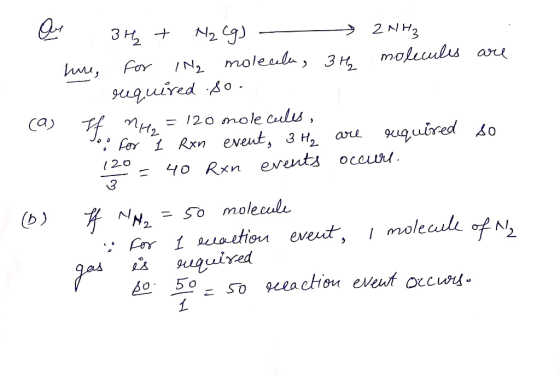
Data Analysis Part A 1. a. Given 120 molecules of H2, calculate the maximum number of...
answer please number 1) a and b and 2 and 3 Experiment 4: Limiting reagent Often reactants are added in amounts diff...
 answer please number 1) a and b and 2 and 3
Experiment 4: Limiting reagent Often reactants are added in amounts different from the proportions given by the chemical equation in such cases, only one of the reactants may be completely consumed at the end of the reaction, whereas some amounts of other reactants will remain unreacted. The limiting reactant (or limiting reagent) is the reactant that is entirely consumed or converted to product when a reaction goes to completion....
answer please number 1) a and b and 2 and 3
Experiment 4: Limiting reagent Often reactants are added in amounts different from the proportions given by the chemical equation in such cases, only one of the reactants may be completely consumed at the end of the reaction, whereas some amounts of other reactants will remain unreacted. The limiting reactant (or limiting reagent) is the reactant that is entirely consumed or converted to product when a reaction goes to completion....
3. For the reaction, N2 + 3H2 → 2NH3 What is the maximum number of moles...
3. For the reaction, N2 + 3H2 → 2NH3 What is the maximum number of moles of NH3 which could be formed from 12.26 mol of N2 and 2.11 mol of H2?
an equilibrium mixture is analyzed and found to contain 0.94M N2 , 0.701M H2 and .35...
an equilibrium mixture is analyzed and found to contain 0.94M N2 , 0.701M H2 and .35 M NH3 at room temp. A. what is Kc for reaction N2(g) +3H2(g) -> 2NH3 (g) ? B. write out the relationship between Kc and Kp, then calc Kp at 25C please show all work
Given the following data for heats of reaction N2(g) + 3H2(g) ----> 2NH3(g) H = -91.8 kJ...
 Given the following data for heats of reaction
N2(g) + 3H2(g) ---->
2NH3(g) H
= -91.8 kJ
C(graphite) + 2H2(g) ------->
CH4(g)H
= -74.9kJ
H2(g) + 2C(graphite) + N2(g)
--------> 2HCN(g) H
= 270.3 kJ
Calculate
H for the reaction used to make HCN
CH4(g) + NH3(g) --------> HCN(g) +
3H2(g)
Given the following data for heats of reaction
N2(g) + 3H2(g) ---->
2NH3(g) H
= -91.8 kJ
C(graphite) + 2H2(g) ------->
CH4(g)H
= -74.9kJ
H2(g) + 2C(graphite) + N2(g)
--------> 2HCN(g) H
= 270.3 kJ
Calculate
H for the reaction used to make HCN
CH4(g) + NH3(g) --------> HCN(g) +
3H2(g)
(ii) Calculate AH° for the reaction N2H4(1) + O2(g) → N2(g) + 2H2O(1) using the data...
 (ii) Calculate AH° for the reaction N2H4(1) + O2(g) → N2(g) + 2H2O(1) using the data given below: 2NH3(g) + 3N2O(g) → 4N2(g) + 3H2O(1) N2O(g) + 3H2(g) → N2H4(l) + H2O(1) 2NH3(g) + O2(g) → N2H4(1) + H2O(1) H2(g) + 1/2O2(g) → H2O(1) AH° = -1010. kJ AH° = -317 kJ AH° = -143 kJ AH° = -286 kJ
3H2(g)+N2(g)→2NH3(g) Part A: How many moles of NH3 can be produced from 12.0 mol of H2...
3H2(g)+N2(g)→2NH3(g) Part A: How many moles of NH3 can be produced from 12.0 mol of H2 and excess N2? = 8.00 mol I need answers for Part B-D Part B: How many grams of NH3 can be produced from 3.75 mol of N2 and excess H2? Part C: How many grams of H2 are needed to produce 11.79 g of NH3? Part D: How many molecules (not moles) of NH3 are produced from 5.00×10⁻⁴ g of H2?
1. Consider the reaction H2(g) + F2(g) ----->2HF(g) Use the standard thermodynamic data in the tables...
1. Consider the reaction H2(g) + F2(g) ----->2HF(g) Use the standard thermodynamic data in the tables linked above. Calculate delta G for this reaction at 298.15K if the pressure of HF(g) is reduced to 11.42 mm Hg, while the pressures of H2(g) and F2(g) remain at 1 atm. ANSWER: _____ kJ/mol 2. Consider the reaction N2(g) + 3H2(g) ------>2NH3(g) Using the standard thermodynamic data in the tables linked above, calculate delta Grxn for this reaction at 298.15K if the pressure...
1. Consider the reaction: 2NH3(g) → N2(g) + 3 H2 (8) AG = +33.3 kJ a....
 1. Consider the reaction: 2NH3(g) → N2(g) + 3 H2 (8) AG = +33.3 kJ a. Is this reaction spontaneous? Explain. b. Predict the sign of AS. Explain. C. Based on your answer to part b, is this reaction exothermic or endothermic? Explain. For the reaction N2(g) + 3H2(g) 2NH3 (8) a. Using values in Appendix Cin your book, calculate AHⓇ and AS. b. Assuming that AHºand ASº don't change with temperature, calculate the value for AG at 400K Is...
Show all work and calculations. Find the ΔH for the target reaction below, given the following...
Show all work and calculations. Find the ΔH for the target reaction below, given the following step reactions and subsequent ΔH values: N2H4(l) + CH4O(l) → CH2O(g) + N2(g) + 3H2 (g) 2NH3(g) → N2H4(l) + H2(g) ΔH = 22.5 kJ 2NH3(g) → N2(g) + 3H 2(g) ΔH = 57.5 kJ CH2O(g) + H2(g) → CH 4O(l) ΔH = 81.2 kJ
Use the data from this table of thermodynamic properties to calculate the values of ASn for...
 Use the data from this table of thermodynamic properties to calculate the values of ASn for each of the reactions at 25° C. A. CO(g) + 2 H2(g) →CH,OH(1) B. N2(g) + 3H2(g) + 2NH3(g) ASE
 answer please number 1) a and b and 2 and 3
Experiment 4: Limiting reagent Often reactants are added in amounts different from the proportions given by the chemical equation in such cases, only one of the reactants may be completely consumed at the end of the reaction, whereas some amounts of other reactants will remain unreacted. The limiting reactant (or limiting reagent) is the reactant that is entirely consumed or converted to product when a reaction goes to completion....
answer please number 1) a and b and 2 and 3
Experiment 4: Limiting reagent Often reactants are added in amounts different from the proportions given by the chemical equation in such cases, only one of the reactants may be completely consumed at the end of the reaction, whereas some amounts of other reactants will remain unreacted. The limiting reactant (or limiting reagent) is the reactant that is entirely consumed or converted to product when a reaction goes to completion....
 Given the following data for heats of reaction
N2(g) + 3H2(g) ---->
2NH3(g) H
= -91.8 kJ
C(graphite) + 2H2(g) ------->
CH4(g)H
= -74.9kJ
H2(g) + 2C(graphite) + N2(g)
--------> 2HCN(g) H
= 270.3 kJ
Calculate
H for the reaction used to make HCN
CH4(g) + NH3(g) --------> HCN(g) +
3H2(g)
Given the following data for heats of reaction
N2(g) + 3H2(g) ---->
2NH3(g) H
= -91.8 kJ
C(graphite) + 2H2(g) ------->
CH4(g)H
= -74.9kJ
H2(g) + 2C(graphite) + N2(g)
--------> 2HCN(g) H
= 270.3 kJ
Calculate
H for the reaction used to make HCN
CH4(g) + NH3(g) --------> HCN(g) +
3H2(g)
 (ii) Calculate AH° for the reaction N2H4(1) + O2(g) → N2(g) + 2H2O(1) using the data given below: 2NH3(g) + 3N2O(g) → 4N2(g) + 3H2O(1) N2O(g) + 3H2(g) → N2H4(l) + H2O(1) 2NH3(g) + O2(g) → N2H4(1) + H2O(1) H2(g) + 1/2O2(g) → H2O(1) AH° = -1010. kJ AH° = -317 kJ AH° = -143 kJ AH° = -286 kJ
 1. Consider the reaction: 2NH3(g) → N2(g) + 3 H2 (8) AG = +33.3 kJ a. Is this reaction spontaneous? Explain. b. Predict the sign of AS. Explain. C. Based on your answer to part b, is this reaction exothermic or endothermic? Explain. For the reaction N2(g) + 3H2(g) 2NH3 (8) a. Using values in Appendix Cin your book, calculate AHⓇ and AS. b. Assuming that AHºand ASº don't change with temperature, calculate the value for AG at 400K Is...
 Use the data from this table of thermodynamic properties to calculate the values of ASn for each of the reactions at 25° C. A. CO(g) + 2 H2(g) →CH,OH(1) B. N2(g) + 3H2(g) + 2NH3(g) ASE
Most questions answered within 3 hours.
-
Where is the error in this code sequence?
String s1 = "Hello";
String s2 = "ello";...
asked 10 months ago -
Financial data for Joel de Paris, Inc., for last year
follow:
Joel de Paris, Inc.
Balance...
asked 10 months ago -
Consider this reaction:
Al2(SO4)3 (aq)+ BaCl3
(aq) Al2Cl6 (aq)- +
3BaSO4(s) . What is the...
asked 10 months ago -
Suppose that Savneet is considering increasing her
recent random sample from 20 car rentals to 40...
asked 10 months ago -
Trucks arrive at an unloading terminal at an average rate of 120
per hour.
Trucks arrive...
asked 10 months ago -
Why are methanol and ethanol completely soluble in water while
octanol is not very little soluble....
asked 10 months ago -
A facilities manager at a university reads in a research report
that the mean amount of...
asked 10 months ago -
When the CuSO4 is rehydrated by adding water to the anhydrous
compound, is this an endothermic...
asked 10 months ago -
A ray of sunlight is passing from diamond into crown glass; the
angle of incidence is...
asked 10 months ago -
A block of mass 0.249 kg is placed on top of a light, vertical
spring of...
asked 10 months ago -
how do the kidneys compensate in the presences of acidosis
a) trigger hyperventilate
b) reserve acid...
asked 10 months ago -
Question 501 pts
The rental rate of capital to the firm increases. Which of the
following...
asked 10 months ago