
Homework Answers
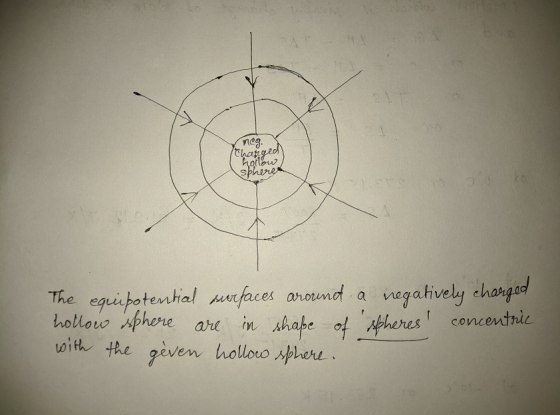
correct answer is "sphere"
Add Answer to:
If you draw a few electric field lines and equipotential surfaces outside a negatively charged hollow...
An isolated metal sphere carries a total charge of -9 C. Draw the electric fields lines...
An isolated metal sphere carries a total charge of -9 C. Draw the electric fields lines and equipotential surfaces to help you solve this problem. (a) What shape are the electric field lines? (b) What shape are the equipotential surfaces?
Part 1 Part 2. Consider the equipotential surfaces in the picture. The equipotential lines are separated...
 Part 1
Part 2.
Consider the equipotential surfaces in the picture. The equipotential lines are separated by 1 cm 300 V -+ +- -200 V -100 V What is the magnitude of the average electric field between points A and C? The maximum charge that can be stored on a conducting sphere is determined by the electric field required the ionize the material surrounding it. Consider a uniform conducting sphere in air. Air ionizes when the electric field at the...
Part 1
Part 2.
Consider the equipotential surfaces in the picture. The equipotential lines are separated by 1 cm 300 V -+ +- -200 V -100 V What is the magnitude of the average electric field between points A and C? The maximum charge that can be stored on a conducting sphere is determined by the electric field required the ionize the material surrounding it. Consider a uniform conducting sphere in air. Air ionizes when the electric field at the...
1) Do the electric field lines cross? Can two equipotential 2) Explain why the equipotential surfaces...
 1) Do the electric field lines cross? Can two equipotential 2) Explain why the equipotential surfaces should be always 3) A uniform electric field is parallel to the y-axis. What lines ever cross? Explain. perpendicular to the electric field lines? direction can a charge be displaced in this field without any external work being done on the charge?
Electric Fields and Potentials What do you think the electrie field lines look like in the...
 Electric Fields and Potentials What do you think the electrie field lines look like in the region of space between a single positive charge and a single negative ch 6. arge? What do you think the equipotential lines look like in the region of space between a single positive charge and a single negative charge? 7. What is the shape of the electric field if there are two positive charges near each other? 8. 850 0 q What is the...
The drawing shows a cross-sectional view of two spherical equipotential surfaces and two electric field lines...
 The drawing shows a cross-sectional view of two spherical
equipotential surfaces and two electric field lines that are
perpendicular to these surfaces. When an electron moves from point
A to point B (against the electric field), the
electric force does +3.2 x 10⁻¹⁹ J of work. What are the
electric potential differences (a) VB -
VA, (b) VC -
VB, and (c) VC -
VA?
Electric field lines Equipotential surfaces Cross-sectional view) O (a) o V, (b) 0 V, (c)...
The drawing shows a cross-sectional view of two spherical
equipotential surfaces and two electric field lines that are
perpendicular to these surfaces. When an electron moves from point
A to point B (against the electric field), the
electric force does +3.2 x 10⁻¹⁹ J of work. What are the
electric potential differences (a) VB -
VA, (b) VC -
VB, and (c) VC -
VA?
Electric field lines Equipotential surfaces Cross-sectional view) O (a) o V, (b) 0 V, (c)...
Draw the Electric Field and Equipotential surfaces for a negative point charge.
Draw the Electric Field and Equipotential surfaces for a negative point charge.
1· The sketch shows cross sections of equipotential surfaces between two charged conductors that are shown...
 1· The sketch shows cross sections of equipotential surfaces between two charged conductors that are shown in solid black 20V 40 V (a) What is the potential difference between points B and E? (b) At which of the labeled points will the electric field have the greatest magnitude? (c) what is the electric field at point A (magnitude and direction)? 2. The sketch on the back of this page shows cross sections of two conducting spherical sbells. (a -5.0 cm,...
2) Explain why the equipotential surfaces should be always perpendicular to the electric field lines? 3)...
 2) Explain why the equipotential surfaces should be always perpendicular to the electric field lines? 3) A uniform electric field is parallel to the y-axis. What direction can a charge be displaced in this field without any external work being done on the charge?
2. Draw the lines of force ( electric field ) and the equipotential lines for the...
 2. Draw the lines of force ( electric field ) and the equipotential lines for the charge. +3 +4 2 C/m
-Q2 +01 Draw and identify the lines of the electric field and the equipotential lines for...
 -Q2 +01 Draw and identify the lines of the electric field and the equipotential lines for the following arrangement of conductors: a punctiform charge and a parallel plate Q1> Q2
 Part 1
Part 2.
Consider the equipotential surfaces in the picture. The equipotential lines are separated by 1 cm 300 V -+ +- -200 V -100 V What is the magnitude of the average electric field between points A and C? The maximum charge that can be stored on a conducting sphere is determined by the electric field required the ionize the material surrounding it. Consider a uniform conducting sphere in air. Air ionizes when the electric field at the...
Part 1
Part 2.
Consider the equipotential surfaces in the picture. The equipotential lines are separated by 1 cm 300 V -+ +- -200 V -100 V What is the magnitude of the average electric field between points A and C? The maximum charge that can be stored on a conducting sphere is determined by the electric field required the ionize the material surrounding it. Consider a uniform conducting sphere in air. Air ionizes when the electric field at the...
 1) Do the electric field lines cross? Can two equipotential 2) Explain why the equipotential surfaces should be always 3) A uniform electric field is parallel to the y-axis. What lines ever cross? Explain. perpendicular to the electric field lines? direction can a charge be displaced in this field without any external work being done on the charge?
 Electric Fields and Potentials What do you think the electrie field lines look like in the region of space between a single positive charge and a single negative ch 6. arge? What do you think the equipotential lines look like in the region of space between a single positive charge and a single negative charge? 7. What is the shape of the electric field if there are two positive charges near each other? 8. 850 0 q What is the...
 The drawing shows a cross-sectional view of two spherical
equipotential surfaces and two electric field lines that are
perpendicular to these surfaces. When an electron moves from point
A to point B (against the electric field), the
electric force does +3.2 x 10⁻¹⁹ J of work. What are the
electric potential differences (a) VB -
VA, (b) VC -
VB, and (c) VC -
VA?
Electric field lines Equipotential surfaces Cross-sectional view) O (a) o V, (b) 0 V, (c)...
The drawing shows a cross-sectional view of two spherical
equipotential surfaces and two electric field lines that are
perpendicular to these surfaces. When an electron moves from point
A to point B (against the electric field), the
electric force does +3.2 x 10⁻¹⁹ J of work. What are the
electric potential differences (a) VB -
VA, (b) VC -
VB, and (c) VC -
VA?
Electric field lines Equipotential surfaces Cross-sectional view) O (a) o V, (b) 0 V, (c)...
 1· The sketch shows cross sections of equipotential surfaces between two charged conductors that are shown in solid black 20V 40 V (a) What is the potential difference between points B and E? (b) At which of the labeled points will the electric field have the greatest magnitude? (c) what is the electric field at point A (magnitude and direction)? 2. The sketch on the back of this page shows cross sections of two conducting spherical sbells. (a -5.0 cm,...
 2) Explain why the equipotential surfaces should be always perpendicular to the electric field lines? 3) A uniform electric field is parallel to the y-axis. What direction can a charge be displaced in this field without any external work being done on the charge?
 2. Draw the lines of force ( electric field ) and the equipotential lines for the charge. +3 +4 2 C/m
 -Q2 +01 Draw and identify the lines of the electric field and the equipotential lines for the following arrangement of conductors: a punctiform charge and a parallel plate Q1> Q2
Most questions answered within 3 hours.
-
Where is the error in this code sequence?
String s1 = "Hello";
String s2 = "ello";...
asked 10 months ago -
Financial data for Joel de Paris, Inc., for last year
follow:
Joel de Paris, Inc.
Balance...
asked 10 months ago -
Consider this reaction:
Al2(SO4)3 (aq)+ BaCl3
(aq) Al2Cl6 (aq)- +
3BaSO4(s) . What is the...
asked 10 months ago -
Suppose that Savneet is considering increasing her
recent random sample from 20 car rentals to 40...
asked 10 months ago -
Trucks arrive at an unloading terminal at an average rate of 120
per hour.
Trucks arrive...
asked 10 months ago -
Why are methanol and ethanol completely soluble in water while
octanol is not very little soluble....
asked 10 months ago -
A facilities manager at a university reads in a research report
that the mean amount of...
asked 10 months ago -
When the CuSO4 is rehydrated by adding water to the anhydrous
compound, is this an endothermic...
asked 10 months ago -
A ray of sunlight is passing from diamond into crown glass; the
angle of incidence is...
asked 10 months ago -
A block of mass 0.249 kg is placed on top of a light, vertical
spring of...
asked 10 months ago -
how do the kidneys compensate in the presences of acidosis
a) trigger hyperventilate
b) reserve acid...
asked 10 months ago -
Question 501 pts
The rental rate of capital to the firm increases. Which of the
following...
asked 10 months ago