NEED HELP ASAP!
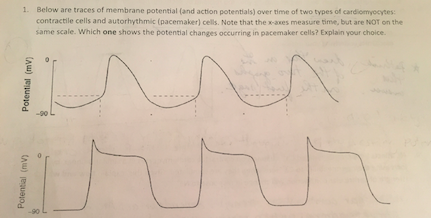
I need to use this graph to answer the questions below. Need ASAP
1. Some snake venoms (produced by cobras and their relatives) block the low voltage-gated, T-type Ca2+ channels on pacemaker cells. On the appropriate axes above, draw a new trace of membrane potential over time, showing how this venom will change membrane potential and action potential frequency. Explain the channel mechanics that underlie your answer.
2. Imagine that a grizzly bear begins chasing you. You respond by secreting norepinephrine (NE), a hormone that binds to pacemaker cells and increases the conductance/permeability of their low voltage-gated (leaky) Na+ channels and T-type Ca2+ channels. On the appropriate axes above, draw (with a dashed line) another trace showing how NE will alter membrane potential and AP frequency over time. Explain the channel mechanics underlying your answer.
3. NE affects L-type voltage-gated Ca2+ channels on contractile cardiomyocytes in a similar manner, by increasing their permeability to Ca2+ ions when they are stimulated. Given this, explain how and why the strength of ventricular contraction will change will change in response to NE.
Homework Answers
Question 1-
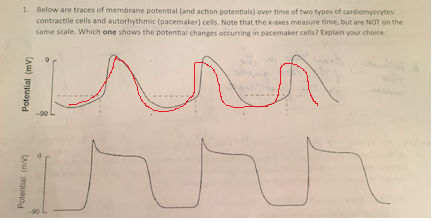
In the graph, the red line is showing venom effect in the pacemaker cells. This is showing a reduction in length of generating action potential gradually. After some time a prolonged length will observe for exciting the action potential, finally the end up with no action potential.
Add Answer to:
NEED HELP ASAP!
I need to use this graph to answer the questions below. Need
ASAP...
Please answer all parts. Thanks in advance 19) Which statement(s) is(are) NOT true regarding cardiac muscle?...
 Please answer all parts. Thanks in advance
19) Which statement(s) is(are) NOT true regarding cardiac muscle? Choose ALL that apply. (2.5 pts) a) Autorhythmic cells do not contribute significantly to the force of heart contraction because they do not contain many myofibrils. b) Cardiac muscle consists of autorhythmic fibers and contractile fibers. c) Cardiac muscle is similar to skeletal muscle since t contains thick and thin filaments, d) Cardiac muscle is similar to skeletal muscle in that the muscle fibers...
Please answer all parts. Thanks in advance
19) Which statement(s) is(are) NOT true regarding cardiac muscle? Choose ALL that apply. (2.5 pts) a) Autorhythmic cells do not contribute significantly to the force of heart contraction because they do not contain many myofibrils. b) Cardiac muscle consists of autorhythmic fibers and contractile fibers. c) Cardiac muscle is similar to skeletal muscle since t contains thick and thin filaments, d) Cardiac muscle is similar to skeletal muscle in that the muscle fibers...
8. Use this trace of actio (6) n potentials produced by a cardiomyocyte to answer the...
 8. Use this trace of actio (6) n potentials produced by a cardiomyocyte to answer the following questions. 90 L a. Is this a trace from a contractile cell or a pacemaker cell? Circle one. b. The type of channel responsible for causing the plateau phase of this cell is c. Imagine that a toxin caused L-type Ca channels to remain open half as long as usual. On the axes above, draw another trace of action potentials, showing the changes...
Please help me with several of these questions, thank you very much. 1. During the propagation...
Please help me with several of these questions, thank you very much. 1. During the propagation of an action potential along the axon of a neuron, what is happening at the leading edge (the front) of the region of depolarization as it moves down the axon? a. Ligand-gated Na+channels are opening. b. Voltage-gated Na+channels are opening. c. Ligand-gated K+channels are opening. d. Voltage-gated Na+channels have become inactive and refractory. e. Voltage-gated Na+channels are closing. 2. During transcellular transport of glucose...
could you please explain how you did each one 5. Draw a graph showing what would...
 could you please explain how you did each one
5. Draw a graph showing what would happen to resting membrane potential over time, if the sodium/potassium pump were not functioning. How would this affect a neuron's ability to produce action potentials? What does this imply about the quantity of ions that normally cross the membrane during the course of an action potential? (Group D). Topic 2: Action potential conduction and synaptic transmission 6. How would you alter sodium and/or potassium...
could you please explain how you did each one
5. Draw a graph showing what would happen to resting membrane potential over time, if the sodium/potassium pump were not functioning. How would this affect a neuron's ability to produce action potentials? What does this imply about the quantity of ions that normally cross the membrane during the course of an action potential? (Group D). Topic 2: Action potential conduction and synaptic transmission 6. How would you alter sodium and/or potassium...
***I need help on PART E of this problem. All of the information is given on...
 ***I need help on PART E of
this problem. All of the information is given on the worksheet
along with the hints on each part. Thank you!
The post-synaptic cell at a chemical synapse has the following distribution of ions between the cytosol and the extracellular environment. Consider that the relative permeabilities for Na, K and Cl' are 1, 100 and 50, and that there are no other significant permeabilities, lon Concentration (in mM) Extracellular Equilibrium potential mV) Intracellular 146...
***I need help on PART E of
this problem. All of the information is given on the worksheet
along with the hints on each part. Thank you!
The post-synaptic cell at a chemical synapse has the following distribution of ions between the cytosol and the extracellular environment. Consider that the relative permeabilities for Na, K and Cl' are 1, 100 and 50, and that there are no other significant permeabilities, lon Concentration (in mM) Extracellular Equilibrium potential mV) Intracellular 146...
Please answer all five multiple choice questions! i will give a thumbs up! 2015 BIOLOGY 24.The...
Please answer all five multiple choice questions! i will give a thumbs up! 2015 BIOLOGY 24.The concentration difference of ions across the membrane is maintained by a) Na+ ion channels. b) the Na+ K+ pump. c) K+ channels. d) Cl- channels 30. Developmental genes are a) usually highly variable. b) never expressed. c) usually highly conserved. d) found mainly in the mitochondrial genome. 2014 17. When the beta cells of the pancreas release insulin into the blood, a) the blood...
*** I need help with PART F of this problem. Hints are given in other parts...
 *** I need help with PART F of
this problem. Hints are given in other parts of the problem and all
information available is given on the worksheet. Please help, thank
you!
The post-synaptic cell at a chemical synapse has the following distribution of ions between the cytosol and the extracellular environment. Consider that the relative permeabilities for Na, K and Cl' are 1, 100 and 50, and that there are no other significant permeabilities, lon Concentration (in mM) Extracellular...
*** I need help with PART F of
this problem. Hints are given in other parts of the problem and all
information available is given on the worksheet. Please help, thank
you!
The post-synaptic cell at a chemical synapse has the following distribution of ions between the cytosol and the extracellular environment. Consider that the relative permeabilities for Na, K and Cl' are 1, 100 and 50, and that there are no other significant permeabilities, lon Concentration (in mM) Extracellular...
KEY TERMS March the numbered form with the definition that is it be definition the responding...
 KEY TERMS March the numbered form with the definition that is it be definition the responding sumber in front of the appropriate 40. excitatory postsynaptic potential 21. resting potential 22 on leakage channels 23. equilibrium potential -24 graded potential 25. gated ion channels 26. depolarization 27. hyperpolarization Sensory neurons 2. central nervous system 3. motor neurons 4. intercurons 5. peripheral nervous system 6. somatic motor neurons *7. autonomic motor neurons 8. sympathetic 9. parasympathetic 10. cell body all dendrites 12....
for each, what is the right answer? 30. When a neuron encodes the strength of a...
 for
each, what is the right answer?
30. When a neuron encodes the strength of a stimulus, it does so by changing A) the frequency of action potentials. B) the duration of each action potential C) the polarity of every alternate action potential. D) the size of each action potential E) the direction of the action potentials along the axon. 31. The relative refractory period of an axon begins with A) activation of chemically-gated K+ channels. B) increasing Na+ flux...
for
each, what is the right answer?
30. When a neuron encodes the strength of a stimulus, it does so by changing A) the frequency of action potentials. B) the duration of each action potential C) the polarity of every alternate action potential. D) the size of each action potential E) the direction of the action potentials along the axon. 31. The relative refractory period of an axon begins with A) activation of chemically-gated K+ channels. B) increasing Na+ flux...
In answering the following questions, pretendu don't know anything about what is happening before the break...
 In answering the following questions, pretendu don't know anything about what is happening before the break in the records. Keep in mind that voltage clamping is a tool that allows the experimenter to control the voltage across the membrane, to measure resultant current flows across the membrane, and from that in tomation to interpret the states of transmembrane ion channels. (So "action potential" and voltage clamp" cannot appear in a description of a single scenario; nor can "repolarization" and "voltage...
 Please answer all parts. Thanks in advance
19) Which statement(s) is(are) NOT true regarding cardiac muscle? Choose ALL that apply. (2.5 pts) a) Autorhythmic cells do not contribute significantly to the force of heart contraction because they do not contain many myofibrils. b) Cardiac muscle consists of autorhythmic fibers and contractile fibers. c) Cardiac muscle is similar to skeletal muscle since t contains thick and thin filaments, d) Cardiac muscle is similar to skeletal muscle in that the muscle fibers...
Please answer all parts. Thanks in advance
19) Which statement(s) is(are) NOT true regarding cardiac muscle? Choose ALL that apply. (2.5 pts) a) Autorhythmic cells do not contribute significantly to the force of heart contraction because they do not contain many myofibrils. b) Cardiac muscle consists of autorhythmic fibers and contractile fibers. c) Cardiac muscle is similar to skeletal muscle since t contains thick and thin filaments, d) Cardiac muscle is similar to skeletal muscle in that the muscle fibers...
 8. Use this trace of actio (6) n potentials produced by a cardiomyocyte to answer the following questions. 90 L a. Is this a trace from a contractile cell or a pacemaker cell? Circle one. b. The type of channel responsible for causing the plateau phase of this cell is c. Imagine that a toxin caused L-type Ca channels to remain open half as long as usual. On the axes above, draw another trace of action potentials, showing the changes...
 could you please explain how you did each one
5. Draw a graph showing what would happen to resting membrane potential over time, if the sodium/potassium pump were not functioning. How would this affect a neuron's ability to produce action potentials? What does this imply about the quantity of ions that normally cross the membrane during the course of an action potential? (Group D). Topic 2: Action potential conduction and synaptic transmission 6. How would you alter sodium and/or potassium...
could you please explain how you did each one
5. Draw a graph showing what would happen to resting membrane potential over time, if the sodium/potassium pump were not functioning. How would this affect a neuron's ability to produce action potentials? What does this imply about the quantity of ions that normally cross the membrane during the course of an action potential? (Group D). Topic 2: Action potential conduction and synaptic transmission 6. How would you alter sodium and/or potassium...
 ***I need help on PART E of
this problem. All of the information is given on the worksheet
along with the hints on each part. Thank you!
The post-synaptic cell at a chemical synapse has the following distribution of ions between the cytosol and the extracellular environment. Consider that the relative permeabilities for Na, K and Cl' are 1, 100 and 50, and that there are no other significant permeabilities, lon Concentration (in mM) Extracellular Equilibrium potential mV) Intracellular 146...
***I need help on PART E of
this problem. All of the information is given on the worksheet
along with the hints on each part. Thank you!
The post-synaptic cell at a chemical synapse has the following distribution of ions between the cytosol and the extracellular environment. Consider that the relative permeabilities for Na, K and Cl' are 1, 100 and 50, and that there are no other significant permeabilities, lon Concentration (in mM) Extracellular Equilibrium potential mV) Intracellular 146...
 *** I need help with PART F of
this problem. Hints are given in other parts of the problem and all
information available is given on the worksheet. Please help, thank
you!
The post-synaptic cell at a chemical synapse has the following distribution of ions between the cytosol and the extracellular environment. Consider that the relative permeabilities for Na, K and Cl' are 1, 100 and 50, and that there are no other significant permeabilities, lon Concentration (in mM) Extracellular...
*** I need help with PART F of
this problem. Hints are given in other parts of the problem and all
information available is given on the worksheet. Please help, thank
you!
The post-synaptic cell at a chemical synapse has the following distribution of ions between the cytosol and the extracellular environment. Consider that the relative permeabilities for Na, K and Cl' are 1, 100 and 50, and that there are no other significant permeabilities, lon Concentration (in mM) Extracellular...
 KEY TERMS March the numbered form with the definition that is it be definition the responding sumber in front of the appropriate 40. excitatory postsynaptic potential 21. resting potential 22 on leakage channels 23. equilibrium potential -24 graded potential 25. gated ion channels 26. depolarization 27. hyperpolarization Sensory neurons 2. central nervous system 3. motor neurons 4. intercurons 5. peripheral nervous system 6. somatic motor neurons *7. autonomic motor neurons 8. sympathetic 9. parasympathetic 10. cell body all dendrites 12....
 for
each, what is the right answer?
30. When a neuron encodes the strength of a stimulus, it does so by changing A) the frequency of action potentials. B) the duration of each action potential C) the polarity of every alternate action potential. D) the size of each action potential E) the direction of the action potentials along the axon. 31. The relative refractory period of an axon begins with A) activation of chemically-gated K+ channels. B) increasing Na+ flux...
for
each, what is the right answer?
30. When a neuron encodes the strength of a stimulus, it does so by changing A) the frequency of action potentials. B) the duration of each action potential C) the polarity of every alternate action potential. D) the size of each action potential E) the direction of the action potentials along the axon. 31. The relative refractory period of an axon begins with A) activation of chemically-gated K+ channels. B) increasing Na+ flux...
 In answering the following questions, pretendu don't know anything about what is happening before the break in the records. Keep in mind that voltage clamping is a tool that allows the experimenter to control the voltage across the membrane, to measure resultant current flows across the membrane, and from that in tomation to interpret the states of transmembrane ion channels. (So "action potential" and voltage clamp" cannot appear in a description of a single scenario; nor can "repolarization" and "voltage...
Most questions answered within 3 hours.
-
Where is the error in this code sequence?
String s1 = "Hello";
String s2 = "ello";...
asked 10 months ago -
Financial data for Joel de Paris, Inc., for last year
follow:
Joel de Paris, Inc.
Balance...
asked 10 months ago -
Consider this reaction:
Al2(SO4)3 (aq)+ BaCl3
(aq) Al2Cl6 (aq)- +
3BaSO4(s) . What is the...
asked 10 months ago -
Suppose that Savneet is considering increasing her
recent random sample from 20 car rentals to 40...
asked 10 months ago -
Trucks arrive at an unloading terminal at an average rate of 120
per hour.
Trucks arrive...
asked 10 months ago -
Why are methanol and ethanol completely soluble in water while
octanol is not very little soluble....
asked 10 months ago -
A facilities manager at a university reads in a research report
that the mean amount of...
asked 10 months ago -
When the CuSO4 is rehydrated by adding water to the anhydrous
compound, is this an endothermic...
asked 10 months ago -
A ray of sunlight is passing from diamond into crown glass; the
angle of incidence is...
asked 10 months ago -
A block of mass 0.249 kg is placed on top of a light, vertical
spring of...
asked 10 months ago -
how do the kidneys compensate in the presences of acidosis
a) trigger hyperventilate
b) reserve acid...
asked 10 months ago -
Question 501 pts
The rental rate of capital to the firm increases. Which of the
following...
asked 10 months ago