
Homework Answers
Question:-
Answer:- The correct answer is c) choice 2.
Choice 2 represents the correct arrow pushing of electrons for the reaction between chloroacetic acid and sodium hydroxide.
Add Answer to:
Choose the correct arrow pushing mechanism for the reaction between chloroacetic acid and sodium hydroxide. Choice...
a) complete the curved arrow electron-pushing mechanism and predict the major organic product of the reaction...
 a) complete the curved arrow electron-pushing mechanism and
predict the major organic product of the reaction when
1-chloropentane is treated with hydroxide in ethanol as shown
below.
a) Complete the curved arrow electron-pushing mechanism and predict the major organic product of the reaction when 1-chloropentane is treated with hydroxide in ethanol as shown below. Use curved arrows to show the Draw the structure of the organic product formed in the reaction. Draw lone pairs. conversion to the product. CH3CH2OH -CI...
a) complete the curved arrow electron-pushing mechanism and
predict the major organic product of the reaction when
1-chloropentane is treated with hydroxide in ethanol as shown
below.
a) Complete the curved arrow electron-pushing mechanism and predict the major organic product of the reaction when 1-chloropentane is treated with hydroxide in ethanol as shown below. Use curved arrows to show the Draw the structure of the organic product formed in the reaction. Draw lone pairs. conversion to the product. CH3CH2OH -CI...
1. Complete the mechanism of this Friedel-Crafts reaction below with the correct arrow pushing and missing...
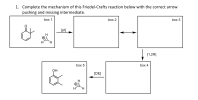 1. Complete the mechanism of this Friedel-Crafts reaction below with the correct arrow pushing and missing intermediate. box 1 box 2 box 3 [pt] [1,2R] box 5 box 4 [DE] H
2. Complete the mechanism of this Friedel-Crafts reaction below with the correct arrow pushing and missing...
 2. Complete the mechanism of this Friedel-Crafts reaction below with the correct arrow pushing and missing intermediate. box 1 box 2 [DN] + box 3 ci-Alci [1,2R] [AN] - AICI [AE] box 5 box 4 [DE]
a) Complete the curved arrow electron-pushing mechanism and predict the major organic product of the reaction...
 a) Complete the curved arrow electron-pushing mechanism and predict the major organic product of the reaction when 1-chloropentane is treated with hydroxide in ethanol as shown below. Use curved arrows to show the conversion to the product. Draw the structure of the organic product formed in the reaction. Draw lone pairs. CH3 :Ci: CH3CH2OH -Cl b) Select the option that describes the mechanism of the reaction above. O E1 O E2
What is the equation for the reaction between aqueous chloroacetic acid (ClCH2COOH) and aqueous NaOH? Correct...
What is the equation for the reaction between aqueous chloroacetic acid (ClCH2COOH) and aqueous NaOH? Correct me if wrong: ClCH2COOH (aq) + NaOH (aq) ↔ ClCH2COO- (aq) + H2O (l) ?? or would the sodium ion combine with the conjugate base?
Provide a mechanism for the following reaction. Show arrow pushing and any intermediates. 6. Provide a...
 Provide a mechanism for the following reaction. Show arrow pushing
and any intermediates.
6. Provide a mechanism for the following reaction. Show arrow pushing a n for the following reaction. Show arrow pushing and any intermediates. OCH3 CH3 methanol OH sulfuric acid (catalyst)
Provide a mechanism for the following reaction. Show arrow pushing
and any intermediates.
6. Provide a mechanism for the following reaction. Show arrow pushing a n for the following reaction. Show arrow pushing and any intermediates. OCH3 CH3 methanol OH sulfuric acid (catalyst)
a) Complete the curved arrow electron-pushing mechanism and predict the major organic product of the reaction...
 a) Complete the curved arrow electron-pushing mechanism and predict the major organic product of the reaction when 1-chloropentane is treated with hydroxide in ethanol as shown below. Use curved arrows to show the conversion to the product. Draw the structure of the organic product formed in the reaction. Draw lone pairs. CH3 :ci: СНЫСн,он HO b) Select the option that describes the mechanism of the reaction above. 10 SNI OSN2 Ο Ε1 lo ez
8. Complete the following reaction by arrow pushing mechanism and identify the sequence of arrow pushing...
 8. Complete the following reaction by arrow pushing mechanism and identify the sequence of arrow pushing patterns. (6 pts) OH + H CI: :0- + C: I C + H2O
write out the arrow pushing mechanism ( step by step) for the following reaction microscale reaction...
write out the arrow pushing mechanism ( step by step) for the following reaction microscale reaction of o-phenylenediamine and Formic acid using the following procedure: 1. weigh out 3 mol of o-phenylenediamine (nee the converged in g) add 5ml of conical vial 2. add 1ml 96%formic acid. attaché water jacketed. reflex for an hour 3. cool transfer to 25ml flask in an ice bath 4. wash with 2ml of water add 1.5 conce ammonium hydroxide to percipetate. filter cold mixture...
3. For one of the two reactions below, please show a complete arrow-pushing mechanism that accounts...
 3. For one of the two reactions below, please show a complete arrow-pushing mechanism that accounts for the transformation shown (you can show the mechanism towards either enantiomer). Clearly cross out the mechanism you do not want graded. (10 pts) ОН 1. BH3. THE 2. H202, sodium hydroxide 1. Brz, H,O 2. NaOEt, ethanol
 a) complete the curved arrow electron-pushing mechanism and
predict the major organic product of the reaction when
1-chloropentane is treated with hydroxide in ethanol as shown
below.
a) Complete the curved arrow electron-pushing mechanism and predict the major organic product of the reaction when 1-chloropentane is treated with hydroxide in ethanol as shown below. Use curved arrows to show the Draw the structure of the organic product formed in the reaction. Draw lone pairs. conversion to the product. CH3CH2OH -CI...
a) complete the curved arrow electron-pushing mechanism and
predict the major organic product of the reaction when
1-chloropentane is treated with hydroxide in ethanol as shown
below.
a) Complete the curved arrow electron-pushing mechanism and predict the major organic product of the reaction when 1-chloropentane is treated with hydroxide in ethanol as shown below. Use curved arrows to show the Draw the structure of the organic product formed in the reaction. Draw lone pairs. conversion to the product. CH3CH2OH -CI...
 1. Complete the mechanism of this Friedel-Crafts reaction below with the correct arrow pushing and missing intermediate. box 1 box 2 box 3 [pt] [1,2R] box 5 box 4 [DE] H
 2. Complete the mechanism of this Friedel-Crafts reaction below with the correct arrow pushing and missing intermediate. box 1 box 2 [DN] + box 3 ci-Alci [1,2R] [AN] - AICI [AE] box 5 box 4 [DE]
 a) Complete the curved arrow electron-pushing mechanism and predict the major organic product of the reaction when 1-chloropentane is treated with hydroxide in ethanol as shown below. Use curved arrows to show the conversion to the product. Draw the structure of the organic product formed in the reaction. Draw lone pairs. CH3 :Ci: CH3CH2OH -Cl b) Select the option that describes the mechanism of the reaction above. O E1 O E2
 Provide a mechanism for the following reaction. Show arrow pushing
and any intermediates.
6. Provide a mechanism for the following reaction. Show arrow pushing a n for the following reaction. Show arrow pushing and any intermediates. OCH3 CH3 methanol OH sulfuric acid (catalyst)
Provide a mechanism for the following reaction. Show arrow pushing
and any intermediates.
6. Provide a mechanism for the following reaction. Show arrow pushing a n for the following reaction. Show arrow pushing and any intermediates. OCH3 CH3 methanol OH sulfuric acid (catalyst)
 a) Complete the curved arrow electron-pushing mechanism and predict the major organic product of the reaction when 1-chloropentane is treated with hydroxide in ethanol as shown below. Use curved arrows to show the conversion to the product. Draw the structure of the organic product formed in the reaction. Draw lone pairs. CH3 :ci: СНЫСн,он HO b) Select the option that describes the mechanism of the reaction above. 10 SNI OSN2 Ο Ε1 lo ez
 8. Complete the following reaction by arrow pushing mechanism and identify the sequence of arrow pushing patterns. (6 pts) OH + H CI: :0- + C: I C + H2O
 3. For one of the two reactions below, please show a complete arrow-pushing mechanism that accounts for the transformation shown (you can show the mechanism towards either enantiomer). Clearly cross out the mechanism you do not want graded. (10 pts) ОН 1. BH3. THE 2. H202, sodium hydroxide 1. Brz, H,O 2. NaOEt, ethanol
Most questions answered within 3 hours.
-
Where is the error in this code sequence?
String s1 = "Hello";
String s2 = "ello";...
asked 10 months ago -
Financial data for Joel de Paris, Inc., for last year
follow:
Joel de Paris, Inc.
Balance...
asked 10 months ago -
Consider this reaction:
Al2(SO4)3 (aq)+ BaCl3
(aq) Al2Cl6 (aq)- +
3BaSO4(s) . What is the...
asked 10 months ago -
Suppose that Savneet is considering increasing her
recent random sample from 20 car rentals to 40...
asked 10 months ago -
Trucks arrive at an unloading terminal at an average rate of 120
per hour.
Trucks arrive...
asked 10 months ago -
Why are methanol and ethanol completely soluble in water while
octanol is not very little soluble....
asked 10 months ago -
A facilities manager at a university reads in a research report
that the mean amount of...
asked 10 months ago -
When the CuSO4 is rehydrated by adding water to the anhydrous
compound, is this an endothermic...
asked 10 months ago -
A ray of sunlight is passing from diamond into crown glass; the
angle of incidence is...
asked 10 months ago -
A block of mass 0.249 kg is placed on top of a light, vertical
spring of...
asked 10 months ago -
how do the kidneys compensate in the presences of acidosis
a) trigger hyperventilate
b) reserve acid...
asked 10 months ago -
Question 501 pts
The rental rate of capital to the firm increases. Which of the
following...
asked 10 months ago