Use the exact values you enter to make later calculations. A group of students performed the...
Use the exact values you enter to make later calculations.
A group of students performed the same "Conservation of Mechanical
Energy" experiment that you performed in lab. However, instead of
keeping the horizontal portion of the ramp at a constant height
h2 from the tabletop, they varied this height
and released the ball from the same height h1
each time. They then entered their results into the first two
columns of the table shown in part (a).
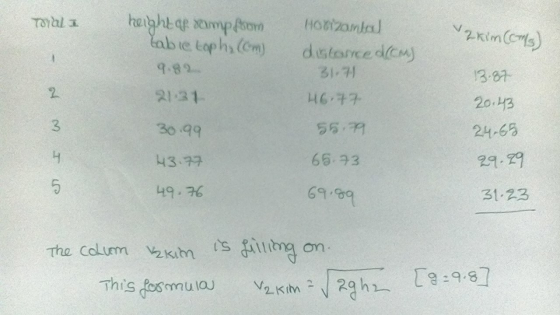
(a) Complete the table below.
| Trial # | Height of ramp from table top h2 (cm) | Horizontal distance d (cm) | v2kin (cm/s) |
|---|---|---|---|
| 1 | 9.82 | 31.71 | |
| 2 | 21.31 | 46.77 | |
| 3 | 30.99 | 55.79 | |
| 4 | 43.77 | 65.73 | |
| 5 | 49.76 | 69.89 |
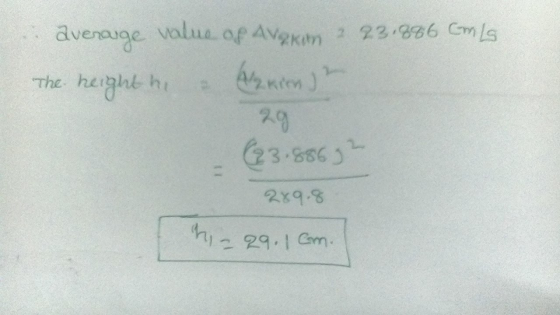
(b) Use the average value of v2kin to determine
the height h1 through which the ball falls.
Homework Answers
Add Answer to:
Use the exact values you enter to make later calculations.
A group of students performed the...
A group of students perform the same "Conservation of Mechanical Energy" experiment that you performed in...
A group of students perform the same "Conservation of Mechanical Energy" experiment that you performed in lab by allowing a solid sphere and then a solid cylinder to roll down the ramp. The solid sphere was released from a height of 12.9 cm. From what height hcylinder should the solid cylinder be released so that it has the same speed as the solid sphere when it reaches the bottom of the ramp?
Use the exact values you enter to make later calculations. A group of students performed the...
Use the exact values you enter to make later calculations. A group of students performed the same "Newton's Second Law" experiment that you did in class. For this lab, assume g = 9.81 m/s2. They obtained the following results: m1(kg) t1(s) v1(m/s) t2(s) v2(m/s) 0.050 1.2000 0.2500 1.7279 0.5177 0.100 1.2300 0.3240 1.6064 0.7186 0.150 1.1500 0.3820 1.4591 0.9120 0.200 1.1100 0.4240 1.3806 1.0839 where m1 is the value of the hanging mass (including the mass of the hanger), v1...
Use the exact values you enter to make later calculations. A group of students performed the...
Use the exact values you enter to make later calculations. A group of students performed the same "Newton's Second Law" experiment that you did in class. For this lab, assume g = 9.81 m/s2. They obtained the following results: m1(kg) t1(s) v1(m/s) t2(s) v2(m/s) 0.050 1.2000 0.2500 1.8108 0.3849 0.100 1.2300 0.3240 1.6360 0.6412 0.150 1.1500 0.3820 1.4768 0.8120 0.200 1.1100 0.4240 1.3935 1.0067 where m1 is the value of the hanging mass (including the mass of the hanger), v1...
Use the exact values you enter to make later calculations. Part A A group of students...
Use the exact values you enter to make later calculations. Part A A group of students performed the same "Ohm's Law" experiment that you did in class. They obtained the following results: Trial ΔV (volts) I (mA) 1 1.00 5.3 2 1.90 9.5 3 3.00 16.3 4 4.00 20.6 5 4.90 25.3 where ΔV is the voltage difference across the resistor and I is the current traveling through the resistor at the same time. (a) Analyze the data. (You will...
Please help. Show work. Use the exact values you enter to make later calculations A ray...
 Please help. Show work.
Use the exact values you enter to make later calculations A ray of light strikes a flat, 2.00-cm-thick block of glass (n-1.67) at an angle of θ-40.0° with respect to the normal (see figure below). 2.00 cm (a) Find the angle of refraction at the top surface and the angle of incidence at the bottom surface. 6 638 Your response differs from the correct answer by more than 10%. Double check your calculations. (b) Find the...
Please help. Show work.
Use the exact values you enter to make later calculations A ray of light strikes a flat, 2.00-cm-thick block of glass (n-1.67) at an angle of θ-40.0° with respect to the normal (see figure below). 2.00 cm (a) Find the angle of refraction at the top surface and the angle of incidence at the bottom surface. 6 638 Your response differs from the correct answer by more than 10%. Double check your calculations. (b) Find the...
"Extra 2.6.07 (Multistep) Use the exact values you enter to make later calculations. Push down, Relaxed...
 "Extra 2.6.07 (Multistep) Use the exact values you enter to make later calculations. Push down, Relaxed ; length release from rest A spring has a relaxed length of 29 cm (0.29 m) and its spring stiffness is 6 N/m. You glue a 76 gram block (0.076 kg) to the top of the spring, and push the block down, compressing the spring so its total length is 16 cm. You make sure the block is at rest, then at time t...
Extra 2.6.07 (Multistep) Use the exact values you enter to make later calculations. Push down, from...
 Extra 2.6.07 (Multistep) Use the exact values you enter to make later calculations. Push down, from Relaxed length rest A spring has a relaxed length of 27 cm (0.27 m) and its spring stiffness is 6 N/m. You glue a 83 gram block (0.083 kg) to the top of the spring, and push the block down, compressing the spring so its total length is 17 cm. You make sure the block is at rest, then at time t0 you quickly...
 Please help. Show work.
Use the exact values you enter to make later calculations A ray of light strikes a flat, 2.00-cm-thick block of glass (n-1.67) at an angle of θ-40.0° with respect to the normal (see figure below). 2.00 cm (a) Find the angle of refraction at the top surface and the angle of incidence at the bottom surface. 6 638 Your response differs from the correct answer by more than 10%. Double check your calculations. (b) Find the...
Please help. Show work.
Use the exact values you enter to make later calculations A ray of light strikes a flat, 2.00-cm-thick block of glass (n-1.67) at an angle of θ-40.0° with respect to the normal (see figure below). 2.00 cm (a) Find the angle of refraction at the top surface and the angle of incidence at the bottom surface. 6 638 Your response differs from the correct answer by more than 10%. Double check your calculations. (b) Find the...
 "Extra 2.6.07 (Multistep) Use the exact values you enter to make later calculations. Push down, Relaxed ; length release from rest A spring has a relaxed length of 29 cm (0.29 m) and its spring stiffness is 6 N/m. You glue a 76 gram block (0.076 kg) to the top of the spring, and push the block down, compressing the spring so its total length is 16 cm. You make sure the block is at rest, then at time t...
 Extra 2.6.07 (Multistep) Use the exact values you enter to make later calculations. Push down, from Relaxed length rest A spring has a relaxed length of 27 cm (0.27 m) and its spring stiffness is 6 N/m. You glue a 83 gram block (0.083 kg) to the top of the spring, and push the block down, compressing the spring so its total length is 17 cm. You make sure the block is at rest, then at time t0 you quickly...
Most questions answered within 3 hours.
-
Where is the error in this code sequence?
String s1 = "Hello";
String s2 = "ello";...
asked 10 months ago -
Financial data for Joel de Paris, Inc., for last year
follow:
Joel de Paris, Inc.
Balance...
asked 10 months ago -
Consider this reaction:
Al2(SO4)3 (aq)+ BaCl3
(aq) Al2Cl6 (aq)- +
3BaSO4(s) . What is the...
asked 10 months ago -
Suppose that Savneet is considering increasing her
recent random sample from 20 car rentals to 40...
asked 10 months ago -
Trucks arrive at an unloading terminal at an average rate of 120
per hour.
Trucks arrive...
asked 10 months ago -
Why are methanol and ethanol completely soluble in water while
octanol is not very little soluble....
asked 10 months ago -
A facilities manager at a university reads in a research report
that the mean amount of...
asked 10 months ago -
When the CuSO4 is rehydrated by adding water to the anhydrous
compound, is this an endothermic...
asked 10 months ago -
A ray of sunlight is passing from diamond into crown glass; the
angle of incidence is...
asked 10 months ago -
A block of mass 0.249 kg is placed on top of a light, vertical
spring of...
asked 10 months ago -
how do the kidneys compensate in the presences of acidosis
a) trigger hyperventilate
b) reserve acid...
asked 10 months ago -
Question 501 pts
The rental rate of capital to the firm increases. Which of the
following...
asked 10 months ago