A jet pilot takes his aircraft in a vertical loop, as shown.
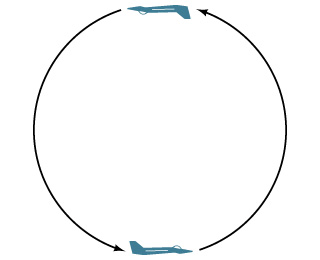
- If the jet is moving at a speed of 1140 km/h at the lowest point of the loop, determine the minimum radius of the circle so that the centripetal acceleration at the lowest point does not exceed 7.0 g's?
- Calculate the 69-kg pilot's effective weight (the force with which the seat pushes up on him) at the bottom of the circle, and at the top of the circle (assume the same speed)?
Homework Answers
The concepts used to solve this problem are centripetal force and Newton’s second law of motion.
Use the expressions for centripetal force and Newton’s second law of motion to determine the radius of the path.
Use the expression for normal force at the bottom of the circular path and at the top to find the effective weight of the pilot at the bottom and top of the circle respectively.
The centripetal force is the one acting on a body moving in a circular path and the direction of the force is towards the center of the curvature of the path.
The expression for centripetal force is,
Here,is the centripetal force, is the mass of the body, is its velocity and is the radius of the circular path.
According to Newton’s second law of motion, the rate of change of momentum of a body is directly proportional to the unbalanced external force acting on it and the expression for this external force is,
Here, is the external force acting on the body, is its momentum and is the time.
Another expression for Newton’s second law of motion is,
Here, is the mass and is the acceleration.
(1)
The expression for centripetal force acting on the jet is,
According to Newton’s second law, the net force acting on the jet is,
Equating the above two expressions, the equation for radius of the path is,
Substitute for and for .
(2.1)
The expression for effective weight of the pilot at the bottom of the circle is,
Substitute for ,for , for and for .
(2.2)
The expression for effective weight of the pilot at the top of the circle is,
Substitute for ,for , for and for .
The negative sign indicates the direction of force. So, weight at the top is,
Ans: Part 1
The minimum radius of the circle is .
Part 2.1The pilot's effective weight at the bottom of the circle is .
Part 2.2The pilot's effective weight at the top of the circle is .
Add Answer to:
A jet pilot takes his aircraft in a vertical loop, as
shown.
If the jet is...
A jet pilot performs a vertical loop the loop such that at the lowest point of...
A jet pilot performs a vertical loop the loop such that at the lowest point of the loop, his jet's speed is 924 km/h. a) Calculate the minumum radius of the circle so that the centripetal acceleration at the lowest point does not exceed 13.734 m/s2. b) Calculate the 87 kg pilot's apparent weight at the bottom of the circle. c) Calculate the pilot's apparent weight at the top assuming the jet has a constant speed and that the jet...
The pilot of an airplane executes a constant-speed loop-the-loop maneuver. His path is a vertical circle....
The pilot of an airplane executes a constant-speed loop-the-loop maneuver. His path is a vertical circle. The speed of the airplane is 250 mi/h, and the radius of the circle is 1350 ft. (a) What is the pilot's apparent weight at the lowest point if his true weight is 160 lb? (b) What is his apparent weight at the highest point? (c) What If? Describe how the pilot could experience weightlessness if both the radius and the speed can be...
The pilot of an airplane executes a constant-speed loop-the-loop maneuver. His path is a vertical circle....
The pilot of an airplane executes a constant-speed loop-the-loop maneuver. His path is a vertical circle. The speed of the airplane is 350 mi/h, and the radius of the circle is 1000 ft. (a) What is the pilot's apparent weight at the lowest point if his true weight is 160 lb? lb (b) What is his apparent weight at the highest point? lb (c) What If? Describe how the pilot could experience weightlessness if both the radius and the speed...
A 70 kg stunt pilot begins pulling out of a dive into a vertical circle. If...
A 70 kg stunt pilot begins pulling out of a dive into a vertical circle. If the plane’s speed at the lowest point of the circle is 80 m/s, what is the apparent weight of the pilot at the lowest point of the pullout? The pilot experiences a force of 5g from the centripetal acceleration at the bottom of the dive.
The plot ofan airplane executes constant-speed loop-the-loop maneuver in vertical circle as in the figure below....
 The plot ofan airplane executes constant-speed loop-the-loop maneuver in vertical circle as in the figure below. The speed of the airplane is 2.40 × 10² m/s, and the radius of the circle s 3.05 × 10³ m. (a) What is the pilot's apparent weight at the lowest point of the circle if his true weight is 740 N? (b) What is his apparent weight at the highest point of the circle? (c) Describe how the pilot could experience weightlessness if...
In a loop-the-loop ride a car goes around a vertical, circular loop at a constant speed....
In a loop-the-loop ride a car goes around a vertical, circular loop at a constant speed. The car has a mass m = 286 kg and moves with speed v = 13.82 m/s. The loop-the-loop has a radius of R = 8 m. 1) What is the magnitude of the normal force on the care when it is at the bottom of the circle? (But as the car is accelerating upward.) 2) What is the magnitude of the normal force...
A 54.0-kg child takes a ride on a Ferris wheel that rotates four times each minute and has a diameter of 20.0 m.
A 54.0-kg child takes a ride on a Ferris wheel that rotates four times each minute and has a diameter of 20.0 m. (a) What is the centripetal acceleration of the child? (b) What force (magnitude and direction) does the seat exert on the child at the lowest point of the ride? (c) What force does the seat exert on the child at the highest point of the ride? (d) What force does the seat exert on the child when the child is halfway...
In a loop-the-loop ride a car goes around a vertical, circular loop at a constant speed....
 In a loop-the-loop ride a car goes around a vertical, circular loop at a constant speed. The car has a mass m = 296 kg and moves with speed v = 14.77 m/s. The loop-the-loop has a radius of R = 8.8 m. 1) What is the magnitude of the normal force on the care when it is at the bottom of the circle? (But as the car is accelerating upward.) N Submit 2) What is the magnitude of the...
u Review Pilot travels around the vertical curve having a radius of curvature p = 800...
 u Review Pilot travels around the vertical curve having a radius of curvature p = 800 m. He has a mass of 74 kg. (Figure 1) Part A Determine the maximum constant speed at which the pilot can travel, so that he experiences a maximum acceleration an = 89 = 78.5 m/s² Express your answer to three significant figures and include the appropriate units. Figure (< 1 of 1 > CH HÅ* o 2 ? Value Units v= Submit Request...
A 50.0-kg child takes a ride on a Ferris wheel that rotates four times each minute...
A 50.0-kg child takes a ride on a Ferris wheel that rotates four times each minute and has a diameter of 26.0 m. (a) What is the centripetal acceleration of the child? magnitude m/s2 direction (b) What force (magnitude and direction) does the seat exert on the child at the lowest point of the ride? magnitude N direction (c) What force does the seat exert on the child at the highest point of the ride? magnitude N direction (d) What...
 The plot ofan airplane executes constant-speed loop-the-loop maneuver in vertical circle as in the figure below. The speed of the airplane is 2.40 × 10² m/s, and the radius of the circle s 3.05 × 10³ m. (a) What is the pilot's apparent weight at the lowest point of the circle if his true weight is 740 N? (b) What is his apparent weight at the highest point of the circle? (c) Describe how the pilot could experience weightlessness if...
 In a loop-the-loop ride a car goes around a vertical, circular loop at a constant speed. The car has a mass m = 296 kg and moves with speed v = 14.77 m/s. The loop-the-loop has a radius of R = 8.8 m. 1) What is the magnitude of the normal force on the care when it is at the bottom of the circle? (But as the car is accelerating upward.) N Submit 2) What is the magnitude of the...
 u Review Pilot travels around the vertical curve having a radius of curvature p = 800 m. He has a mass of 74 kg. (Figure 1) Part A Determine the maximum constant speed at which the pilot can travel, so that he experiences a maximum acceleration an = 89 = 78.5 m/s² Express your answer to three significant figures and include the appropriate units. Figure (< 1 of 1 > CH HÅ* o 2 ? Value Units v= Submit Request...
Most questions answered within 3 hours.
-
Where is the error in this code sequence?
String s1 = "Hello";
String s2 = "ello";...
asked 10 months ago -
Financial data for Joel de Paris, Inc., for last year
follow:
Joel de Paris, Inc.
Balance...
asked 10 months ago -
Consider this reaction:
Al2(SO4)3 (aq)+ BaCl3
(aq) Al2Cl6 (aq)- +
3BaSO4(s) . What is the...
asked 10 months ago -
Suppose that Savneet is considering increasing her
recent random sample from 20 car rentals to 40...
asked 10 months ago -
Trucks arrive at an unloading terminal at an average rate of 120
per hour.
Trucks arrive...
asked 10 months ago -
Why are methanol and ethanol completely soluble in water while
octanol is not very little soluble....
asked 10 months ago -
A facilities manager at a university reads in a research report
that the mean amount of...
asked 10 months ago -
When the CuSO4 is rehydrated by adding water to the anhydrous
compound, is this an endothermic...
asked 10 months ago -
A ray of sunlight is passing from diamond into crown glass; the
angle of incidence is...
asked 10 months ago -
A block of mass 0.249 kg is placed on top of a light, vertical
spring of...
asked 10 months ago -
how do the kidneys compensate in the presences of acidosis
a) trigger hyperventilate
b) reserve acid...
asked 10 months ago -
Question 501 pts
The rental rate of capital to the firm increases. Which of the
following...
asked 10 months ago