
Homework Answers
Given: Angle between tensile load axis and slip plane normal for both planes is 45 degree.
Slip will initiate if the Schmid factor (m) exceeds a certain value. Schmid factor (m) is given by dot product of applied tensile load axis direction with shear stress directions. Let us consider that the tensile load is applied in the direction [010].
Therefore, m = cos  . cos
. cos  , where cos
is the angle between tensile axis direction [010] and normal to
the plane
, where cos
is the angle between tensile axis direction [010] and normal to
the plane  and cos
is the angle between tensile axis direction [010] and slip
direction.
and cos
is the angle between tensile axis direction [010] and slip
direction.
(a)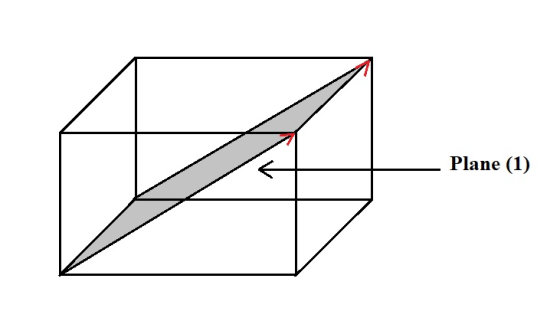
<Plane (1)>: Slip Plane is
and Slip Directions are  and
and ![\left [ \overline{1}00 \right ]](http://img.homeworklib.com/questions/de4117e0-b0e1-11eb-8ddc-3368d78c268a.png?x-oss-process=image/resize,w_560) .
.
In this case, we have two slip directions. Now Schmid factor, m
= cos
. cos
.
cos
= Angle between tensile axis [010] and
= 45 degree
= 
cos
= Angle between tensile axis [010] and
and
.
(i) cos
=  =
=
Thus, Schmid factor, m = cos
. cos
= 0.49
(ii) cos
=  = 0
= 0
Thus, Thus, Schmid factor, m = cos
. cos
. = 0
Hence, in this case, slip will initiate on slip plane
in the slip direction
.
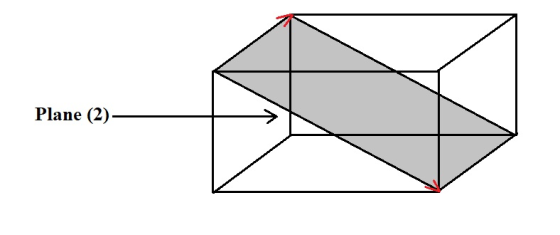
<Plane (2)>: Slip Plane is  and Slip Directions are
and
and Slip Directions are
and ![\left [ 01\overline{1} \right ]](http://img.homeworklib.com/questions/e4704030-b0e1-11eb-bc20-034cc29a1f8d.png?x-oss-process=image/resize,w_560)
In this case, we again have two slip directions. Now Schmid
factor, m = cos
. cos
.
cos
= Angle between tensile axis [010] and
= 45 degree
=
cos
= Angle between tensile axis [010] and
and
.
(i) cos
=  = 0
= 0
Thus, Schmid factor, m = cos
. cos
= 0
(ii) cos
=  =
=
Thus, Schmid factor, m = cos
. cos
. = 0.49.
Hence, in this case, slip will initiate on slip plane
in the slip direction .
(b) Given: Critical resolved shear stress is 7 MN/m2
The formula for Critical resolved shear stress (CRSS) is given by
CRSS =  , where
  = applied stress and m = Schmid factor.
Hence,  = 14.28 MN /m2
(c)
| Dislocation Type | Slip Direction | Dislocation character |
| A | (a) | edge |
| B | (b) | screw |
| C | (a) | edge |
| D | (b) | screw |
(d) If tensile axis were parallel to direction (b) in slip plane (1), then no slip will occur and therefore, no deformation will be observed in the single crystal.
Thank you. I have tried to answer the questions.
Add Answer to:
A single crystal in the form of a cube has two possible slip planes. (1) and...
1. Chapter 9. Problem#1 (40p): Consider a single crystal FCC iron oriented itch tensile stress applied along |122] direction. A) (10p) Draw a unit eell and show there: the plane (111), tensile di...
 1. Chapter 9. Problem#1 (40p): Consider a single crystal FCC iron oriented itch tensile stress applied along |122] direction. A) (10p) Draw a unit eell and show there: the plane (111), tensile direction, normal to the plane direction and slip directions (110,(101] and lo11) B) (10p) Compute the resolved shear stress in (MPa) on plane (111) along the three slip direction given in (B), when tensile stress of 80 MPa is applied. C) (10p) If the critical resolved shear stress...
Question 4: Write down all of the slip planes and slip directions for simple cubic (SC). How many...
 Question 4: Write down all of the slip planes and slip directions for simple cubic (SC). How many slip systems are there? Question 5: The Burgers vector b indicates the direction and magnitude of dislocation slip in crystal structures. Said simply, the Burgers vector closes the loop when traversing an equal number of steps around a dislocation. Using a figure like shown here, graphically draw the Burgers vector around a dislocation defect in a simple cubic crystal. Question 6: Permanent...
1. Consider a metal single crystal oriented such that the normal to the slip plane and...
 1. Consider a metal single crystal oriented such that the normal to the slip plane and the slip direction are at angles of 43.10 and 47.9° respectively, with the tensile axis. If the critical resolved shear stress is 20.7 MPa will an applied stress of 45 MPa cause the single crystal to yield? If not, what stress will be necessary? (10 points)
Problem 3: Consider a metal single crystal oriented such that the normal to the slip plane...
 Problem 3: Consider a metal single crystal oriented such that the normal to the slip plane and the slip direction are at angles of 43.1° and 47.9°, respectively, with the tensile axis. If the critical resolved shear stress is 20.7 MPa (3000 psi), will an applied stress of 45 MPa (6500 psi) cause the single crystal to yield? If not, what stress will be necessary?
A single crystal of Al has the FCC crystal structure and is oriented such that a...
A single crystal of Al has the FCC crystal structure and is oriented such that a tensile stress is applied parallel to the [010] direction. If the critical resolved shear stress for this material is 0.2 MPa, calculate the magnitude(s) of applied stress(es) necessary to cause slip to occur on the (111) plane in each of the [1̅10] [1̅01] [011̅] Also, which of these slip systems is “preferred” for slip?
3. (20 pts. total) The primary slip plane for a BCC structure is the (110 family...
 3. (20 pts. total) The primary slip plane for a BCC structure is the (110 family of planes although slip can also occur on alternate planes. a. (3 pts.) On the left cube below, draw and label two planes from the (110 family of planes. b. (3 pts.) On the right cube below, two alternate slip planes are shown. What are the Miller indices of these planes? (Note: The blue plane intersects the y-axis at 1/2 and the z-axis at...
1. A single crystal sample of a metal with a HCP structure is subjected to an axial tensile force. The sample is of circ...
1. A single crystal sample of a metal with a HCP structure is subjected to an axial tensile force. The sample is of circular cross-section, with a diameter of 4 mm, and is of 50 mm length. An elastic extension of 0.047 mm is measured when an axial tensile force of 1.25 kN is applied. When the tensile force is increased to 2.8 kN plastic deformation commences. (a) Given that Poisson’s ratio for the metal is 0.35, estimate the theoretical...
A zinc single crystal is being pulled in tension, with the normal to its basal plane...
 A zinc single crystal is being pulled in tension, with the normal to its basal plane (0001) at 60° to the tensile axis and with the slip direction [1120] at 40° to the tensile axis. What is the resolved shear stress, acting in the slip direction when a tensile stress of 0.5 MPa is applied? Answer:
(a) Consider a cylinder of FCC single crystal under tensile stress. The crystal is oriented such...
(a) Consider a cylinder of FCC single crystal under tensile stress. The crystal is oriented such that its [120] direction is parallel to the loading axis and the measurement is performed at room temperature. Determine the primary slip system for this configuration and give the magnitude of the resultant Schmid factor (cosφ∙cosλ). (b) If slip occurs at an applied tensile stress of 10 MPa, what is the material’s critical resolved shear stress? (c) Assume you now replace the sample with...
how do you fill out the table? Step 2: BCC Single Crystal For a BCC single...
 how
do you fill out the table?
Step 2: BCC Single Crystal For a BCC single crystal, thOnsile direction is along [123]. (1) Calculate the Schmid factors for all slip systems in Table 1 below. (2) Which slip system will be activated first, as the tensile load gradually increases? Tip: you may want to use a computer program such as Excel to facilitate the calculation. cos Schmid factor Slip first? Slip Systems cos (011)[111] (011)[111] 0.9449 (011)[111] (011)[111] (101)[111] (101)[111]...
how
do you fill out the table?
Step 2: BCC Single Crystal For a BCC single crystal, thOnsile direction is along [123]. (1) Calculate the Schmid factors for all slip systems in Table 1 below. (2) Which slip system will be activated first, as the tensile load gradually increases? Tip: you may want to use a computer program such as Excel to facilitate the calculation. cos Schmid factor Slip first? Slip Systems cos (011)[111] (011)[111] 0.9449 (011)[111] (011)[111] (101)[111] (101)[111]...
 1. Chapter 9. Problem#1 (40p): Consider a single crystal FCC iron oriented itch tensile stress applied along |122] direction. A) (10p) Draw a unit eell and show there: the plane (111), tensile direction, normal to the plane direction and slip directions (110,(101] and lo11) B) (10p) Compute the resolved shear stress in (MPa) on plane (111) along the three slip direction given in (B), when tensile stress of 80 MPa is applied. C) (10p) If the critical resolved shear stress...
 Question 4: Write down all of the slip planes and slip directions for simple cubic (SC). How many slip systems are there? Question 5: The Burgers vector b indicates the direction and magnitude of dislocation slip in crystal structures. Said simply, the Burgers vector closes the loop when traversing an equal number of steps around a dislocation. Using a figure like shown here, graphically draw the Burgers vector around a dislocation defect in a simple cubic crystal. Question 6: Permanent...
 1. Consider a metal single crystal oriented such that the normal to the slip plane and the slip direction are at angles of 43.10 and 47.9° respectively, with the tensile axis. If the critical resolved shear stress is 20.7 MPa will an applied stress of 45 MPa cause the single crystal to yield? If not, what stress will be necessary? (10 points)
 Problem 3: Consider a metal single crystal oriented such that the normal to the slip plane and the slip direction are at angles of 43.1° and 47.9°, respectively, with the tensile axis. If the critical resolved shear stress is 20.7 MPa (3000 psi), will an applied stress of 45 MPa (6500 psi) cause the single crystal to yield? If not, what stress will be necessary?
 3. (20 pts. total) The primary slip plane for a BCC structure is the (110 family of planes although slip can also occur on alternate planes. a. (3 pts.) On the left cube below, draw and label two planes from the (110 family of planes. b. (3 pts.) On the right cube below, two alternate slip planes are shown. What are the Miller indices of these planes? (Note: The blue plane intersects the y-axis at 1/2 and the z-axis at...
 A zinc single crystal is being pulled in tension, with the normal to its basal plane (0001) at 60° to the tensile axis and with the slip direction [1120] at 40° to the tensile axis. What is the resolved shear stress, acting in the slip direction when a tensile stress of 0.5 MPa is applied? Answer:
 how
do you fill out the table?
Step 2: BCC Single Crystal For a BCC single crystal, thOnsile direction is along [123]. (1) Calculate the Schmid factors for all slip systems in Table 1 below. (2) Which slip system will be activated first, as the tensile load gradually increases? Tip: you may want to use a computer program such as Excel to facilitate the calculation. cos Schmid factor Slip first? Slip Systems cos (011)[111] (011)[111] 0.9449 (011)[111] (011)[111] (101)[111] (101)[111]...
how
do you fill out the table?
Step 2: BCC Single Crystal For a BCC single crystal, thOnsile direction is along [123]. (1) Calculate the Schmid factors for all slip systems in Table 1 below. (2) Which slip system will be activated first, as the tensile load gradually increases? Tip: you may want to use a computer program such as Excel to facilitate the calculation. cos Schmid factor Slip first? Slip Systems cos (011)[111] (011)[111] 0.9449 (011)[111] (011)[111] (101)[111] (101)[111]...
Most questions answered within 3 hours.
-
Where is the error in this code sequence?
String s1 = "Hello";
String s2 = "ello";...
asked 10 months ago -
Financial data for Joel de Paris, Inc., for last year
follow:
Joel de Paris, Inc.
Balance...
asked 10 months ago -
Consider this reaction:
Al2(SO4)3 (aq)+ BaCl3
(aq) Al2Cl6 (aq)- +
3BaSO4(s) . What is the...
asked 10 months ago -
Suppose that Savneet is considering increasing her
recent random sample from 20 car rentals to 40...
asked 10 months ago -
Trucks arrive at an unloading terminal at an average rate of 120
per hour.
Trucks arrive...
asked 10 months ago -
Why are methanol and ethanol completely soluble in water while
octanol is not very little soluble....
asked 10 months ago -
A facilities manager at a university reads in a research report
that the mean amount of...
asked 10 months ago -
When the CuSO4 is rehydrated by adding water to the anhydrous
compound, is this an endothermic...
asked 10 months ago -
A ray of sunlight is passing from diamond into crown glass; the
angle of incidence is...
asked 10 months ago -
A block of mass 0.249 kg is placed on top of a light, vertical
spring of...
asked 10 months ago -
how do the kidneys compensate in the presences of acidosis
a) trigger hyperventilate
b) reserve acid...
asked 10 months ago -
Question 501 pts
The rental rate of capital to the firm increases. Which of the
following...
asked 10 months ago