#1) For the following pentapeptide (Where pH =1):
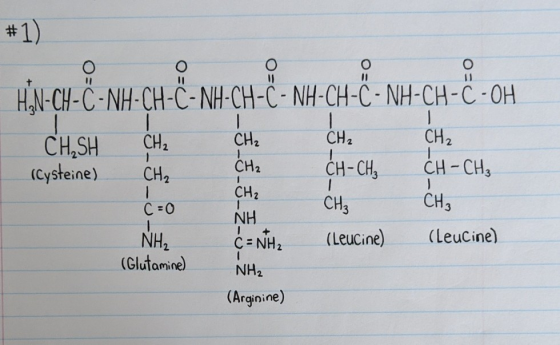
a) What would the net charge be for the following pH?
pH 0 =
pH 3 =
pH 5 =
pH 7 =
pH 10 =
pH 13 =
b) Calculate the pl of the pentapeptide. (Cysteine: pK1 = 1.96, pK2 = 10.128) ( Glutamine: pK1 = 2.17 , pK2 = 9.13) (Arginine: pK1 = 2.17. pK2 = 9.04) (Leucine: pK1 = 2.36 , pK2 = 9.60)
c) If you were to place your pentapeptide into a buffer with a pH of 4, in what direction would it move? Choose one of the three options below:
i) Towards the positive electrode.
ii) It will not move.
iii) Towards the negative electrode.
d) If you were to separate 2 other peptides from your pentapeptide, at what pH would you be able to do so and why?
Peptide 1 is made of the amino acids : Alanine - Arginine - Lysine - Serine
Peptide 2 is made of the amino acids : Alanine - Aspartate - Glutamic Acid - Serine
Homework Answers
To calculate the charge at different pH we need to find the pKa values of diiferent ionisable groups. In above eg
pKa for cysteine is 8.3, pKa for argenine is 12.48, pKa for NH3 is 8, pKa for COO- is 3.1
When the pH is lesser then pKa it means that there are more H+ ions present in the media which will associate with NH2 and will get a a positive charge becoming NH3+
Similarly when the pH is more then pKa it means that there are more OH- ions present in the media which will deprotonate COOH and there would be a negative charge COO-.
1) At pH=0 charges would be as follows +1+0+1+1=3
2) At pH=3 charges would be as follows +1+0+1-1=1
3) At pH=5 charges would be as follows +1+0+1-1=1
4)At pH=7 charges would be as follows +1+0+1-1=1
5)At pH=10charges would be as follows -1-1+1-1=-2
6)At pH=13 charges would be as follows -1-1-1-1=-4
c)At pH=4 the net charge on the peptide would be +1+0+1-1=+1 so the peptide would move toward negative electrode. The positive charge would attract toward the negative charge.
Add Answer to:
#1) For the following pentapeptide (Where pH =1):
a) What would the net charge be for...
c) You place your pentapeptide into a buffer with a pH=4. What direction will your pentapeptide...
 c) You place your pentapeptide into a buffer with a pH=4. What direction will your pentapeptide move: Circle the correct answer. (2 marks) It will not move. Towards the positive electrode Towards the negative electrode Briefly Explain why: (2 marks) d) You are trying to separate 2 other peptides from your pentapeptide. Peptide 1 is made up of the amino acids: ARKS Peptide 2 is made up of the amino acids: ADES At what pH would you be able to...
The one-letter sequence is: WATER a) Draw the peptide (R-groups trans), indicating charges, in pr...
 The one-letter sequence is: WATER
a) Draw the peptide (R-groups trans), indicating charges, in
predominant form found at pH = 0.
b) What is the isoelectric point?
c) What is the average charge on the population of peptide
macromolecules at pH = 2.2?
d) What is the average charge on the population of peptide
macromolecules at pH = 12.5?
TABLE 4.1 Amino Acid Alanine Arginine Asparagine Aspartic acid Cysteine....« Glutamic acid Glutamine Glycine Histidine Isoleucine Leucine Lysine … Methionine Phenylalanine...
The one-letter sequence is: WATER
a) Draw the peptide (R-groups trans), indicating charges, in
predominant form found at pH = 0.
b) What is the isoelectric point?
c) What is the average charge on the population of peptide
macromolecules at pH = 2.2?
d) What is the average charge on the population of peptide
macromolecules at pH = 12.5?
TABLE 4.1 Amino Acid Alanine Arginine Asparagine Aspartic acid Cysteine....« Glutamic acid Glutamine Glycine Histidine Isoleucine Leucine Lysine … Methionine Phenylalanine...
9) What type of attraction would you expect between the R groups of each of the following amino acids in a tertiary str...
 9) What type of attraction would you expect between the R groups of each of the following amino acids in a tertiary structure of a protein? (see Table 16.2) a) proline and phenylalanine b) Aspartate and arginine c) Tyrosine and water d) Cysteine and cysteine e) Serine and tyrosine f) Leucine and alanine 2
9) What type of attraction would you expect between the R groups of each of the following amino acids in a tertiary structure of a protein?...
9) What type of attraction would you expect between the R groups of each of the following amino acids in a tertiary structure of a protein? (see Table 16.2) a) proline and phenylalanine b) Aspartate and arginine c) Tyrosine and water d) Cysteine and cysteine e) Serine and tyrosine f) Leucine and alanine 2
9) What type of attraction would you expect between the R groups of each of the following amino acids in a tertiary structure of a protein?...
(1) The following diagram represents a titration curve of histidine as pH increases; pKa = 1.82 represents the terminal carboxylic acid group. pK, represents the terminal amino group: 6.0 r...
 (1) The following diagram represents a titration curve of histidine as pH increases; pKa = 1.82 represents the terminal carboxylic acid group. pK, represents the terminal amino group: 6.0 represents the R-group, and pK, E 9.17 7.59 pH 182 3.0 20 10 H (equivalents) At what point on the diagram is histidine predominantly present as the following species? COO A, at pH < 1.82 B. between pH 1.82 and pH 6.0 C) between pH 6.0 and pH 9.17 D. at...
TABLE 5.1 PK values for amino acids 2.36 Amino acid Alanine Arginine Asparagine Aspartic acid Cysteine...
 TABLE 5.1 PK values for amino acids 2.36 Amino acid Alanine Arginine Asparagine Aspartic acid Cysteine Glutamic acid Glutamine Glycine Histidine Isoleucine Leucine Lysine Methionine Phenylalanine Proline Serine Threonine Tryptophan Tyrosine Valine PK, PK₂ 2.34 9.69 2.17 9.04 2.02 8.80 1.88 9.60 1.96 10.28 2.19 9.67 2.17 9.13 2.34 9.60 1.82 9.17 9.60 9.60 2.18 8.95 2.28 1.83 9.13 1.99 10.60 2.219.15 2.09 9.10 2.83 9.39 2.20 9.11 2.32 9.62 2.36 9.21 5.56. Of the amino acids listed in Table...
The chemical structures of the 20 standard amino acids at pH 7, along with their 3...
 The chemical structures of the 20 standard amino acids at pH 7, along with their 3 and 1 letter codes, are givern in alphabetical order below. While the oxygen and nitrogen atoms of the peptide bonds may serve as a donor atom to complex a metal ion, very often the ligands for the metal come from the amino acid side chains. Takea few moments to examine the chemical structures of the different side chains. Circle the side chains that you...
PRELAB ASSIGNMENT 1 Draw the structure of the amino acid son CH-OH Label the alpha carbon...
 PRELAB ASSIGNMENT 1 Draw the structure of the amino acid son CH-OH Label the alpha carbon acid Sorine (en) which has R MO CHE OH CH2 OH 2. Draw the dipeptide that forms betw the peptide bond. s between serine and alanine The dipeptide sequence is Ser Ala Lace CH NCH H, A - — сH — с CH2 OH 3. How many amino aci arty amino acid residues are in a polypeptide containing 6 peptide bonos How many peptide...
1. What amino acids do the following abbreviations stand for? Draw the structure of each. a)...
 1. What amino acids do the following abbreviations stand for? Draw the structure of each. a) lle b) Thr c) Gin 2. Name and draw the structures of the amino acids that fit these descriptions: a) Contains an isopropyl group b) Contains a secondary alcohol group 3. Which of the following objects is chiral? a) A pair of scissors b) A comb c) A drinking glass 4. What does the term achiral mean? Give two examples involving organic structures.. 5....
Will vote for correct answer! Thank you! Given the following four amino acids at pH 7.4,...
 Will vote for correct answer!
Thank you!
Given the following four amino acids at pH 7.4, identify the amino acid and class. Be sure to scroll dow to see all four structures. basic asparagine H3N CH-C O neutral polar glutamine CH O hydrophobic O aspartate CH O glutamate O acidic CEO O neutral polar leucine H3N-CH -C-O isoleucine acidic CH CH O hydrophobic Valine basic O hydrophobic arginine CH -C O histidine basic CH (Continued below...) O acidic CH lysine...
Will vote for correct answer!
Thank you!
Given the following four amino acids at pH 7.4, identify the amino acid and class. Be sure to scroll dow to see all four structures. basic asparagine H3N CH-C O neutral polar glutamine CH O hydrophobic O aspartate CH O glutamate O acidic CEO O neutral polar leucine H3N-CH -C-O isoleucine acidic CH CH O hydrophobic Valine basic O hydrophobic arginine CH -C O histidine basic CH (Continued below...) O acidic CH lysine...
1) Which of the following is an amino acid? A) e R-CH-CH2-C00R -CH-CooR -CH-C-CO ile R-CH-C-NH3...
 1) Which of the following is an amino acid? A) e R-CH-CH2-C00R -CH-CooR -CH-C-CO ile R-CH-C-NH3 R-C=CH-Coo NH3 NH3 NH3 ONH 3 D) coo B) E) 2) Which of the following amino acids has a sulfur in the R group? A) serine B) cysteine C) asparagine D) tyrosine E) leucine 3) Which of the following terms describes the side chain of valine? A) acidic B) basic C) charged, polar D) uncharged, polar E) nonpolar 4) Which of the following is...
 c) You place your pentapeptide into a buffer with a pH=4. What direction will your pentapeptide move: Circle the correct answer. (2 marks) It will not move. Towards the positive electrode Towards the negative electrode Briefly Explain why: (2 marks) d) You are trying to separate 2 other peptides from your pentapeptide. Peptide 1 is made up of the amino acids: ARKS Peptide 2 is made up of the amino acids: ADES At what pH would you be able to...
 The one-letter sequence is: WATER
a) Draw the peptide (R-groups trans), indicating charges, in
predominant form found at pH = 0.
b) What is the isoelectric point?
c) What is the average charge on the population of peptide
macromolecules at pH = 2.2?
d) What is the average charge on the population of peptide
macromolecules at pH = 12.5?
TABLE 4.1 Amino Acid Alanine Arginine Asparagine Aspartic acid Cysteine....« Glutamic acid Glutamine Glycine Histidine Isoleucine Leucine Lysine … Methionine Phenylalanine...
The one-letter sequence is: WATER
a) Draw the peptide (R-groups trans), indicating charges, in
predominant form found at pH = 0.
b) What is the isoelectric point?
c) What is the average charge on the population of peptide
macromolecules at pH = 2.2?
d) What is the average charge on the population of peptide
macromolecules at pH = 12.5?
TABLE 4.1 Amino Acid Alanine Arginine Asparagine Aspartic acid Cysteine....« Glutamic acid Glutamine Glycine Histidine Isoleucine Leucine Lysine … Methionine Phenylalanine...
 9) What type of attraction would you expect between the R groups of each of the following amino acids in a tertiary structure of a protein? (see Table 16.2) a) proline and phenylalanine b) Aspartate and arginine c) Tyrosine and water d) Cysteine and cysteine e) Serine and tyrosine f) Leucine and alanine 2
9) What type of attraction would you expect between the R groups of each of the following amino acids in a tertiary structure of a protein?...
9) What type of attraction would you expect between the R groups of each of the following amino acids in a tertiary structure of a protein? (see Table 16.2) a) proline and phenylalanine b) Aspartate and arginine c) Tyrosine and water d) Cysteine and cysteine e) Serine and tyrosine f) Leucine and alanine 2
9) What type of attraction would you expect between the R groups of each of the following amino acids in a tertiary structure of a protein?...
 (1) The following diagram represents a titration curve of histidine as pH increases; pKa = 1.82 represents the terminal carboxylic acid group. pK, represents the terminal amino group: 6.0 represents the R-group, and pK, E 9.17 7.59 pH 182 3.0 20 10 H (equivalents) At what point on the diagram is histidine predominantly present as the following species? COO A, at pH < 1.82 B. between pH 1.82 and pH 6.0 C) between pH 6.0 and pH 9.17 D. at...
 TABLE 5.1 PK values for amino acids 2.36 Amino acid Alanine Arginine Asparagine Aspartic acid Cysteine Glutamic acid Glutamine Glycine Histidine Isoleucine Leucine Lysine Methionine Phenylalanine Proline Serine Threonine Tryptophan Tyrosine Valine PK, PK₂ 2.34 9.69 2.17 9.04 2.02 8.80 1.88 9.60 1.96 10.28 2.19 9.67 2.17 9.13 2.34 9.60 1.82 9.17 9.60 9.60 2.18 8.95 2.28 1.83 9.13 1.99 10.60 2.219.15 2.09 9.10 2.83 9.39 2.20 9.11 2.32 9.62 2.36 9.21 5.56. Of the amino acids listed in Table...
 The chemical structures of the 20 standard amino acids at pH 7, along with their 3 and 1 letter codes, are givern in alphabetical order below. While the oxygen and nitrogen atoms of the peptide bonds may serve as a donor atom to complex a metal ion, very often the ligands for the metal come from the amino acid side chains. Takea few moments to examine the chemical structures of the different side chains. Circle the side chains that you...
 PRELAB ASSIGNMENT 1 Draw the structure of the amino acid son CH-OH Label the alpha carbon acid Sorine (en) which has R MO CHE OH CH2 OH 2. Draw the dipeptide that forms betw the peptide bond. s between serine and alanine The dipeptide sequence is Ser Ala Lace CH NCH H, A - — сH — с CH2 OH 3. How many amino aci arty amino acid residues are in a polypeptide containing 6 peptide bonos How many peptide...
 1. What amino acids do the following abbreviations stand for? Draw the structure of each. a) lle b) Thr c) Gin 2. Name and draw the structures of the amino acids that fit these descriptions: a) Contains an isopropyl group b) Contains a secondary alcohol group 3. Which of the following objects is chiral? a) A pair of scissors b) A comb c) A drinking glass 4. What does the term achiral mean? Give two examples involving organic structures.. 5....
 Will vote for correct answer!
Thank you!
Given the following four amino acids at pH 7.4, identify the amino acid and class. Be sure to scroll dow to see all four structures. basic asparagine H3N CH-C O neutral polar glutamine CH O hydrophobic O aspartate CH O glutamate O acidic CEO O neutral polar leucine H3N-CH -C-O isoleucine acidic CH CH O hydrophobic Valine basic O hydrophobic arginine CH -C O histidine basic CH (Continued below...) O acidic CH lysine...
Will vote for correct answer!
Thank you!
Given the following four amino acids at pH 7.4, identify the amino acid and class. Be sure to scroll dow to see all four structures. basic asparagine H3N CH-C O neutral polar glutamine CH O hydrophobic O aspartate CH O glutamate O acidic CEO O neutral polar leucine H3N-CH -C-O isoleucine acidic CH CH O hydrophobic Valine basic O hydrophobic arginine CH -C O histidine basic CH (Continued below...) O acidic CH lysine...
 1) Which of the following is an amino acid? A) e R-CH-CH2-C00R -CH-CooR -CH-C-CO ile R-CH-C-NH3 R-C=CH-Coo NH3 NH3 NH3 ONH 3 D) coo B) E) 2) Which of the following amino acids has a sulfur in the R group? A) serine B) cysteine C) asparagine D) tyrosine E) leucine 3) Which of the following terms describes the side chain of valine? A) acidic B) basic C) charged, polar D) uncharged, polar E) nonpolar 4) Which of the following is...
Most questions answered within 3 hours.
-
Where is the error in this code sequence?
String s1 = "Hello";
String s2 = "ello";...
asked 10 months ago -
Financial data for Joel de Paris, Inc., for last year
follow:
Joel de Paris, Inc.
Balance...
asked 10 months ago -
Consider this reaction:
Al2(SO4)3 (aq)+ BaCl3
(aq) Al2Cl6 (aq)- +
3BaSO4(s) . What is the...
asked 10 months ago -
Suppose that Savneet is considering increasing her
recent random sample from 20 car rentals to 40...
asked 10 months ago -
Trucks arrive at an unloading terminal at an average rate of 120
per hour.
Trucks arrive...
asked 10 months ago -
Why are methanol and ethanol completely soluble in water while
octanol is not very little soluble....
asked 10 months ago -
A facilities manager at a university reads in a research report
that the mean amount of...
asked 10 months ago -
When the CuSO4 is rehydrated by adding water to the anhydrous
compound, is this an endothermic...
asked 10 months ago -
A ray of sunlight is passing from diamond into crown glass; the
angle of incidence is...
asked 10 months ago -
A block of mass 0.249 kg is placed on top of a light, vertical
spring of...
asked 10 months ago -
how do the kidneys compensate in the presences of acidosis
a) trigger hyperventilate
b) reserve acid...
asked 10 months ago -
Question 501 pts
The rental rate of capital to the firm increases. Which of the
following...
asked 10 months ago