
Homework Answers
Add Answer to:
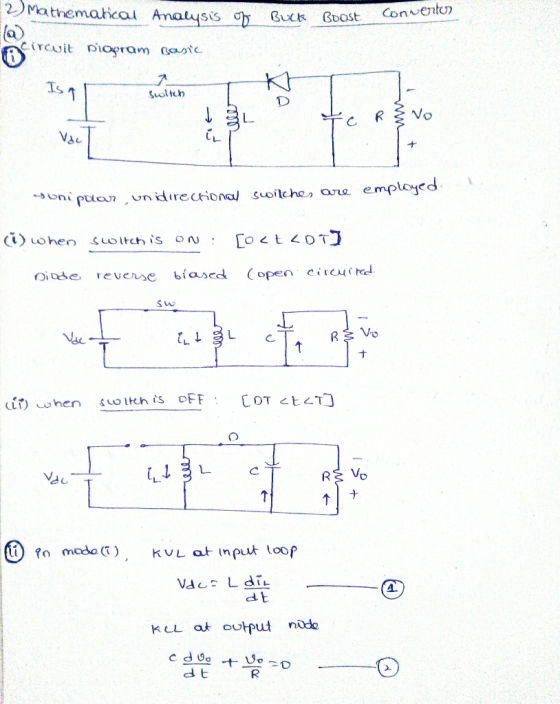
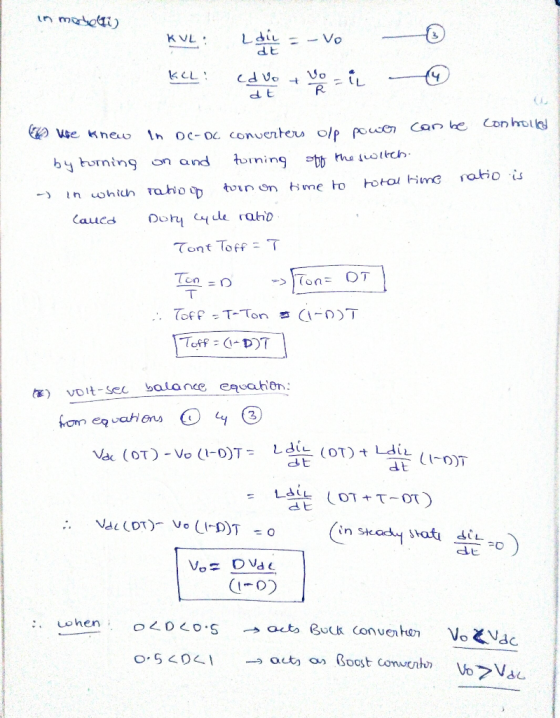
Draw a well-labelled circuit diagram of a Buck-Boost converter and draw the equivalent circuit diagrams for...
Problems: 1) A buck-boost converter is supplied from a source with an equivalent impedance. The converter...
 Problems: 1) A buck-boost converter is supplied from a source with an equivalent impedance. The converter can be considered ideal and represented as a transformer as seen in the circuit below. a) Calculate the duty cycle for maximum output voltage and the maximum output voltage. b) Plot the output voltage as a function of duty cycle to verify part a) 2.5 Ω , 20 V 75 Ω 1:M(D); Ideal Buck-Boost Converter Equivalent
dea..alla..olo M nt Code TE 372 Draw the circuit diagram of buck-boost converter, Draw the equivalent...
 dea..alla..olo M nt Code TE 372 Draw the circuit diagram of buck-boost converter, Draw the equivalent circut dingram or switch close dand switch open 4 Points Ans:
Following figure shows the circuit diagram for a buck-boost converter for switch off and switch o...
 Following figure shows the circuit diagram for a buck-boost converter for switch off and switch on. The plots for inductor voltage Vl and inductor current iL are also shown. The average value of i, is denoted by I1, average output current is -l and average input current is ld. Similarly, the average value of u1 is denoted by V1, output voltage is-, and input DC voltage is Va. Time period of the switch is Ts 1/f and its duty cycle...
Buck Converter Question Q3. A Buck converter is used to produce a regulated 10V, 5A DC...
 Buck Converter Question
Q3. A Buck converter is used to produce a regulated 10V, 5A DC power supply from a variable DC source with an nominal input voltage of Vin = 20V±5V. The Buck converter switches at 250kHz, and operates entirely in the continuous conduction mode. The output filter capacitance is C1.0uF 3.a. Draw the circuit topology for the Buck converter. Ensure that your circuit includes the input DC source, the output load resistance, the switching devices (i.e. MOSFET and...
Buck Converter Question
Q3. A Buck converter is used to produce a regulated 10V, 5A DC power supply from a variable DC source with an nominal input voltage of Vin = 20V±5V. The Buck converter switches at 250kHz, and operates entirely in the continuous conduction mode. The output filter capacitance is C1.0uF 3.a. Draw the circuit topology for the Buck converter. Ensure that your circuit includes the input DC source, the output load resistance, the switching devices (i.e. MOSFET and...
(a) Two three-phase, 400kV (rms), 50Hz, AC networks are connected together via a current-source HVDC link...
(a) Two three-phase, 400kV (rms), 50Hz, AC networks are connected together via a current-source HVDC link made up of a three-phase, 12-pulse full-wave thyristor rectifier and a three-phase, 12-pulse full-wave thyristor inverter. (i) Draw the circuit diagram for this system and explain, for the rectifier stage, how the firing delay angle may be used to control the average DC voltage. (ii) Explain the main advantages of HVDC transmission compared to AC transmission. (b) An H-Bridge converter is to be used...
The following circuit is a buck-boost converter where M1 functions as a switch. a. Describe how...
 The following circuit is a buck-boost converter where M1 functions as a switch. a. Describe how the converter works when M1 is switched on and off. b. Provide proof that V where D is the duty cycle controlled by the MOSFET, M1. 1-D Ignore the voltage drop across the transistor and the diode. D1 Vin C1 Gate drive circuit L1 RL c. Plot the transistor current, the inductor current, the capacitor current, and the load current as a function of...
3. A controlled single-phase fiull-wave controlled rectifier is connected in a de motor drive in Figure...
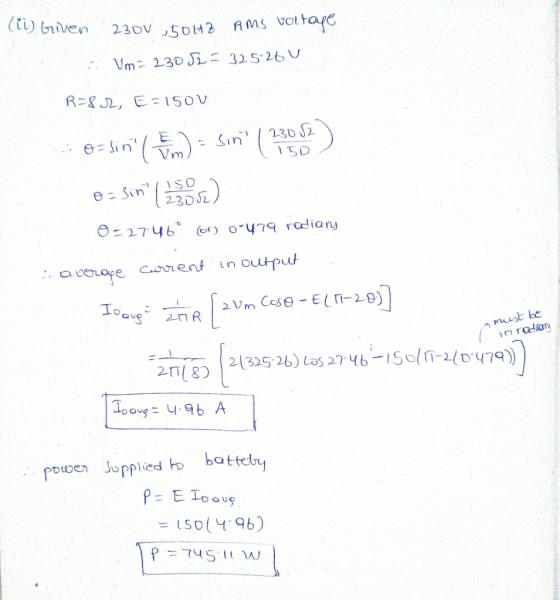
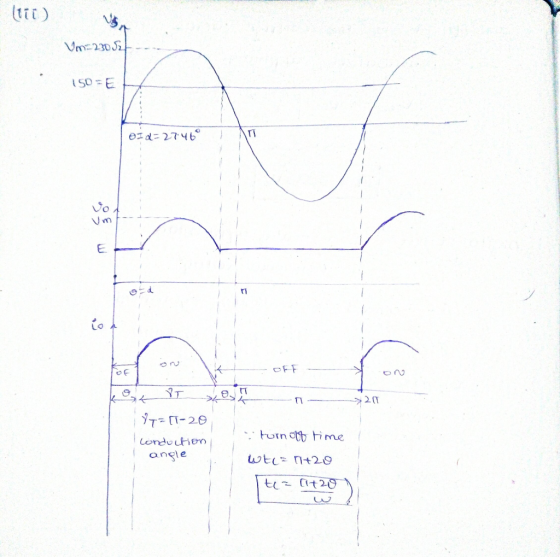
 3. A controlled single-phase fiull-wave controlled rectifier is connected in a de motor drive in Figure 4. The de motor armature inductance can be assumed large enough such that any motor curent ripple is negligible. (a) Assuming negligible supply reactance, show that the average rectifier output voltage V, in tems of the supply ms voltage E and the firing angle a, is given by 2/2E (6 marks) cos a _ (b) Given that the supply voltage is 230V, 50HZ and...
PROBLEM 1: For the ideal buck-boost converter shown below: ig(t) Vg(t) (a) Draw equivalent steady-state circuit....
 PROBLEM 1: For the ideal buck-boost converter shown below: ig(t) Vg(t) (a) Draw equivalent steady-state circuit. (b) From the equivalent steady-state circuit, find the expressions for the steady-state values of L, 4, and Po as a function of ,, D, and the circuit parameters. (c) Draw equivalent average circuit. di (d) From the equivalent average circuit, derive differential equations describing L and dt as a function of V^(i),d(t),V.),i(C), and circuit parameters dt
i. The speed of a separately excited dc motor is controlled by a one-phase full-wave converter. The field circuit is also controlled by a full-wave converter, see V supply) Vs pk-150V Ra-0.310 L Rf 1...
 i. The speed of a separately excited dc motor is controlled by a one-phase full-wave converter. The field circuit is also controlled by a full-wave converter, see V supply) Vs pk-150V Ra-0.310 L Rf 152O E-63V α. 1-35A Figure 3 The AC supply voltage to the armature and field converters is one-phase, 150Vpeak, 50Hz. The armature resistance Ra-0.31Ω, the field circuit resistance Rf-152Ω, and the motor voltage constant is Kv-1.3V/A. The armature current corresponding to the load demand la-35A The...
(i) (ii) Draw the structural diagram of a Gate Turn-Off (GTO) thyristor. [7%] Explain the operation...
 (i) (ii) Draw the structural diagram of a Gate Turn-Off (GTO) thyristor. [7%] Explain the operation of GTO and clearly state the voltage and frequency range for its application [15%] State four advantages of GTOs when compared to conventional thyristors. (iii) [8%] (b) Consider the single-phase full bridge rectifier shown below where R=6 12, L = 6 mH, E = 60 V and the ac source voltage is 230 V, 50 Hz. * * 13 பண்பு 14* (i) For continuous...
 Problems: 1) A buck-boost converter is supplied from a source with an equivalent impedance. The converter can be considered ideal and represented as a transformer as seen in the circuit below. a) Calculate the duty cycle for maximum output voltage and the maximum output voltage. b) Plot the output voltage as a function of duty cycle to verify part a) 2.5 Ω , 20 V 75 Ω 1:M(D); Ideal Buck-Boost Converter Equivalent
 dea..alla..olo M nt Code TE 372 Draw the circuit diagram of buck-boost converter, Draw the equivalent circut dingram or switch close dand switch open 4 Points Ans:
 Following figure shows the circuit diagram for a buck-boost converter for switch off and switch on. The plots for inductor voltage Vl and inductor current iL are also shown. The average value of i, is denoted by I1, average output current is -l and average input current is ld. Similarly, the average value of u1 is denoted by V1, output voltage is-, and input DC voltage is Va. Time period of the switch is Ts 1/f and its duty cycle...
 Buck Converter Question
Q3. A Buck converter is used to produce a regulated 10V, 5A DC power supply from a variable DC source with an nominal input voltage of Vin = 20V±5V. The Buck converter switches at 250kHz, and operates entirely in the continuous conduction mode. The output filter capacitance is C1.0uF 3.a. Draw the circuit topology for the Buck converter. Ensure that your circuit includes the input DC source, the output load resistance, the switching devices (i.e. MOSFET and...
Buck Converter Question
Q3. A Buck converter is used to produce a regulated 10V, 5A DC power supply from a variable DC source with an nominal input voltage of Vin = 20V±5V. The Buck converter switches at 250kHz, and operates entirely in the continuous conduction mode. The output filter capacitance is C1.0uF 3.a. Draw the circuit topology for the Buck converter. Ensure that your circuit includes the input DC source, the output load resistance, the switching devices (i.e. MOSFET and...
 The following circuit is a buck-boost converter where M1 functions as a switch. a. Describe how the converter works when M1 is switched on and off. b. Provide proof that V where D is the duty cycle controlled by the MOSFET, M1. 1-D Ignore the voltage drop across the transistor and the diode. D1 Vin C1 Gate drive circuit L1 RL c. Plot the transistor current, the inductor current, the capacitor current, and the load current as a function of...
 3. A controlled single-phase fiull-wave controlled rectifier is connected in a de motor drive in Figure 4. The de motor armature inductance can be assumed large enough such that any motor curent ripple is negligible. (a) Assuming negligible supply reactance, show that the average rectifier output voltage V, in tems of the supply ms voltage E and the firing angle a, is given by 2/2E (6 marks) cos a _ (b) Given that the supply voltage is 230V, 50HZ and...
 PROBLEM 1: For the ideal buck-boost converter shown below: ig(t) Vg(t) (a) Draw equivalent steady-state circuit. (b) From the equivalent steady-state circuit, find the expressions for the steady-state values of L, 4, and Po as a function of ,, D, and the circuit parameters. (c) Draw equivalent average circuit. di (d) From the equivalent average circuit, derive differential equations describing L and dt as a function of V^(i),d(t),V.),i(C), and circuit parameters dt
 i. The speed of a separately excited dc motor is controlled by a one-phase full-wave converter. The field circuit is also controlled by a full-wave converter, see V supply) Vs pk-150V Ra-0.310 L Rf 152O E-63V α. 1-35A Figure 3 The AC supply voltage to the armature and field converters is one-phase, 150Vpeak, 50Hz. The armature resistance Ra-0.31Ω, the field circuit resistance Rf-152Ω, and the motor voltage constant is Kv-1.3V/A. The armature current corresponding to the load demand la-35A The...
 (i) (ii) Draw the structural diagram of a Gate Turn-Off (GTO) thyristor. [7%] Explain the operation of GTO and clearly state the voltage and frequency range for its application [15%] State four advantages of GTOs when compared to conventional thyristors. (iii) [8%] (b) Consider the single-phase full bridge rectifier shown below where R=6 12, L = 6 mH, E = 60 V and the ac source voltage is 230 V, 50 Hz. * * 13 பண்பு 14* (i) For continuous...
Most questions answered within 3 hours.
-
Where is the error in this code sequence?
String s1 = "Hello";
String s2 = "ello";...
asked 11 months ago -
Financial data for Joel de Paris, Inc., for last year
follow:
Joel de Paris, Inc.
Balance...
asked 11 months ago -
Consider this reaction:
Al2(SO4)3 (aq)+ BaCl3
(aq) Al2Cl6 (aq)- +
3BaSO4(s) . What is the...
asked 11 months ago -
Suppose that Savneet is considering increasing her
recent random sample from 20 car rentals to 40...
asked 11 months ago -
Trucks arrive at an unloading terminal at an average rate of 120
per hour.
Trucks arrive...
asked 11 months ago -
Why are methanol and ethanol completely soluble in water while
octanol is not very little soluble....
asked 11 months ago -
A facilities manager at a university reads in a research report
that the mean amount of...
asked 11 months ago -
When the CuSO4 is rehydrated by adding water to the anhydrous
compound, is this an endothermic...
asked 11 months ago -
A ray of sunlight is passing from diamond into crown glass; the
angle of incidence is...
asked 11 months ago -
A block of mass 0.249 kg is placed on top of a light, vertical
spring of...
asked 11 months ago -
how do the kidneys compensate in the presences of acidosis
a) trigger hyperventilate
b) reserve acid...
asked 11 months ago -
Question 501 pts
The rental rate of capital to the firm increases. Which of the
following...
asked 11 months ago