A piston cylinder system contains 0.2 kg or water. The initial state of the system, p1...
A piston cylinder system contains 0.2 kg or water.
The initial state of the system, p1 = 10 bar, x1 = 0.3.
The final state of the system is at T2 = 360 C.
The process from 1 to 2 is constant pressure.
What is the heat transfer for this process?
Your solution should have units of [kJ/kg] ( make sure you have the proper sign, if positive just give the value, if negative add "-" before value)
Homework Answers

Add Answer to:
A piston cylinder system contains 0.2 kg or water.
The initial state of the system, p1...
2 1 point A piston cylinder system contains 0.2 kg or water. The initial state of...
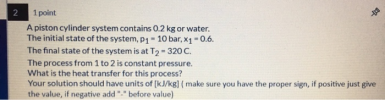 2 1 point A piston cylinder system contains 0.2 kg or water. The initial state of the system, P1 - 10 bar, X1 -0.6. The final state of the system is at T2 = 320 C. The process from 1 to 2 is constant pressure. What is the heat transfer for this process? Your solution should have units of [kJ/kg] ( make sure you have the proper sign, if positive just give the value, if negative add "." before value)
A piston-cylinder assembly contains 2.8 kg of water at 237.3°C and 3 bar. The water is...
 A piston-cylinder assembly contains 2.8 kg of water at 237.3°C and 3 bar. The water is compressed to a saturated vapor state where the pressure is 52 bar. During compression, there is a heat transfer of energy from the water to its surroundings having a magnitude of 213 kJ. Neglecting changes in kinetic energy and potential energy, determine the work, in kJ, for the process of the water.
A piston-cylinder assembly contains propane, initially at 27 °C, 1 bar, and a volume of 0.2...
 A piston-cylinder assembly contains propane, initially at 27 °C,
1 bar, and a volume of 0.2 m3 . The propane undergoes a process to
a final pressure of 6 bar, during which the pressure-volume
relationship is pV1.1 = constant. For the propane, evaluate the
work and heat transfer, each in kJ. Kinetic and potential energy
effects can be ignored.
Problem 10. A piston-cylinder assembly contains propane, initially at 27 'C, 1 bar, and a volume of 0.2 m2. The propane...
A piston-cylinder assembly contains propane, initially at 27 °C,
1 bar, and a volume of 0.2 m3 . The propane undergoes a process to
a final pressure of 6 bar, during which the pressure-volume
relationship is pV1.1 = constant. For the propane, evaluate the
work and heat transfer, each in kJ. Kinetic and potential energy
effects can be ignored.
Problem 10. A piston-cylinder assembly contains propane, initially at 27 'C, 1 bar, and a volume of 0.2 m2. The propane...
A frictionless vertical piston-cylinder device contains 3 kg of H2O initially at T1 = 180°C and...
 A frictionless vertical piston-cylinder device contains 3 kg of H2O initially at T1 = 180°C and p1 = 50 bar. The device is heated until the temperature is T2 = 400°C. Assume a quasiequillibrium process which occurs slowly with no acceleration as the piston moves. Kinetic and potential energy effects are negligible. Determine: a. work (kJ) during process (indicate magnitude and direction) b. heat transfer (kJ) during process (indicate magnitude and direction)
Five kg of water is contained in a piston–cylinder assembly, initially at 5 bar and 360°C....
Five kg of water is contained in a piston–cylinder assembly, initially at 5 bar and 360°C. The water is slowly heated at constant pressure to a final state. The heat transfer for the process is 2960 kJ and kinetic and potential energy effects are negligible. Determine the final volume, in m3, and the work for the process, in kJ.
Problem 1 A piston-cylinder system contains a paddle stirrer (a paddle with blades that can stir...
Problem 1 A piston-cylinder system contains a paddle stirrer (a paddle with blades that can stir the contents of the cylinder). The cylinder contains a gas that is initially at 150 kPa and occupies a volume of 0.196 m3 . The piston is unrestrained and has a cross-sectional area of 0.196 m2 . 20 kJ of electrical energy is supplied to the paddle stirrer, resulting in the piston moving up by 0.2 m. During this process, 5.27 kJ of heat...
Question 1 A piston-cylinder assembly contains 3.2 kg of water at 211.9oC and 3 bar. The...
Question 1 A piston-cylinder assembly contains 3.2 kg of water at 211.9oC and 3 bar. The water is compressed to a saturated vapor state where the pressure is 51.5 bar. During compression, there is a heat transfer of energy from the water to its surroundings having a magnitude of 230 kJ. Neglecting changes in kinetic energy and potential energy, determine the work, in kJ, for the process of the water. Question 2 Water, initially saturated vapor at 10.2 bar, fills...
A cylinder fitted with piston contains 0.2 kg of N2 at 100 kPa and 30°C. The...
A cylinder fitted with piston contains 0.2 kg of N2 at 100 kPa and 30°C. The piston is moved compressing N2 until the pressure becomes 1 MPa and temperature becomes 150°C. The work done during the process is 20 kJ. Determine the heat transferred from N2 to the surroundings. Take Cv = 0.75 kJ/kg K for N2.
3.83 A piston-cylinder assembly contains propane, initially at 27°C, 1 bar, and a volume of 0.2...
 3.83 A piston-cylinder assembly contains propane, initially at 27°C, 1 bar, and a volume of 0.2 mº. The propane undergoes a process to a final pressure of 4 bar, during which the pressure-volume relationship is pl.1 = constant. For the propane, evaluate the work and heat transfer, each in kJ. Kinetic and potential energy effects can be ignored.
1.Water vapor contained in a piston–cylinder assembly undergoes an isothermal expansion at 277°C from a pressure...
1.Water vapor contained in a piston–cylinder assembly undergoes an isothermal expansion at 277°C from a pressure of 5.1 bar to a pressure of 2.7 bar. Evaluate the work, in kJ/kg. 2.Nitrogen (N2) contained in a piston–cylinder arrangement, initially at 9.3 bar and 437 K, undergoes an expansion to a final temperature of 300 K, during which the pressure–volume relationship is pV1.1 = constant. Assuming the ideal gas model for the N2, determine the heat transfer in kJ/kg. 3.Argon contained in...
 2 1 point A piston cylinder system contains 0.2 kg or water. The initial state of the system, P1 - 10 bar, X1 -0.6. The final state of the system is at T2 = 320 C. The process from 1 to 2 is constant pressure. What is the heat transfer for this process? Your solution should have units of [kJ/kg] ( make sure you have the proper sign, if positive just give the value, if negative add "." before value)
 A piston-cylinder assembly contains 2.8 kg of water at 237.3°C and 3 bar. The water is compressed to a saturated vapor state where the pressure is 52 bar. During compression, there is a heat transfer of energy from the water to its surroundings having a magnitude of 213 kJ. Neglecting changes in kinetic energy and potential energy, determine the work, in kJ, for the process of the water.
 A piston-cylinder assembly contains propane, initially at 27 °C,
1 bar, and a volume of 0.2 m3 . The propane undergoes a process to
a final pressure of 6 bar, during which the pressure-volume
relationship is pV1.1 = constant. For the propane, evaluate the
work and heat transfer, each in kJ. Kinetic and potential energy
effects can be ignored.
Problem 10. A piston-cylinder assembly contains propane, initially at 27 'C, 1 bar, and a volume of 0.2 m2. The propane...
A piston-cylinder assembly contains propane, initially at 27 °C,
1 bar, and a volume of 0.2 m3 . The propane undergoes a process to
a final pressure of 6 bar, during which the pressure-volume
relationship is pV1.1 = constant. For the propane, evaluate the
work and heat transfer, each in kJ. Kinetic and potential energy
effects can be ignored.
Problem 10. A piston-cylinder assembly contains propane, initially at 27 'C, 1 bar, and a volume of 0.2 m2. The propane...
 A frictionless vertical piston-cylinder device contains 3 kg of H2O initially at T1 = 180°C and p1 = 50 bar. The device is heated until the temperature is T2 = 400°C. Assume a quasiequillibrium process which occurs slowly with no acceleration as the piston moves. Kinetic and potential energy effects are negligible. Determine: a. work (kJ) during process (indicate magnitude and direction) b. heat transfer (kJ) during process (indicate magnitude and direction)
 3.83 A piston-cylinder assembly contains propane, initially at 27°C, 1 bar, and a volume of 0.2 mº. The propane undergoes a process to a final pressure of 4 bar, during which the pressure-volume relationship is pl.1 = constant. For the propane, evaluate the work and heat transfer, each in kJ. Kinetic and potential energy effects can be ignored.
Most questions answered within 3 hours.
-
Where is the error in this code sequence?
String s1 = "Hello";
String s2 = "ello";...
asked 11 months ago -
Financial data for Joel de Paris, Inc., for last year
follow:
Joel de Paris, Inc.
Balance...
asked 11 months ago -
Consider this reaction:
Al2(SO4)3 (aq)+ BaCl3
(aq) Al2Cl6 (aq)- +
3BaSO4(s) . What is the...
asked 11 months ago -
Suppose that Savneet is considering increasing her
recent random sample from 20 car rentals to 40...
asked 11 months ago -
Trucks arrive at an unloading terminal at an average rate of 120
per hour.
Trucks arrive...
asked 11 months ago -
Why are methanol and ethanol completely soluble in water while
octanol is not very little soluble....
asked 11 months ago -
A facilities manager at a university reads in a research report
that the mean amount of...
asked 11 months ago -
When the CuSO4 is rehydrated by adding water to the anhydrous
compound, is this an endothermic...
asked 11 months ago -
A ray of sunlight is passing from diamond into crown glass; the
angle of incidence is...
asked 11 months ago -
A block of mass 0.249 kg is placed on top of a light, vertical
spring of...
asked 11 months ago -
how do the kidneys compensate in the presences of acidosis
a) trigger hyperventilate
b) reserve acid...
asked 11 months ago -
Question 501 pts
The rental rate of capital to the firm increases. Which of the
following...
asked 11 months ago