Which compound will not be added to the chemical kinetics experiment? a. propanone b. water c....
Which compound will not be added to the chemical kinetics experiment?
a. propanone
b. water
c. bromothymol blue
d. 2-methylpropan-2-ol
e. propan-2-ol
f. 2-chloro-2-methylpropane
g. sodium hydroxide
Homework Answers

Add Answer to:
Which compound will not be added to the chemical kinetics
experiment?
a. propanone
b. water
c....
Which compound is the most unstable (has the highest energy) in the chemical kinetics experiment? Select...
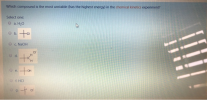 Which compound is the most unstable (has the highest energy) in the chemical kinetics experiment? Select one: a. H20 ob. + 0 C. NaOH od toho etor Of. HCL g. -
what is the best name for the following compound 6-For the reaction the alcohol product is...
 what is the best name for the following compound
6-For the reaction the alcohol product is classified as a CH --Primary Alcohol b-Secondary Alcohol e-Tertiary Alcohol d-Quaternary Alcohol 7-Zaitsev's Rule: When an alkene is produced in an elimination reaction, - The major product is the one with highly substituted double bond. - The major product is the one with less substituted double bond. - The minor product is the one with highly substituted double bond. d-Addition of hydrogen the richest...
what is the best name for the following compound
6-For the reaction the alcohol product is classified as a CH --Primary Alcohol b-Secondary Alcohol e-Tertiary Alcohol d-Quaternary Alcohol 7-Zaitsev's Rule: When an alkene is produced in an elimination reaction, - The major product is the one with highly substituted double bond. - The major product is the one with less substituted double bond. - The minor product is the one with highly substituted double bond. d-Addition of hydrogen the richest...
Select by circle or highlight the compound that is less soluble in water at each of...
 Select by circle or highlight the compound that is less soluble in water at each of the following pairs: a) Butan-2-one and propan-2-one b) Pentan-2-ol and hexan-2-ol c) Pentanol and pentanal d) Butanol and butanethiol e) Propanamine and propanol
1-chloro-1-phenylethane undergoes solvolysis in water by an SN1 mechanism to make 1-phenylethanol. The reaction is follo...
1-chloro-1-phenylethane undergoes solvolysis in water by an SN1 mechanism to make 1-phenylethanol. The reaction is followed with bromothymol blue indicator and an aliquot of sodium hydroxide base. Which of the following statements about the reaction are true? (more than one can apply) A.Carbocations are destabilized by protic solvents like alcohols B. The reaction can be followed because base is generated as a product. C. The first step is the slowest because a bond is being broken. D. Carbocations are stabilized...
2. Write the chemical formulas for the following: b. aluminum a. copper c. hydrochloric acid e....
 2. Write the chemical formulas for the following: b. aluminum a. copper c. hydrochloric acid e. copper(II) chloride g. sodium hydroxide i. hydrogen k. carbon dioxide m. calcium carbonate o. aluminum chloride q. calcium chloride d. magnesium sulfate – f. sodium bicarbonate h. methane j. sodium chloride 1. oxygen n. magnesium hydroxide p. sodium carbonate — r. water t. carbon monoxide S. sodium v. iron u. sulfur w.iron (II) sulfide y. sulfuric acid x. magnesium chloride z. sodium sulfate 3....
EXPERIMENT 4 Organic Families - Reactions and Identification of Functional Groups PART A. Reactions of Alkanes and Alkenes 1. Action of Bromine Water Observation Organic Compound cyclohexene c...
 EXPERIMENT 4 Organic Families - Reactions and Identification of Functional Groups PART A. Reactions of Alkanes and Alkenes 1. Action of Bromine Water Observation Organic Compound cyclohexene cyclohexane Equations: Write an equation for the above compounds which caused a decolourisation of bromine water. Name and draw all reactants and products. Distinguishing Test for Primary, Secondary and Tertiary Alcohols PART B. 1. Lucas Test for Alcohols Organic Compound tert-pentanol (2-methyl 2-butanol) 2-pentanol Observation 1-pentanol Equations: Write an equation for the above...
chemical kinetics Exam CSUS Department of Chemistry Experiment 11 Chem. 1A EXPERIMENT 11: Chemical Kinetics Name:...
 chemical kinetics
Exam CSUS Department of Chemistry Experiment 11 Chem. 1A EXPERIMENT 11: Chemical Kinetics Name: PRE-LABORATORY ASSIGNMENT Section: Score: 10 (Turn this in with you lab] 1. Three runs were used to study the reaction: A+B 3C+D The following data were obtained initial concentrations of Cand D = 0): Initial Concentration (M) Concentration after 150 $ Run (A) IAL [B] [C] 1 3.000 2.000 2.970M 2 6.000 2.000 5.940M 3 3.000 4.000 2.880M (a) Fill in the missing concentrations...
chemical kinetics
Exam CSUS Department of Chemistry Experiment 11 Chem. 1A EXPERIMENT 11: Chemical Kinetics Name: PRE-LABORATORY ASSIGNMENT Section: Score: 10 (Turn this in with you lab] 1. Three runs were used to study the reaction: A+B 3C+D The following data were obtained initial concentrations of Cand D = 0): Initial Concentration (M) Concentration after 150 $ Run (A) IAL [B] [C] 1 3.000 2.000 2.970M 2 6.000 2.000 5.940M 3 3.000 4.000 2.880M (a) Fill in the missing concentrations...
Part 1: Predict which compound in each pair is more acidic. Explain your answers. a) cyclopentanol...
Part 1: Predict which compound in each pair is more acidic. Explain your answers. a) cyclopentanol or 3-clorophenol b) cyclohexanol or cyclohexantiol c) cyclohexanol or cyclohexanecarboxylic acid d) 2,2-dichlorobutan-1-ol or butan-1-ol Part 2: Predict which compound in each group is more soluble in water. Explain your answers. a) butan-1-ol, pentan-1-ol or propan-2-ol b) chlorocyclohexane, cyclohexanol or cyclohexane-1,2-diol c) phenol, cyclohexanol or 4-methylcyclohexanol
Choose the compound which best fits each description below. A B C OH HO D E...
 Choose the compound which best fits each description below. A B C OH HO D E F -OH G H LOH .. The compound with the formula C5H100 which reacts with KMnO4 and H2, but not sodium metal Select one: O a. A o b. B O C. C O d. D O e. E O f. F g. 6 0 h. H The compound with the formula C5H100 which reacts with KMnO, and sodium metal, but not Hz Select...
balance the fallowing chemical equation solid calcium is added to liquid water which reacts forming g...
balance the fallowing chemical equation solid calcium is added to liquid water which reacts forming g aqueous calcium hydroxide and hydrogen gas
 Which compound is the most unstable (has the highest energy) in the chemical kinetics experiment? Select one: a. H20 ob. + 0 C. NaOH od toho etor Of. HCL g. -
 what is the best name for the following compound
6-For the reaction the alcohol product is classified as a CH --Primary Alcohol b-Secondary Alcohol e-Tertiary Alcohol d-Quaternary Alcohol 7-Zaitsev's Rule: When an alkene is produced in an elimination reaction, - The major product is the one with highly substituted double bond. - The major product is the one with less substituted double bond. - The minor product is the one with highly substituted double bond. d-Addition of hydrogen the richest...
what is the best name for the following compound
6-For the reaction the alcohol product is classified as a CH --Primary Alcohol b-Secondary Alcohol e-Tertiary Alcohol d-Quaternary Alcohol 7-Zaitsev's Rule: When an alkene is produced in an elimination reaction, - The major product is the one with highly substituted double bond. - The major product is the one with less substituted double bond. - The minor product is the one with highly substituted double bond. d-Addition of hydrogen the richest...
 Select by circle or highlight the compound that is less soluble in water at each of the following pairs: a) Butan-2-one and propan-2-one b) Pentan-2-ol and hexan-2-ol c) Pentanol and pentanal d) Butanol and butanethiol e) Propanamine and propanol
 2. Write the chemical formulas for the following: b. aluminum a. copper c. hydrochloric acid e. copper(II) chloride g. sodium hydroxide i. hydrogen k. carbon dioxide m. calcium carbonate o. aluminum chloride q. calcium chloride d. magnesium sulfate – f. sodium bicarbonate h. methane j. sodium chloride 1. oxygen n. magnesium hydroxide p. sodium carbonate — r. water t. carbon monoxide S. sodium v. iron u. sulfur w.iron (II) sulfide y. sulfuric acid x. magnesium chloride z. sodium sulfate 3....
 EXPERIMENT 4 Organic Families - Reactions and Identification of Functional Groups PART A. Reactions of Alkanes and Alkenes 1. Action of Bromine Water Observation Organic Compound cyclohexene cyclohexane Equations: Write an equation for the above compounds which caused a decolourisation of bromine water. Name and draw all reactants and products. Distinguishing Test for Primary, Secondary and Tertiary Alcohols PART B. 1. Lucas Test for Alcohols Organic Compound tert-pentanol (2-methyl 2-butanol) 2-pentanol Observation 1-pentanol Equations: Write an equation for the above...
 chemical kinetics
Exam CSUS Department of Chemistry Experiment 11 Chem. 1A EXPERIMENT 11: Chemical Kinetics Name: PRE-LABORATORY ASSIGNMENT Section: Score: 10 (Turn this in with you lab] 1. Three runs were used to study the reaction: A+B 3C+D The following data were obtained initial concentrations of Cand D = 0): Initial Concentration (M) Concentration after 150 $ Run (A) IAL [B] [C] 1 3.000 2.000 2.970M 2 6.000 2.000 5.940M 3 3.000 4.000 2.880M (a) Fill in the missing concentrations...
chemical kinetics
Exam CSUS Department of Chemistry Experiment 11 Chem. 1A EXPERIMENT 11: Chemical Kinetics Name: PRE-LABORATORY ASSIGNMENT Section: Score: 10 (Turn this in with you lab] 1. Three runs were used to study the reaction: A+B 3C+D The following data were obtained initial concentrations of Cand D = 0): Initial Concentration (M) Concentration after 150 $ Run (A) IAL [B] [C] 1 3.000 2.000 2.970M 2 6.000 2.000 5.940M 3 3.000 4.000 2.880M (a) Fill in the missing concentrations...
 Choose the compound which best fits each description below. A B C OH HO D E F -OH G H LOH .. The compound with the formula C5H100 which reacts with KMnO4 and H2, but not sodium metal Select one: O a. A o b. B O C. C O d. D O e. E O f. F g. 6 0 h. H The compound with the formula C5H100 which reacts with KMnO, and sodium metal, but not Hz Select...
Most questions answered within 3 hours.
-
Where is the error in this code sequence?
String s1 = "Hello";
String s2 = "ello";...
asked 10 months ago -
Financial data for Joel de Paris, Inc., for last year
follow:
Joel de Paris, Inc.
Balance...
asked 10 months ago -
Consider this reaction:
Al2(SO4)3 (aq)+ BaCl3
(aq) Al2Cl6 (aq)- +
3BaSO4(s) . What is the...
asked 10 months ago -
Suppose that Savneet is considering increasing her
recent random sample from 20 car rentals to 40...
asked 10 months ago -
Trucks arrive at an unloading terminal at an average rate of 120
per hour.
Trucks arrive...
asked 10 months ago -
Why are methanol and ethanol completely soluble in water while
octanol is not very little soluble....
asked 10 months ago -
A facilities manager at a university reads in a research report
that the mean amount of...
asked 10 months ago -
When the CuSO4 is rehydrated by adding water to the anhydrous
compound, is this an endothermic...
asked 10 months ago -
A ray of sunlight is passing from diamond into crown glass; the
angle of incidence is...
asked 10 months ago -
A block of mass 0.249 kg is placed on top of a light, vertical
spring of...
asked 10 months ago -
how do the kidneys compensate in the presences of acidosis
a) trigger hyperventilate
b) reserve acid...
asked 10 months ago -
Question 501 pts
The rental rate of capital to the firm increases. Which of the
following...
asked 10 months ago