
Homework Answers
Heap is a binary tree based data structure. It is an array object that can be viewed as a nearly complete binary tree. Each node of the tree corresponds to an element of the array that stores the value in the node. The heap tree is completely filled on all levels except possibly the lowest. Lowest level possibly filled from left up to a point.
Heap tree is categorized into max-heap and min-heap.
Max-heap:
Every nodes of a max-heap except root node has the "less than or
equal to" (  ) relation with its parent node.
Min-heap:
Every nodes of a min-heap except root node has the "greater than or
equal to" (  ) relation with its parent node.
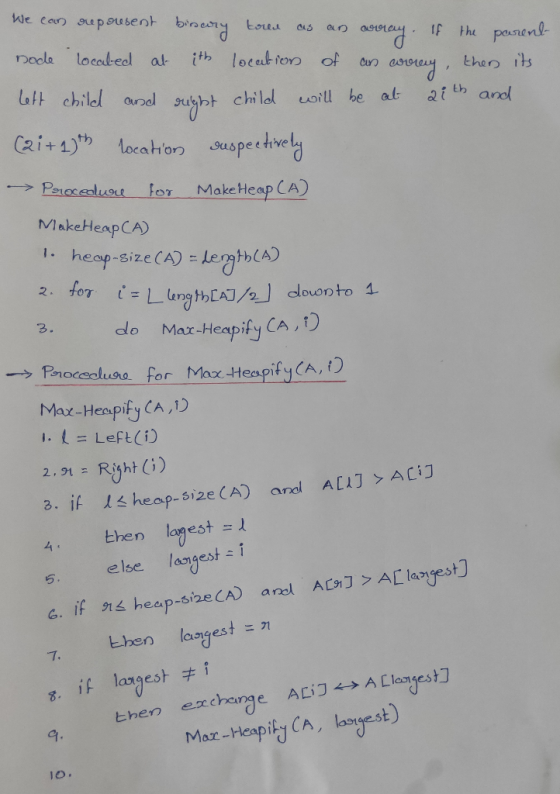
A heap can be stored as an array. Here we need to build a max-heap tree for a given array [1,2,3,4,5,6,7]. The algorithm MakeHeap(A) we are using here contains a subroutine that is Max-Heapify(A,i).
Assume that given array is A and its elements stored in the location 1 through 7.
| 1 | 2 | 3 | 4 | 5 | 6 | 7 |
We can use MakeHeap(A) and Max-Heapify(A,i) to build a max-heap of the array A.
Length of array = length(A) = 7
Procedure for MakeHeap(A) and Max-Heapify(A,i) are given in the attachment. Illustration of the changes in the array and tree also mentioned in attachment.

In fig (c) we can see the final array and max-heap of given elements.
Note: MakeHeap() algorithm using a bottom-up approach to heapify the given array. In thi sexample the length of the array is 7. MakeHeap() procedure calls the Max-Heapify() for each value of i. ie, 3,2 and 1.
I hope I have answered your query.
Add Answer to:
Define the term Heap. Illustrate the tree changes in the bottom-up Make Heap algorithm applied to...
ALGORITHM AND DATA STRUCTURES Question Question 1: Convert the following binary tree into a heap using...
ALGORITHM AND DATA STRUCTURES Question Question 1: Convert the following binary tree into a heap using the Heapify algorithm. Draw the diagrams of the tree step by step after every alteration. Question 2: Show the heap that results when the items are inserted into the heap one by one, starting with one that is empty. 7, 3, 8, 1, 4, 20, 11, 33, 45, 23, 6 Question 3. Draw the 2-3-4 tree that results when values are inserted in the...
need solution plz Question 1 (CLO-4, PLo-3) Figure 1 show an input tree T. 1. Analyze the tree and mention weather the tree is a heap or not by checking heap's property. If yes, justify your a...
 need solution plz
Question 1 (CLO-4, PLo-3) Figure 1 show an input tree T. 1. Analyze the tree and mention weather the tree is a heap or not by checking heap's property. If yes, justify your answer. If no, make it a heap by adjusting the node's location 2. Alter the value of T[l1] to 100 using alter-heap algorithm. Analyze the tree again and state whether i. The tree is still a heap or not? ii. If not, which one...
need solution plz
Question 1 (CLO-4, PLo-3) Figure 1 show an input tree T. 1. Analyze the tree and mention weather the tree is a heap or not by checking heap's property. If yes, justify your answer. If no, make it a heap by adjusting the node's location 2. Alter the value of T[l1] to 100 using alter-heap algorithm. Analyze the tree again and state whether i. The tree is still a heap or not? ii. If not, which one...
need full solution of this question plz help me Question 1 (CLO-4, PLo-3) Figure 1 show an input tree T. 1. Analyze the tree and mention weather the tree is a heap or not by checking heap's pr...
 need full solution of this question plz help me
Question 1 (CLO-4, PLo-3) Figure 1 show an input tree T. 1. Analyze the tree and mention weather the tree is a heap or not by checking heap's property. If yes, justify your answer. If no, make it a heap by adjusting the node's location 2. Alter the value of T[l1] to 100 using alter-heap algorithm. Analyze the tree again and state whether i. The tree is still a heap or...
need full solution of this question plz help me
Question 1 (CLO-4, PLo-3) Figure 1 show an input tree T. 1. Analyze the tree and mention weather the tree is a heap or not by checking heap's property. If yes, justify your answer. If no, make it a heap by adjusting the node's location 2. Alter the value of T[l1] to 100 using alter-heap algorithm. Analyze the tree again and state whether i. The tree is still a heap or...
please be accurate, make sure that the answer is correct and explain each step. Draw the...
please be accurate, make sure that the answer is correct and explain each step. Draw the min-heap that results from the bottom-up heap construction algorithm on the following list of values: 10, 17, 15, 25, 40, 19, 45, 16, 12, 8, 18, 14, 13, 9, 20, 11, 13 Starting from the bottom layer, use the values from left to right as specified above. Show immediate steps and the final tree representing the min-heap. Afterwards perform the operation removeMin 3 times...
1. In Lab 4, you developed a program to build a Max Heap, and then Heap...
 1. In Lab 4, you developed a program to build a Max Heap, and then Heap Sort. Update the program by adding two additional functions: (a) AddData(A, N, V) where V is the new value added. (b) Delete a data Delete by giving the index of the data position Make sure to display the array after calling each of the function. 2. Write a program to implement Binary Search Algorithm, which will return the index of the data searched (V)....
Discrete Mathematics Time Complexity Analysis Due: May 9th, 2019 Math 4 6026 Heap Sort Another algorithm for sorting uses a specialized tree structure called a "heap." Specifically, we wi...
 Discrete Mathematics
Time Complexity Analysis Due: May 9th, 2019 Math 4 6026 Heap Sort Another algorithm for sorting uses a specialized tree structure called a "heap." Specifically, we will use a binary heap, which is like a binary tree with hierarchy. Here is an example of a binary heap structure 1. 2. There is a top vertex, called the parent vertex (aka node). The top parent vertex connects to two vertices a level below. These vertices are the "left child"...
Discrete Mathematics
Time Complexity Analysis Due: May 9th, 2019 Math 4 6026 Heap Sort Another algorithm for sorting uses a specialized tree structure called a "heap." Specifically, we will use a binary heap, which is like a binary tree with hierarchy. Here is an example of a binary heap structure 1. 2. There is a top vertex, called the parent vertex (aka node). The top parent vertex connects to two vertices a level below. These vertices are the "left child"...
It is a bonus homework to implement either the AVL tree or the heap sort algorithm....
It is a bonus homework to implement either the AVL tree or the heap sort algorithm. You need to write your program in C++ following the object-oriented style, which means to have a header file to define a class, and to have an implementation C++ file to implement the class. You need to have a main.cpp file to test your implementation. Can you explain how you got your answer also .... please and thank you very much.
1. Consider the following unordered list: 20, 35, 25, 10, 40, 50, 45. Perform heap sort...
 1. Consider the following unordered list: 20, 35, 25, 10, 40, 50, 45. Perform heap sort to sort this list in nondecreasing (ascending) order. a. Perform the bottom-up method to arrange these values into a max heap. Show the heapify operations on each relevant subtree. (10 points) b. Show the tree representation and the array representation of these numbers after every dequeue operation. Remember that dequeue does not delete a number. Dequeue will instead remove that number from the heap...
Given the following weighted graph G. use Prim's algorithm to determine the Minimum-Cost Spanning Tree (MCST)...
 Given the following weighted graph G. use Prim's algorithm to determine the Minimum-Cost Spanning Tree (MCST) with node 1 as the "root". List the vertices in the order in which the algorithm adds them to the solution, along with the edge and its weight used to make the selection, one per line. Each line should look like this: add vertex y: edge = (x,y), weight = 5 When the algorithm ends there are, generally, edges left in the heap. List...
1. Let A = {a1, ..., an} and B = {b1, ..., bm} be two sets...
1. Let A = {a1, ..., an} and B = {b1, ..., bm} be two sets of numbers. Consider the problem of finding their intersection, i.e., the set C of all the numbers that are in both A and B. a. Design a presorting based algorithm for solving this problem and determine its efficiency class. 2. Estimate how many searches will be needed to justify time spent on presorting an array of 103 elements if sorting is done by mergesort...
 need solution plz
Question 1 (CLO-4, PLo-3) Figure 1 show an input tree T. 1. Analyze the tree and mention weather the tree is a heap or not by checking heap's property. If yes, justify your answer. If no, make it a heap by adjusting the node's location 2. Alter the value of T[l1] to 100 using alter-heap algorithm. Analyze the tree again and state whether i. The tree is still a heap or not? ii. If not, which one...
need solution plz
Question 1 (CLO-4, PLo-3) Figure 1 show an input tree T. 1. Analyze the tree and mention weather the tree is a heap or not by checking heap's property. If yes, justify your answer. If no, make it a heap by adjusting the node's location 2. Alter the value of T[l1] to 100 using alter-heap algorithm. Analyze the tree again and state whether i. The tree is still a heap or not? ii. If not, which one...
 need full solution of this question plz help me
Question 1 (CLO-4, PLo-3) Figure 1 show an input tree T. 1. Analyze the tree and mention weather the tree is a heap or not by checking heap's property. If yes, justify your answer. If no, make it a heap by adjusting the node's location 2. Alter the value of T[l1] to 100 using alter-heap algorithm. Analyze the tree again and state whether i. The tree is still a heap or...
need full solution of this question plz help me
Question 1 (CLO-4, PLo-3) Figure 1 show an input tree T. 1. Analyze the tree and mention weather the tree is a heap or not by checking heap's property. If yes, justify your answer. If no, make it a heap by adjusting the node's location 2. Alter the value of T[l1] to 100 using alter-heap algorithm. Analyze the tree again and state whether i. The tree is still a heap or...
 1. In Lab 4, you developed a program to build a Max Heap, and then Heap Sort. Update the program by adding two additional functions: (a) AddData(A, N, V) where V is the new value added. (b) Delete a data Delete by giving the index of the data position Make sure to display the array after calling each of the function. 2. Write a program to implement Binary Search Algorithm, which will return the index of the data searched (V)....
 Discrete Mathematics
Time Complexity Analysis Due: May 9th, 2019 Math 4 6026 Heap Sort Another algorithm for sorting uses a specialized tree structure called a "heap." Specifically, we will use a binary heap, which is like a binary tree with hierarchy. Here is an example of a binary heap structure 1. 2. There is a top vertex, called the parent vertex (aka node). The top parent vertex connects to two vertices a level below. These vertices are the "left child"...
Discrete Mathematics
Time Complexity Analysis Due: May 9th, 2019 Math 4 6026 Heap Sort Another algorithm for sorting uses a specialized tree structure called a "heap." Specifically, we will use a binary heap, which is like a binary tree with hierarchy. Here is an example of a binary heap structure 1. 2. There is a top vertex, called the parent vertex (aka node). The top parent vertex connects to two vertices a level below. These vertices are the "left child"...
 1. Consider the following unordered list: 20, 35, 25, 10, 40, 50, 45. Perform heap sort to sort this list in nondecreasing (ascending) order. a. Perform the bottom-up method to arrange these values into a max heap. Show the heapify operations on each relevant subtree. (10 points) b. Show the tree representation and the array representation of these numbers after every dequeue operation. Remember that dequeue does not delete a number. Dequeue will instead remove that number from the heap...
 Given the following weighted graph G. use Prim's algorithm to determine the Minimum-Cost Spanning Tree (MCST) with node 1 as the "root". List the vertices in the order in which the algorithm adds them to the solution, along with the edge and its weight used to make the selection, one per line. Each line should look like this: add vertex y: edge = (x,y), weight = 5 When the algorithm ends there are, generally, edges left in the heap. List...
Most questions answered within 3 hours.
-
Where is the error in this code sequence?
String s1 = "Hello";
String s2 = "ello";...
asked 10 months ago -
Financial data for Joel de Paris, Inc., for last year
follow:
Joel de Paris, Inc.
Balance...
asked 10 months ago -
Consider this reaction:
Al2(SO4)3 (aq)+ BaCl3
(aq) Al2Cl6 (aq)- +
3BaSO4(s) . What is the...
asked 10 months ago -
Suppose that Savneet is considering increasing her
recent random sample from 20 car rentals to 40...
asked 10 months ago -
Trucks arrive at an unloading terminal at an average rate of 120
per hour.
Trucks arrive...
asked 10 months ago -
Why are methanol and ethanol completely soluble in water while
octanol is not very little soluble....
asked 10 months ago -
A facilities manager at a university reads in a research report
that the mean amount of...
asked 10 months ago -
When the CuSO4 is rehydrated by adding water to the anhydrous
compound, is this an endothermic...
asked 10 months ago -
A ray of sunlight is passing from diamond into crown glass; the
angle of incidence is...
asked 10 months ago -
A block of mass 0.249 kg is placed on top of a light, vertical
spring of...
asked 10 months ago -
how do the kidneys compensate in the presences of acidosis
a) trigger hyperventilate
b) reserve acid...
asked 10 months ago -
Question 501 pts
The rental rate of capital to the firm increases. Which of the
following...
asked 10 months ago