It is a bonus homework to implement either the AVL tree or the heap sort algorithm....
It is a bonus homework to implement either the AVL tree or the heap sort algorithm. You need to write your program in C++ following the object-oriented style, which means to have a header file to define a class, and to have an implementation C++ file to implement the class. You need to have a main.cpp file to test your implementation.
Can you explain how you got your answer also .... please and thank you very much.
Homework Answers
/* Please read all the comments */
/* See the output */
// C++ program to simulate the Heap sort
#include <iostream>
using namespace std;
// Largest element is kept at root place in binary
tree.
// Due to behavior of Complete Binary Tree, buildHeap() method can
be done in array manner
// Assume Max element, parent data is at Index I
// Left child would be 2I + 1 && Right Child would be 2I +
2
// Array index is from 0
void buildHeap(int arr[], int totalElement, int i)
{
int biggest = i; // Initialize biggest as root
int leftChild = 2*i + 1;
int rightChild = 2*i + 2;
// check if left child is biggest than
root
if (leftChild < totalElement &&
arr[leftChild] > arr[biggest])
biggest = leftChild;
// If right child is larger than
biggest
if (rightChild < totalElement &&
arr[rightChild] > arr[biggest])
biggest = rightChild;
// If biggest is not root
if (biggest != i)
{
swap(arr[i],
arr[biggest]);
// Recurse again
buildHeap the for rest affected section
buildHeap(arr, totalElement,
biggest);
}
}
// function to do heap sort
void heapSort(int arr[], int total)
{
// start to Build heap
for (int i = total / 2 - 1; i >= 0; i--)
buildHeap(arr, total,
i);
// One by one get element from heap
for (int i=total-1; i>=0; i--)
{
// Move current root element for
the end position
swap(arr[0], arr[i]);
// Call buildHeap() with
reduced heap
buildHeap(arr, i, 0);
}
}
// Function to show the array element
void showArray(int arr[], int n)
{
for (int i=0; i<n; ++i)
cout << arr[i] << "
";
cout << "\n";
}
// Main Program
int main()
{
int intArray[] = {12, 11, 13, 5, 6, 7};
int n = sizeof(intArray)/sizeof(intArray[0]);
cout<< "Array Before sort "<<endl;
showArray(intArray,n);
cout<<" After HeapSort" ;
heapSort(intArray, n);
cout << "Sorted array is \n";
showArray(intArray, n);
}
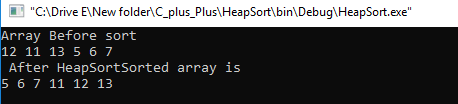
/* This is screen shot of output*/
Add Answer to:
It is
a bonus
homework to
implement either the AVL
tree or the
heap
sort algorithm....
You are going to implement Treesort algorithm in C++ to sort string data. Here are the...
 You are going to implement Treesort algorithm in C++ to sort string data. Here are the steps to complete the homework 1) Use the following class definition for binary search tree nodes. Its constructor is incomplete you should first complete the constructor. class TreeNode t public: string data; / this is the string stored in the node TreeNode left: TreeNode right; TreeNode (string element, TreeNode 1t, TreeNode rt //your code here 2) Write a function that will insert a string...
Goal: design and implement a dictionary. implement your dictionary using AVL tree . Problem: Each entry...
Goal: design and implement a dictionary. implement your dictionary using AVL tree . Problem: Each entry in the dictionary is a pair: (word, meaning). Word is a one-word string, meaning can be a string of one or more words (it’s your choice of implementation, you can restrict the meaning to one-word strings). The dictionary is case-insensitive. It means “Book”, “BOOK”, “book” are all the same . Your dictionary application must provide its operations through the following menu (make sure that...
Implement a method to build an AVL tree out of a sorted (ascending order) array of...
Implement a method to build an AVL tree out of a sorted (ascending order) array of unique integers, with the fastest possible big O running time. You may implement private helper methods as necessary. If your code builds a tree that is other than an AVL tree, you will not get any credit. If your code builds an AVL tree, but is not the fastest big O implementation, you will get at most 12 points. You may use any of...
Min heap class implementation in Python. Implement a min-using an array. Your min-heap class will have...
 Min heap class implementation in Python.
Implement a min-using an array. Your min-heap class will have one private attribute, an array of integers. Implement the following methods for the min-heap class You may not use the built-in min function. init - Constructor makes an empty heap str - Prints the heap out in any way you want for debugging only) makenull(self) - Makes the heap empty insert(self,x) - Insert element x into the heap parent(self,i) - Returns the index of...
Min heap class implementation in Python.
Implement a min-using an array. Your min-heap class will have one private attribute, an array of integers. Implement the following methods for the min-heap class You may not use the built-in min function. init - Constructor makes an empty heap str - Prints the heap out in any way you want for debugging only) makenull(self) - Makes the heap empty insert(self,x) - Insert element x into the heap parent(self,i) - Returns the index of...
Implement in C SharpCreate a new algorithm based on the algorithm, selection sort. The new algorithm...
Implement in C SharpCreate a new algorithm based on the algorithm, selection sort. The new algorithm should be able to sort an array like this: Input: an array that has n elements, and the values of its elements are assigned randomly, for example: Index 0 1 2 3 4 5 value 7 3 6 2 1 5 Output: an array - its first n/2 elements are sorted in ascending order and its second n/2 elements sorted in descending order. That...
Implement an AVL tree stored in a random access file Each node contains an integer key,...
 Implement an AVL tree stored in a random access file
Each node contains an integer key, one or more fixed length
character strings, a left child reference, a right child reference
and a height
The format of the file is shown on the next slide
The methods you must implement are shown on the
followingslides.
Duplicate keys cannot be entered in the tree
Your implementation MUST NOT load the whole
tree in memory. Each operation only makes copies of the...
Implement an AVL tree stored in a random access file
Each node contains an integer key, one or more fixed length
character strings, a left child reference, a right child reference
and a height
The format of the file is shown on the next slide
The methods you must implement are shown on the
followingslides.
Duplicate keys cannot be entered in the tree
Your implementation MUST NOT load the whole
tree in memory. Each operation only makes copies of the...
Implement downHeap(Node *n) for a min heap implemented as an ordinary binary tree with an integer...
Implement downHeap(Node *n) for a min heap implemented as an ordinary binary tree with an integer member variable "value" and left and right child pointers. Any node might have only a left child, only a right child, both, or neither. The starter code below defines a class called "Node" that has two child pointers ("left" , "right") and an integer "value" member variable. There is also a constructor Node(int val) that initializes the children to nullptr and the node's value...
Write a Python function to implement the quick sort algorithm over a singly linked list. The...
Write a Python function to implement the quick sort algorithm over a singly linked list. The input of your function should be a reference pointing to the first node of a linked list, and the output of your function should also be a reference to the first node of a linked list, in which the data have been sorted into the ascending order. (You may use the LinkedQueue class we introduced in the lecture directly in your program.)
C++ (Using Binary Search Trees) other methods will result in downvote Implement the binary search tree...
C++ (Using Binary Search Trees) other methods will result in downvote Implement the binary search tree methods (bst.cpp) for the binary search tree provided in the header file. Test your implementation with the included test. bst.h bst_test.cpp Note: Your implementation must correspond to declarations in the header file, and pass the test. Do not modify these two. I will compile your code against these. If the compilation fails, you will get down vote. bst.h #ifndef BINARY_SEARCH_TREE_H #define BINARY_SEARCH_TREE_H #include <string>...
 You are going to implement Treesort algorithm in C++ to sort string data. Here are the steps to complete the homework 1) Use the following class definition for binary search tree nodes. Its constructor is incomplete you should first complete the constructor. class TreeNode t public: string data; / this is the string stored in the node TreeNode left: TreeNode right; TreeNode (string element, TreeNode 1t, TreeNode rt //your code here 2) Write a function that will insert a string...
 Min heap class implementation in Python.
Implement a min-using an array. Your min-heap class will have one private attribute, an array of integers. Implement the following methods for the min-heap class You may not use the built-in min function. init - Constructor makes an empty heap str - Prints the heap out in any way you want for debugging only) makenull(self) - Makes the heap empty insert(self,x) - Insert element x into the heap parent(self,i) - Returns the index of...
Min heap class implementation in Python.
Implement a min-using an array. Your min-heap class will have one private attribute, an array of integers. Implement the following methods for the min-heap class You may not use the built-in min function. init - Constructor makes an empty heap str - Prints the heap out in any way you want for debugging only) makenull(self) - Makes the heap empty insert(self,x) - Insert element x into the heap parent(self,i) - Returns the index of...
 Implement an AVL tree stored in a random access file
Each node contains an integer key, one or more fixed length
character strings, a left child reference, a right child reference
and a height
The format of the file is shown on the next slide
The methods you must implement are shown on the
followingslides.
Duplicate keys cannot be entered in the tree
Your implementation MUST NOT load the whole
tree in memory. Each operation only makes copies of the...
Implement an AVL tree stored in a random access file
Each node contains an integer key, one or more fixed length
character strings, a left child reference, a right child reference
and a height
The format of the file is shown on the next slide
The methods you must implement are shown on the
followingslides.
Duplicate keys cannot be entered in the tree
Your implementation MUST NOT load the whole
tree in memory. Each operation only makes copies of the...
Most questions answered within 3 hours.
-
Where is the error in this code sequence?
String s1 = "Hello";
String s2 = "ello";...
asked 10 months ago -
Financial data for Joel de Paris, Inc., for last year
follow:
Joel de Paris, Inc.
Balance...
asked 10 months ago -
Consider this reaction:
Al2(SO4)3 (aq)+ BaCl3
(aq) Al2Cl6 (aq)- +
3BaSO4(s) . What is the...
asked 10 months ago -
Suppose that Savneet is considering increasing her
recent random sample from 20 car rentals to 40...
asked 10 months ago -
Trucks arrive at an unloading terminal at an average rate of 120
per hour.
Trucks arrive...
asked 10 months ago -
Why are methanol and ethanol completely soluble in water while
octanol is not very little soluble....
asked 10 months ago -
A facilities manager at a university reads in a research report
that the mean amount of...
asked 10 months ago -
When the CuSO4 is rehydrated by adding water to the anhydrous
compound, is this an endothermic...
asked 10 months ago -
A ray of sunlight is passing from diamond into crown glass; the
angle of incidence is...
asked 10 months ago -
A block of mass 0.249 kg is placed on top of a light, vertical
spring of...
asked 10 months ago -
how do the kidneys compensate in the presences of acidosis
a) trigger hyperventilate
b) reserve acid...
asked 10 months ago -
Question 501 pts
The rental rate of capital to the firm increases. Which of the
following...
asked 10 months ago