Formation of a replication fork results in: A. continuous synthesis of DNA on the lagging strand....
Formation of a replication fork results in:
- A. continuous synthesis of DNA on the lagging strand.
- B. supercoiling in the parental DNA ahead of the fork.
- C. of new 3' -OH regions on the template DNA.
- D. binding of SSB protein on the double-stranded parental DNA.
- E. All of the above occur when the replication fork is formed.
Homework Answers
B. Supercoiling in the parental DNA ahead of the fork.
Formation of replication fork produces supercoiling ahead of the fork that increases the strain on parental DNA.
Continuous synthesis of new DNA occur on leading strand template.
3'OH is form by the introduction of RNA primer by NRA primase as DNA polymerase can not initiate polymerisation without 3'OH.
SSB protein binds on the separated single strands of DNA to to hold it separated from other strand.
Add Answer to:
Formation of a replication fork results in:
A. continuous synthesis of DNA on the lagging strand....
Vocabulary: DNA Replication
Vocabulary: DNA Replication A. Helicase B. Primase C. Single Strand Binding Protein (SSB) D. Topoisomerase E. Origin of Replication F. DNA Polymerase G. Leading Strand H. Lagging strand I. DNA Ligase J. Okazaki Fragment K. Replication Fork L. RNA Primer M. Topoisomerase .1. Site where the replication of a DNA molecule begins. 2. The new continuous complementary DNA strand synthesized in the direction for the replication fork. 3. A discontinuously synthesized DNA strand that elongates in a direction away from the replication fork 4. Relaxes...
DNA Replication. Sketch a replication fork of bacterial DNA in which one strand is being replicated...
 DNA Replication. Sketch a replication fork of bacterial DNA in which one strand is being replicated discontinuously and the other is being replicated continuously. List six different enzyme activities associated with the replication process, identity the function of each activity, and show where each would be located on the replication fork. In addition, identify the following features on your sketch: DNA template, RNA primer, Okazaki fragments, and single-stranded DNA binding protein.
Name of 7 line please Lagging strand Template DNA 5 SSB protein PUNONIMNIMONDS Parental 3' DNA...
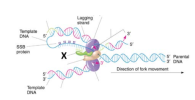 Name of 7 line please
Lagging strand Template DNA 5 SSB protein PUNONIMNIMONDS Parental 3' DNA Direction of fork movement Template DNA
Name of 7 line please
Lagging strand Template DNA 5 SSB protein PUNONIMNIMONDS Parental 3' DNA Direction of fork movement Template DNA
The lagging strand in DNA replication?: (A) is synthesized after the leading strand. (B) causes the...
The lagging strand in DNA replication?: (A) is synthesized after the leading strand. (B) causes the formation of Okazaki fragments in the leading strand. (C) is a consequence of replicating both strands of template DNA at a single replication fork. (D) requires its own replisome.
In DNA replication, the ________ strand grows towards the replication fork, while the ________ strand grows...
In DNA replication, the ________ strand grows towards the replication fork, while the ________ strand grows away from the replication fork. mRNA; leading leading; lagging leading; template lagging; template lagging; leading Which of the following is not necessarily related to tumour formation? an overactive MYC gene proto-oncogenes inactive tumour-suppressor genes cell de-differentiation metastasis The total number of unique, three-base combinations of the four nucleic acid bases in DNA is 12. 16. 20. 64. 256. The purpose of cloning is to...
dentify the correct action and event for clamp loading proteins catalyzes the joining of deoxyribonucleotide 5...
 dentify the correct action and event for clamp loading proteins catalyzes the joining of deoxyribonucleotide 5 -triphosphates (dNTPs) to form the growing DNA chain O an enzyme that can synthesize short fragments of RNA de novo which are complementary to the parent strand template and serve as primers for DNA replication proteins that specifically recognize and bind DNA at the junction between the primer and template proteins that bind adjacent to the clamp-loading proteins, forming a ring around the template...
Match the following (Total 24 pts) Enzyme responsible for joining DNA strands together The nascent DNA...
 Match the following (Total 24 pts) Enzyme responsible for joining DNA strands together The nascent DNA strand that is being synthesized in the same direction as the replication fork. Enz 39 DNA polymerase 40 DNA helicase responsible for transcribing RNA 41DNA sliding clamp 42 Single Stranded Binding Proteins DShort, newly synthesized DNA fragments 43 RNA primer 44 DNA ligase formed on the lagging template strand E Abundle or proteins that assist in the rate of transcription of DNA to mRNA....
1. DNA is coiled around what type of proteins to form nucleosomes A. Polymerases DNA replication...
 1. DNA is coiled around what type of proteins to form nucleosomes A. Polymerases DNA replication of the lagging strand is discontinuous B. Transcription factors DNA replication of the lagging strand is continuous C. Helicases D. Histones E. DICER 2. Which of the following statements is true? A. DNA replication of the leading strand is discontinuous B. DNA replication of the lagging strand is discontinuous C. DNA replication of the leading strand is dispersive D. DNA replication of the lagging...
In DNA replication ywhat are the leading and lagging strand synthesis plus the activities of DNA...
In DNA replication ywhat are the leading and lagging strand synthesis plus the activities of DNA helicase, DNA gyrase, DNA polymerase, RNA primase and DNA ligase
1) Draw a diagram of a bacterial replication fork showing the leading and lagging strand of...
1) Draw a diagram of a bacterial replication fork showing the leading and lagging strand of new DNA and the enzymes responsible for the processes involved. Indicate the 3' and 5' end of each nucleic acid strand. 2) The ends of a linear chromosome cannot be replicated by the normal DNA replication enzymes. Why? How does the eukaryotic cell solve this problem?
 DNA Replication. Sketch a replication fork of bacterial DNA in which one strand is being replicated discontinuously and the other is being replicated continuously. List six different enzyme activities associated with the replication process, identity the function of each activity, and show where each would be located on the replication fork. In addition, identify the following features on your sketch: DNA template, RNA primer, Okazaki fragments, and single-stranded DNA binding protein.
 Name of 7 line please
Lagging strand Template DNA 5 SSB protein PUNONIMNIMONDS Parental 3' DNA Direction of fork movement Template DNA
Name of 7 line please
Lagging strand Template DNA 5 SSB protein PUNONIMNIMONDS Parental 3' DNA Direction of fork movement Template DNA
 dentify the correct action and event for clamp loading proteins catalyzes the joining of deoxyribonucleotide 5 -triphosphates (dNTPs) to form the growing DNA chain O an enzyme that can synthesize short fragments of RNA de novo which are complementary to the parent strand template and serve as primers for DNA replication proteins that specifically recognize and bind DNA at the junction between the primer and template proteins that bind adjacent to the clamp-loading proteins, forming a ring around the template...
 Match the following (Total 24 pts) Enzyme responsible for joining DNA strands together The nascent DNA strand that is being synthesized in the same direction as the replication fork. Enz 39 DNA polymerase 40 DNA helicase responsible for transcribing RNA 41DNA sliding clamp 42 Single Stranded Binding Proteins DShort, newly synthesized DNA fragments 43 RNA primer 44 DNA ligase formed on the lagging template strand E Abundle or proteins that assist in the rate of transcription of DNA to mRNA....
 1. DNA is coiled around what type of proteins to form nucleosomes A. Polymerases DNA replication of the lagging strand is discontinuous B. Transcription factors DNA replication of the lagging strand is continuous C. Helicases D. Histones E. DICER 2. Which of the following statements is true? A. DNA replication of the leading strand is discontinuous B. DNA replication of the lagging strand is discontinuous C. DNA replication of the leading strand is dispersive D. DNA replication of the lagging...
Most questions answered within 3 hours.
-
Where is the error in this code sequence?
String s1 = "Hello";
String s2 = "ello";...
asked 10 months ago -
Financial data for Joel de Paris, Inc., for last year
follow:
Joel de Paris, Inc.
Balance...
asked 10 months ago -
Consider this reaction:
Al2(SO4)3 (aq)+ BaCl3
(aq) Al2Cl6 (aq)- +
3BaSO4(s) . What is the...
asked 10 months ago -
Suppose that Savneet is considering increasing her
recent random sample from 20 car rentals to 40...
asked 10 months ago -
Trucks arrive at an unloading terminal at an average rate of 120
per hour.
Trucks arrive...
asked 10 months ago -
Why are methanol and ethanol completely soluble in water while
octanol is not very little soluble....
asked 10 months ago -
A facilities manager at a university reads in a research report
that the mean amount of...
asked 10 months ago -
When the CuSO4 is rehydrated by adding water to the anhydrous
compound, is this an endothermic...
asked 10 months ago -
A ray of sunlight is passing from diamond into crown glass; the
angle of incidence is...
asked 10 months ago -
A block of mass 0.249 kg is placed on top of a light, vertical
spring of...
asked 10 months ago -
how do the kidneys compensate in the presences of acidosis
a) trigger hyperventilate
b) reserve acid...
asked 10 months ago -
Question 501 pts
The rental rate of capital to the firm increases. Which of the
following...
asked 10 months ago