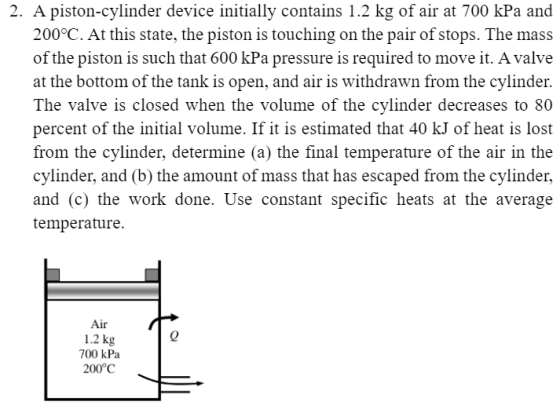
Apiston-cylinder device initiallycontains 1.2 kg of air at 700 kPa and 200°C. At this state, the pistonis touching on the pair of stops. The mass of the pistonis such that 600 kPa pressure is required to move it. Avalve at the bottom of the tank is open,
Homework Answers


Add Answer to:
Apiston-cylinder device initiallycontains 1.2 kg of air at 700 kPa and 200°C. At this state, the pistonis touching on the pair of stops. The mass of the pistonis such that 600 kPa pressure is required to move it. Avalve at the bottom of the tank is open,
A piston–cylinder device initially contains air at 150 kPa and 27 °C. In this state, the...
A piston–cylinder device initially contains air at 150 kPa and 27 °C. In this state, the piston is resting on a pair of stops, and the enclosed volume is 400 litres. The mass of the piston is such that a 200 kPa pressure is required to move it. The air is now heated until its volume has doubled. Sketch the process on a P-V diagram and determine (a) the mass of air and the final temperature, (b) the work done...
A frictionless piston-cylinder device contains 0.2 kg of air at 100 kPa and 27°C. The air...
A frictionless piston-cylinder device contains 0.2 kg of air at 100 kPa and 27°C. The air is now compressed slowly according to the relation P Vk = constant, where k = 1.4, until it reaches a final temperature of 77°C. Sketch the P-V diagram of the process with respect to the relevant constant temperature lines, and indicate the work done on this diagram. Using the basic definition of boundary work done determine the boundary work done during the process [-7.18...
A piston-cylinder device initially contains steam at 200 kPa, 250°C, and 0.4 m3. At this state,...
A piston-cylinder device initially contains steam at 200 kPa, 250°C, and 0.4 m3. At this state, a linear spring is touching the piston, but exerts no force on it. Heat is now slowly transferred to the steam, causing the pressure and the volume to rise to 300 kPa and 0.7 m3, respectively. Show the process on a P-v diagram with respect to saturation lines and determine the following: a. The final temperature b. The work done by the steam c....
13. a)Air is expanded from 1 MPa, 327°C to 200 kPa in a closed piston-cylinder device...
 13. a)Air is expanded from 1 MPa, 327°C to 200 kPa in a closed piston-cylinder device executing a PV1.2 = constant process. Determine the work produced during this process (8pts)
9.4 kg of R-134a fill a O.7-m weighted piston-cylinder device at a pressure of 200 kPa....
 9.4 kg of R-134a fill a O.7-m weighted piston-cylinder device at a pressure of 200 kPa. The container is now heated until the temperature is 30°C. Determine the initial temperature and final volume of R-134a. Use data from the steam tables. The initial temperature is [ °C. ]m3 The final volume is
At steady state, air at 200 kPa, 325 K, and mass flow rate of 1.0 kg/s...
At steady state, air at 200 kPa, 325 K, and mass flow rate of 1.0 kg/s enters an insulated duct having differing inlet and exit cross-sectional areas. The inlet cross-sectional area is 6 cm2. At the duct exit, the pressure of the air is 100 kPa and the velocity is 300 m/s. Neglecting potential energy effects and modeling air as an ideal gas, determine a. the velocity of the air at the inlet, in m/s. b. the temperature of the...
9.4 kg of R-134a fill a O.7-m weighted piston-cylinder device at a pressure of 200 kPa. The container is now heated...
 9.4 kg of R-134a fill a O.7-m weighted piston-cylinder device at a pressure of 200 kPa. The container is now heated until the temperature is 30°C. Determine the initial temperature and final volume of R-134a. Use data from the steam tables. The initial temperature is [ °C. ]m3 The final volume is
9.4 kg of R-134a fill a O.7-m weighted piston-cylinder device at a pressure of 200 kPa. The container is now heated until the temperature is 30°C. Determine the...
9.4 kg of R-134a fill a O.7-m weighted piston-cylinder device at a pressure of 200 kPa. The container is now heated until the temperature is 30°C. Determine the initial temperature and final volume of R-134a. Use data from the steam tables. The initial temperature is [ °C. ]m3 The final volume is
9.4 kg of R-134a fill a O.7-m weighted piston-cylinder device at a pressure of 200 kPa. The container is now heated until the temperature is 30°C. Determine the...
10-kg moist air at the temperature of 24°C, the pressure of 100 kPa, and relative humidity of 90% is enclosed in a cylinder and piston assembly. The enclosed air is cooled down to the temperature of 1...
10-kg moist air at the temperature of 24°C, the pressure of 100 kPa, and relative humidity of 90% is enclosed in a cylinder and piston assembly. The enclosed air is cooled down to the temperature of 12°C at a constant pressure process (when piston can move freely). Determine a) at what temperature vapor starts to condense and b) the mass of condensed water during the process using the psychrometric chart.
Please show all work 1 out of 3 attem A tank contains 23.07 kg of dry air and 0.238 kg of water vapor at 30°C and 97 kPa total pressure. Determine (a) the specific humidity kg H2O/kg dry air (Round y...
Please show all work 1 out of 3 attem A tank contains 23.07 kg of dry air and 0.238 kg of water vapor at 30°C and 97 kPa total pressure. Determine (a) the specific humidity kg H2O/kg dry air (Round your answer to four decimal places) (b) the relative humidity, % (Round your answer to one decimal place) and (c) the volume of the tank. 3 m (Round your answer to one decimal place) 1 out of 3 attem A...
A piston–cylinder device contains 2 kg of air initially at 90 kPa and 30°C. The air is now compressed slowly in a process during which PV k = constant until the volume is reduced by one-half. If the exponent k characterizing the compression process is the
A piston–cylinder device contains 2 kg of air initially at 90 kPa and 30°C. The air is now compressed slowly in a process during which PV k = constant until the volume is reduced by one-half. If the exponent k characterizing the compression process is the specific heat ratio of the air for the average operating temperatures (Table A-2b), the net heat transfer for the process is expected to be zero (adiabatic). Determine the work done and show that the...
 13. a)Air is expanded from 1 MPa, 327°C to 200 kPa in a closed piston-cylinder device executing a PV1.2 = constant process. Determine the work produced during this process (8pts)
 9.4 kg of R-134a fill a O.7-m weighted piston-cylinder device at a pressure of 200 kPa. The container is now heated until the temperature is 30°C. Determine the initial temperature and final volume of R-134a. Use data from the steam tables. The initial temperature is [ °C. ]m3 The final volume is
 9.4 kg of R-134a fill a O.7-m weighted piston-cylinder device at a pressure of 200 kPa. The container is now heated until the temperature is 30°C. Determine the initial temperature and final volume of R-134a. Use data from the steam tables. The initial temperature is [ °C. ]m3 The final volume is
9.4 kg of R-134a fill a O.7-m weighted piston-cylinder device at a pressure of 200 kPa. The container is now heated until the temperature is 30°C. Determine the...
9.4 kg of R-134a fill a O.7-m weighted piston-cylinder device at a pressure of 200 kPa. The container is now heated until the temperature is 30°C. Determine the initial temperature and final volume of R-134a. Use data from the steam tables. The initial temperature is [ °C. ]m3 The final volume is
9.4 kg of R-134a fill a O.7-m weighted piston-cylinder device at a pressure of 200 kPa. The container is now heated until the temperature is 30°C. Determine the...
Most questions answered within 3 hours.
-
Where is the error in this code sequence?
String s1 = "Hello";
String s2 = "ello";...
asked 10 months ago -
Financial data for Joel de Paris, Inc., for last year
follow:
Joel de Paris, Inc.
Balance...
asked 10 months ago -
Consider this reaction:
Al2(SO4)3 (aq)+ BaCl3
(aq) Al2Cl6 (aq)- +
3BaSO4(s) . What is the...
asked 10 months ago -
Suppose that Savneet is considering increasing her
recent random sample from 20 car rentals to 40...
asked 10 months ago -
Trucks arrive at an unloading terminal at an average rate of 120
per hour.
Trucks arrive...
asked 10 months ago -
Why are methanol and ethanol completely soluble in water while
octanol is not very little soluble....
asked 10 months ago -
A facilities manager at a university reads in a research report
that the mean amount of...
asked 10 months ago -
When the CuSO4 is rehydrated by adding water to the anhydrous
compound, is this an endothermic...
asked 10 months ago -
A ray of sunlight is passing from diamond into crown glass; the
angle of incidence is...
asked 10 months ago -
A block of mass 0.249 kg is placed on top of a light, vertical
spring of...
asked 10 months ago -
how do the kidneys compensate in the presences of acidosis
a) trigger hyperventilate
b) reserve acid...
asked 10 months ago -
Question 501 pts
The rental rate of capital to the firm increases. Which of the
following...
asked 10 months ago