the structure and composition of glycoproteins determines the A.B and O blood groups in humans. explain...
the structure and composition of glycoproteins determines the A.B and O blood groups in humans. explain how this happens and draw the structure of carbohydrates attached to the blood antigen O in the Haworth Projetion, showing the correct glycoside linkages
Homework Answers
Glycoproteins are the proteins conjugated with carbohydrates. There are three classes of glycoproteins namely simple glycoproteins, proteoglycans and mucoproteins. Most of the glycoproteins are present on the structures of cell membranes. In simple glycoproteins, protein constituent gives major weight and they act in binding of sperm to egg and cell adhesion.
The surface of blood cells is covered with glycoproteins that project out into the blood stream, so that antibodies can recognise them.
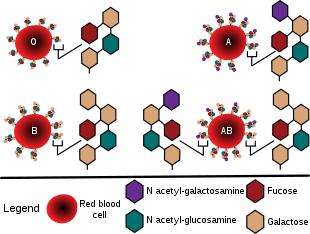
The proteins on the erythrocyte cell surface contain a wide variety of different oligosaccharides that are attached in various ways to the protein. However, it spite of this variation, there are a few structures that are very common. One of the most common “core” structures is something called H-antigen. It is composed of many different sugars but the outside end of the H-antigen structure always consists of a fucose (Fuc) residue, a galactose residue (Gal), and an N-acetylglucosamine (GlcNAc) residue.
The core oligosaccharide is modified by adding an N-acetylgalactosamine (GalNAc) residue in the presence of N-acetylaminogalactosyltransferase enzyme to form a branched structure at the end of the oligosaccharide. This enzyme is coded by a gene on chromosome 9. If the RBC's contain GalNAc on its surface, then the blood type is A. If the gene is defective for making GalNAc enzyme, then the blood group is O.
People with blood type A will not have antibodies to H antigen
since this is the normal precursor to A antigen and there will
always be some on the cell surface. In other words, the H antigen
will be recognized as self.Normal red blood cells are recognized as
“self” so we don’t have antibodies against our own cells. However,
we will have antibodies against the red blood cells of other
people’s blood if their cell surface carbohydrates are different
from ours. This is the basis of ABO blood group and it’s why we
have to match blood types in a blood transfusion.
The ABO blood group was discovered over one hundred years ago by
Karl Landsteiner (Nobel Laureate: Karl Landsteiner). The
biochemical basis was only elucidated in the 1970’s when the
technology for examining the carbohydrate structure of
glycoproteins was worked out.
If the small number of mutations present on allele of the GalNAc enzyme switches it to code for galactose (Gal instead of GalNAc), . The variant enzyme is called B enzyme (galactosyltransferase) and the B antigen structure has a terminal galactose (Gal) instead of a terminal GalNAc. If a person contains homozygous allels for B on chromosome 9, the surface of red blood cells have the B antigen oligosaccharide. No antibodies are synthesised by the body against these cells, because thy are self, but antibodes will be synthesised against others blood groups. So, we must check for compatibility between blood groups during blood transfusion. The following structure gives the linkage of carbohydrate chains to the blood cells.
Add Answer to:
the structure and composition of glycoproteins determines the
A.B and O blood groups in humans. explain...
Explain how many REDUCING GROUPS are in the molecule disaccharide and Draw the structure showing Reducing...
 Explain how many REDUCING GROUPS are in the molecule
disaccharide and Draw the structure showing
Reducing Sugars Draw the structural formula for a-D-glucosyl-(1->6) -D-mannosamine and circle the part of this structure that makes the compound a reducing sugar.
Explain how many REDUCING GROUPS are in the molecule
disaccharide and Draw the structure showing
Reducing Sugars Draw the structural formula for a-D-glucosyl-(1->6) -D-mannosamine and circle the part of this structure that makes the compound a reducing sugar.
there are 5 pictures attached to this question. The first picture which talk about P-R-O strategy...
 there are 5 pictures attached to this question. The first
picture which talk about P-R-O strategy is the question itslef
which I want to know thw aswer. the next 4 pictures are useful
information that may help you to get the answer.
please answer to this question. I need to know ASAP
Increase in hominin brain size Task: Use the P-R-O strategy to construct a theory-based explanation for a puzzling problem. Refer to the handout you received in lecture to...
there are 5 pictures attached to this question. The first
picture which talk about P-R-O strategy is the question itslef
which I want to know thw aswer. the next 4 pictures are useful
information that may help you to get the answer.
please answer to this question. I need to know ASAP
Increase in hominin brain size Task: Use the P-R-O strategy to construct a theory-based explanation for a puzzling problem. Refer to the handout you received in lecture to...
 Explain how many REDUCING GROUPS are in the molecule
disaccharide and Draw the structure showing
Reducing Sugars Draw the structural formula for a-D-glucosyl-(1->6) -D-mannosamine and circle the part of this structure that makes the compound a reducing sugar.
Explain how many REDUCING GROUPS are in the molecule
disaccharide and Draw the structure showing
Reducing Sugars Draw the structural formula for a-D-glucosyl-(1->6) -D-mannosamine and circle the part of this structure that makes the compound a reducing sugar.
 there are 5 pictures attached to this question. The first
picture which talk about P-R-O strategy is the question itslef
which I want to know thw aswer. the next 4 pictures are useful
information that may help you to get the answer.
please answer to this question. I need to know ASAP
Increase in hominin brain size Task: Use the P-R-O strategy to construct a theory-based explanation for a puzzling problem. Refer to the handout you received in lecture to...
there are 5 pictures attached to this question. The first
picture which talk about P-R-O strategy is the question itslef
which I want to know thw aswer. the next 4 pictures are useful
information that may help you to get the answer.
please answer to this question. I need to know ASAP
Increase in hominin brain size Task: Use the P-R-O strategy to construct a theory-based explanation for a puzzling problem. Refer to the handout you received in lecture to...
Most questions answered within 3 hours.
-
Where is the error in this code sequence?
String s1 = "Hello";
String s2 = "ello";...
asked 11 months ago -
Financial data for Joel de Paris, Inc., for last year
follow:
Joel de Paris, Inc.
Balance...
asked 11 months ago -
Consider this reaction:
Al2(SO4)3 (aq)+ BaCl3
(aq) Al2Cl6 (aq)- +
3BaSO4(s) . What is the...
asked 11 months ago -
Suppose that Savneet is considering increasing her
recent random sample from 20 car rentals to 40...
asked 11 months ago -
Trucks arrive at an unloading terminal at an average rate of 120
per hour.
Trucks arrive...
asked 11 months ago -
Why are methanol and ethanol completely soluble in water while
octanol is not very little soluble....
asked 11 months ago -
A facilities manager at a university reads in a research report
that the mean amount of...
asked 11 months ago -
When the CuSO4 is rehydrated by adding water to the anhydrous
compound, is this an endothermic...
asked 11 months ago -
A ray of sunlight is passing from diamond into crown glass; the
angle of incidence is...
asked 11 months ago -
A block of mass 0.249 kg is placed on top of a light, vertical
spring of...
asked 11 months ago -
how do the kidneys compensate in the presences of acidosis
a) trigger hyperventilate
b) reserve acid...
asked 11 months ago -
Question 501 pts
The rental rate of capital to the firm increases. Which of the
following...
asked 11 months ago