A block (m=25 kg) is held in equilibrium by two springs as shown in the figure. Calculate in this condition the unstretched length of the springs.
Data h1 = 2,5, m, k1 = 250 N/m, h2 = 1,5 m, k2 = 300 N/m

Homework Answers

Now From triagle OAB length of stretched spring 1

Now From triagle OCD length of stretched spring 2

Now From the FBD, Using translational equilibrium along X as well as Y axis


using value from equation above


and

Finally
length of unstretched spring 1

length of unstretched spring 2

Add Answer to:
A block (m=25 kg) is held in equilibrium by two springs as shown
in the figure....
Question: A block with mass of m = 3.78 kg is attached to springs with spring...
 Question: A block with mass of m = 3.78 kg is attached to springs with spring constants of ki = 18.1 N/m and k = 25.6 N/m, in different configurations shown in the figures below. Assume in all these cases that friction is negligible. Part 1) You will need to calculate the period of oscillations for each situation In this situation the mass is connected between the two springs which are each connected to opposite walls (Figure 1). What is...
Two springs, with force constants k1=150N/m and k2=235N/m, are connected in series Two springs, with force...
 Two springs, with force
constants k1=150N/m and k2=235N/m, are connected in series
Two springs, with force constants ki = 150 N/m and k2 = 235 N/m, are connected in series, as shown in (Figure 1). Part A When a mass m = 0.60 kg is attached to the springs, what is the amount of stretch, ? Express your answer to two significant figures and include appropriate units. Figure < 1 of 1 > TT HÀ • • • Ea ?...
Two springs, with force
constants k1=150N/m and k2=235N/m, are connected in series
Two springs, with force constants ki = 150 N/m and k2 = 235 N/m, are connected in series, as shown in (Figure 1). Part A When a mass m = 0.60 kg is attached to the springs, what is the amount of stretch, ? Express your answer to two significant figures and include appropriate units. Figure < 1 of 1 > TT HÀ • • • Ea ?...
Problem #1 In the scenario shown below, the springs are unstretched. Assume that ki 10.0 N/m,...
 Problem #1 In the scenario shown below, the springs are unstretched. Assume that ki 10.0 N/m, k2= 18.0 N/m, m 0.400 kg, and the coefficient of kinetic friction between the mass and the horizontal surface beneath it is 0.50. The mass is given a sudden kick so that it begins moving to the right at 4.00 m/s. It moves to the right, momentarily has a speed of zero, and then moves back through the equilibrium position. (a) Draw pictures illustrating...
A 3.00-kg block is connected to two ideal horizontal springs having force constants k1 = 23.0...
A 3.00-kg block is connected to two ideal horizontal springs having force constants k1 = 23.0 N/cm and k2 = 18.0 N/cm. The system is initially in equilibrium on a horizontal, frictionless surface. The block is now pushed 15.0 cm to the right and released from rest. What is the maximum speed of the block?
Bookmark A 0.28 kg block oscillates between two 18 N/m springs, as shown in the figure....
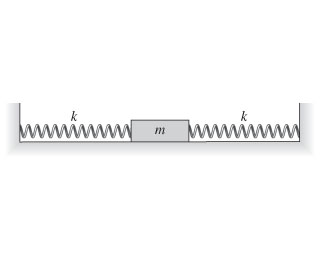 Bookmark A 0.28 kg block oscillates between two 18 N/m springs,
as shown in the figure. (Figure
https://media.cheggcdn.com/media/981/981295cb-0dd2-43e9-9dbb-73b2ec3d730b/phpwRyUKp.png
What's the oscillation period? Express your answer using two
significant figures. Compare with the period of the same block
oscillating on a single 18 N/m spring. Express your answer using
two significant figures.
Bookmark A 0.28 kg block oscillates between two 18 N/m springs,
as shown in the figure. (Figure
https://media.cheggcdn.com/media/981/981295cb-0dd2-43e9-9dbb-73b2ec3d730b/phpwRyUKp.png
What's the oscillation period? Express your answer using two
significant figures. Compare with the period of the same block
oscillating on a single 18 N/m spring. Express your answer using
two significant figures.
3-46. Determine the stretch in each of the two springs required to hold the 20-kg crate...
 3-46. Determine the stretch in each of the two springs required to hold the 20-kg crate in the equilibrium position shown. Each spring has an unstretched length of 2 m and a stiffness of k = 300 N/m. for 12 m Prob. 3-406
Obtain the period of vibration of the system shown in Figure 1. The blue block has...
 Obtain the period of vibration of the system shown in Figure 1.
The blue block has a mass of 58 kg and is pushed down 1 m from its
equilibrium position and it is then released. This system is
subjected to a force F of magnitude 12 N, sufficient to cause
deformation δ. Determine its vibration period
k1=4,495 N/m
k2=6,242 N/m
Obtenga el periodo de vibración del sistema mostrado en la Figura 1. El bloque azul tiene una masa de...
Obtain the period of vibration of the system shown in Figure 1.
The blue block has a mass of 58 kg and is pushed down 1 m from its
equilibrium position and it is then released. This system is
subjected to a force F of magnitude 12 N, sufficient to cause
deformation δ. Determine its vibration period
k1=4,495 N/m
k2=6,242 N/m
Obtenga el periodo de vibración del sistema mostrado en la Figura 1. El bloque azul tiene una masa de...
Here we consider the two masses m1 and m2 connected this time by springs of stiffnesses...
 Here we consider the two masses m1 and m2 connected this time by
springs of stiffnesses k1, k2 and k3 as shown in the figure below.
The movement of each of the 2 masses relative to its position of
static equilibrium is designated by x1(t) and x2(t).
1. Demonstrate that the differential equation whose unknown is
the displacement x1(t) is written as follows:
2. Determine the second differential equation whose unknown is
the displacement x2(t).
3. Determine the free oscillatory...
Here we consider the two masses m1 and m2 connected this time by
springs of stiffnesses k1, k2 and k3 as shown in the figure below.
The movement of each of the 2 masses relative to its position of
static equilibrium is designated by x1(t) and x2(t).
1. Demonstrate that the differential equation whose unknown is
the displacement x1(t) is written as follows:
2. Determine the second differential equation whose unknown is
the displacement x2(t).
3. Determine the free oscillatory...
Newton's Third Law (two springs) Two springs with spring constants k1 = 24.6 N/m and k2...
 Newton's Third Law (two springs) Two springs with spring constants k1 = 24.6 N/m and k2 = 15.6 N/m are connected as shown in the Figure. Find the displacement y of the connection point from its initial equilibrium position when the two springs are stretched a distance d = 1.3 m as a result of the application of force F 0 0.824 m Use Newton's first law and apply it to the connection point! Submit Answer Incorrect. Tries 1/6 Previous...
A block with mass m = 7 kg is attached to two springs with spring constants...
A block with mass m = 7 kg is attached to two springs with spring constants kleft = 37 N/m and kright = 48 N/m. The block is pulled a distance x = 0.21 m to the left of its equilibrium position and released from rest. 6)What is the magnitude of the acceleration of the block as it passes through equilibrium? 7)Where is the block located, relative to equilibrium, at a time 1.23 s after it is released? (if the...
 Question: A block with mass of m = 3.78 kg is attached to springs with spring constants of ki = 18.1 N/m and k = 25.6 N/m, in different configurations shown in the figures below. Assume in all these cases that friction is negligible. Part 1) You will need to calculate the period of oscillations for each situation In this situation the mass is connected between the two springs which are each connected to opposite walls (Figure 1). What is...
 Two springs, with force
constants k1=150N/m and k2=235N/m, are connected in series
Two springs, with force constants ki = 150 N/m and k2 = 235 N/m, are connected in series, as shown in (Figure 1). Part A When a mass m = 0.60 kg is attached to the springs, what is the amount of stretch, ? Express your answer to two significant figures and include appropriate units. Figure < 1 of 1 > TT HÀ • • • Ea ?...
Two springs, with force
constants k1=150N/m and k2=235N/m, are connected in series
Two springs, with force constants ki = 150 N/m and k2 = 235 N/m, are connected in series, as shown in (Figure 1). Part A When a mass m = 0.60 kg is attached to the springs, what is the amount of stretch, ? Express your answer to two significant figures and include appropriate units. Figure < 1 of 1 > TT HÀ • • • Ea ?...
 Problem #1 In the scenario shown below, the springs are unstretched. Assume that ki 10.0 N/m, k2= 18.0 N/m, m 0.400 kg, and the coefficient of kinetic friction between the mass and the horizontal surface beneath it is 0.50. The mass is given a sudden kick so that it begins moving to the right at 4.00 m/s. It moves to the right, momentarily has a speed of zero, and then moves back through the equilibrium position. (a) Draw pictures illustrating...
 3-46. Determine the stretch in each of the two springs required to hold the 20-kg crate in the equilibrium position shown. Each spring has an unstretched length of 2 m and a stiffness of k = 300 N/m. for 12 m Prob. 3-406
 Obtain the period of vibration of the system shown in Figure 1.
The blue block has a mass of 58 kg and is pushed down 1 m from its
equilibrium position and it is then released. This system is
subjected to a force F of magnitude 12 N, sufficient to cause
deformation δ. Determine its vibration period
k1=4,495 N/m
k2=6,242 N/m
Obtenga el periodo de vibración del sistema mostrado en la Figura 1. El bloque azul tiene una masa de...
Obtain the period of vibration of the system shown in Figure 1.
The blue block has a mass of 58 kg and is pushed down 1 m from its
equilibrium position and it is then released. This system is
subjected to a force F of magnitude 12 N, sufficient to cause
deformation δ. Determine its vibration period
k1=4,495 N/m
k2=6,242 N/m
Obtenga el periodo de vibración del sistema mostrado en la Figura 1. El bloque azul tiene una masa de...
 Here we consider the two masses m1 and m2 connected this time by
springs of stiffnesses k1, k2 and k3 as shown in the figure below.
The movement of each of the 2 masses relative to its position of
static equilibrium is designated by x1(t) and x2(t).
1. Demonstrate that the differential equation whose unknown is
the displacement x1(t) is written as follows:
2. Determine the second differential equation whose unknown is
the displacement x2(t).
3. Determine the free oscillatory...
Here we consider the two masses m1 and m2 connected this time by
springs of stiffnesses k1, k2 and k3 as shown in the figure below.
The movement of each of the 2 masses relative to its position of
static equilibrium is designated by x1(t) and x2(t).
1. Demonstrate that the differential equation whose unknown is
the displacement x1(t) is written as follows:
2. Determine the second differential equation whose unknown is
the displacement x2(t).
3. Determine the free oscillatory...
 Newton's Third Law (two springs) Two springs with spring constants k1 = 24.6 N/m and k2 = 15.6 N/m are connected as shown in the Figure. Find the displacement y of the connection point from its initial equilibrium position when the two springs are stretched a distance d = 1.3 m as a result of the application of force F 0 0.824 m Use Newton's first law and apply it to the connection point! Submit Answer Incorrect. Tries 1/6 Previous...
Most questions answered within 3 hours.
-
Where is the error in this code sequence?
String s1 = "Hello";
String s2 = "ello";...
asked 10 months ago -
Financial data for Joel de Paris, Inc., for last year
follow:
Joel de Paris, Inc.
Balance...
asked 10 months ago -
Consider this reaction:
Al2(SO4)3 (aq)+ BaCl3
(aq) Al2Cl6 (aq)- +
3BaSO4(s) . What is the...
asked 10 months ago -
Suppose that Savneet is considering increasing her
recent random sample from 20 car rentals to 40...
asked 10 months ago -
Trucks arrive at an unloading terminal at an average rate of 120
per hour.
Trucks arrive...
asked 10 months ago -
Why are methanol and ethanol completely soluble in water while
octanol is not very little soluble....
asked 10 months ago -
A facilities manager at a university reads in a research report
that the mean amount of...
asked 10 months ago -
When the CuSO4 is rehydrated by adding water to the anhydrous
compound, is this an endothermic...
asked 10 months ago -
A ray of sunlight is passing from diamond into crown glass; the
angle of incidence is...
asked 10 months ago -
A block of mass 0.249 kg is placed on top of a light, vertical
spring of...
asked 10 months ago -
how do the kidneys compensate in the presences of acidosis
a) trigger hyperventilate
b) reserve acid...
asked 10 months ago -
Question 501 pts
The rental rate of capital to the firm increases. Which of the
following...
asked 10 months ago