A 1 to 5 dilution was performed on a serum sample. The diluted sample was analyzed...
Homework Answers
The solution is diluted to 5 times , that means a concentration of solution M1 changes to M1/5 .
M1/ 5 = 100mg /dL
M1 (reported value of glucose ) = 500mg/dL. (Answer)
Or
= 500×10-3g/0.1L = 5 g/L (answer)
Or
= 5g/L ÷ 180g/mol =0.02777mol/L
= 0.028 mol/L (Answer)
Add Answer to:
A 1
to 5 dilution was performed on a serum sample. The diluted sample
was analyzed...
1) if 5 parts sample is added to 10 parts diluents, what is the dilution that...
1) if 5 parts sample is added to 10 parts diluents, what is the dilution that was just made? 2. What is the ratio if 5 parts sample volume is added to 10 parts diluents volume? 3. In a 1 to 3 dilution, what is the dilution FACTOR? 4. In a 1 to 10 dilution, what is the dilution FACTOR? 5. What is the dilution FACTOR if 40 mcL of sample added to 260 mcL of diluent? 6. What is...
13. A 1/2, fourfold serial dilution was performed. The original concentration of the analyte was 1200...
13. A 1/2, fourfold serial dilution was performed. The original concentration of the analyte was 1200 μg/dL. What is the concentration of the analyte in the final tube? 7. Calculate the true analyte value given the following information: Analyte diluted using 10 μL into 90 μL diluent; Diluted analyte value = 85 mg/dL.
o Calculate the following sample concentrations based upon given dilutions. Final (Diluted) Concentration 1st Dilution 2nd...
 o Calculate the following sample concentrations based upon given dilutions. Final (Diluted) Concentration 1st Dilution 2nd Dilution Concentration Original 1:5 1:4 1:15 1:3 1:3 3 (none) 1:2 1:5 (none) 1:5 167 mg/dL b. 139 mg/dL 15 mg/dL d. 557 mg/dL 23 mg/dL Page 2 of 3
2. The AMR for a method for measuring glucose has been determined by the manufacturer to...
 2. The AMR for a method for measuring glucose has been determined by the manufacturer to be 20-500 mg/dL A. The data for its verification study is shown below. Is the method's linearity verified for this range? Standard Standard [Glucose] mg/dL Absorbance Blank Standard 1 Standard 2 Standard 3 Standard 4 Standard 5 Standard 6500 0.000 0.050 0.099 0.201 0.298 0.402 0.501 50 100 200 300 400 B. The method allows a maximum dilution by a factor of 10. What...
A volume of serum sample is diluted with equal amounts of buffer (1:1). Following this, a...
A volume of serum sample is diluted with equal amounts of buffer (1:1). Following this, a series of five dilutions is made of this first dilution by diluting it 1/10, rediluting 1/10, and then three times more, each resulting solution then being a 1/10 dilution of the previous one in the series. What is the concentration of serum in each solution made (6 in total)?
-What is the molarity of 1.5 N CaCl2? -You take 1 mL of patient serum and...
-What is the molarity of 1.5 N CaCl2? -You take 1 mL of patient serum and add it to 3 mL of water. Next, you take 1 mL of the dilution you just made and add it to 4 mL of water. You perform a glucose test using this final sample and receive a result of 6 mg/dL. a. What is the dilution factor of the final sample? b. Is the patient’s glucose value in the reference range?
12. Given a series of 4 dilutions, each 1/5, what is the concentration in tube No....
12. Given a series of 4 dilutions, each 1/5, what is the concentration in tube No. 3 if the original concentration was 100 mg/dL? 13. A 1/2, fourfold serial dilution was performed. The original concentration of the analyte was 1200 μg/dL. What is the concentration of the analyte in the final tube? 7. Calculate the true analyte value given the following information: Analyte diluted using 10 μL into 90 μL diluent; Diluted analyte value = 85 mg/dL.
25 mL of a serum sample is to be analyzed by atomic emission spectroscopy for silver (Ag) metal. ...
 Clearly, the answer is 220ppm. However, I need the steps leading
to it.
25 mL of a serum sample is to be analyzed by atomic emission spectroscopy for silver (Ag) metal. After thorough mixing, a student transferred 2.5 mL of this serum sample to a 100 mL volumetric flask followed by the addition of 10 mL 0.5 M sulfuric acid to the sample. He then diluted it to volume in the volumetric flask with deionized water. After setting up his...
Clearly, the answer is 220ppm. However, I need the steps leading
to it.
25 mL of a serum sample is to be analyzed by atomic emission spectroscopy for silver (Ag) metal. After thorough mixing, a student transferred 2.5 mL of this serum sample to a 100 mL volumetric flask followed by the addition of 10 mL 0.5 M sulfuric acid to the sample. He then diluted it to volume in the volumetric flask with deionized water. After setting up his...
Five milliliters of 5% alcohol are added to 5 mL of urine. Two milliliters of this solution is diluted to 50 mL with wat...
Five milliliters of 5% alcohol are added to 5 mL of urine. Two milliliters of this solution is diluted to 50 mL with water, and 5 mL of this are used for analysis. How many milliliters of urine are in the analysis sample? You are doing a procedure that calls for 5 mL of undiluted urine. You use 3 mL of a 1/5 dilution of urine instead. The answer obtained is 50 mg/dL. What result should be reported? A procedure...
1-4 Pipette 0.1 ml serum and 0.3 mL DI water to a small tube and mix....
 1-4
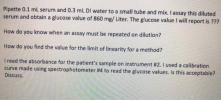
Pipette 0.1 ml serum and 0.3 mL DI water to a small tube and mix. I assay this diluted serum and obtain a glucose value of 860 mg/ Liter. The glucose value I will report is ??? How do you know when an assay must be repeated on dilution? How do you find the value for the limit of linearity for a method? I read the absorbance for the patient's sample on instrument #2. I used a calibration curve...
1-4
Pipette 0.1 ml serum and 0.3 mL DI water to a small tube and mix. I assay this diluted serum and obtain a glucose value of 860 mg/ Liter. The glucose value I will report is ??? How do you know when an assay must be repeated on dilution? How do you find the value for the limit of linearity for a method? I read the absorbance for the patient's sample on instrument #2. I used a calibration curve...
 o Calculate the following sample concentrations based upon given dilutions. Final (Diluted) Concentration 1st Dilution 2nd Dilution Concentration Original 1:5 1:4 1:15 1:3 1:3 3 (none) 1:2 1:5 (none) 1:5 167 mg/dL b. 139 mg/dL 15 mg/dL d. 557 mg/dL 23 mg/dL Page 2 of 3
 2. The AMR for a method for measuring glucose has been determined by the manufacturer to be 20-500 mg/dL A. The data for its verification study is shown below. Is the method's linearity verified for this range? Standard Standard [Glucose] mg/dL Absorbance Blank Standard 1 Standard 2 Standard 3 Standard 4 Standard 5 Standard 6500 0.000 0.050 0.099 0.201 0.298 0.402 0.501 50 100 200 300 400 B. The method allows a maximum dilution by a factor of 10. What...
 Clearly, the answer is 220ppm. However, I need the steps leading
to it.
25 mL of a serum sample is to be analyzed by atomic emission spectroscopy for silver (Ag) metal. After thorough mixing, a student transferred 2.5 mL of this serum sample to a 100 mL volumetric flask followed by the addition of 10 mL 0.5 M sulfuric acid to the sample. He then diluted it to volume in the volumetric flask with deionized water. After setting up his...
Clearly, the answer is 220ppm. However, I need the steps leading
to it.
25 mL of a serum sample is to be analyzed by atomic emission spectroscopy for silver (Ag) metal. After thorough mixing, a student transferred 2.5 mL of this serum sample to a 100 mL volumetric flask followed by the addition of 10 mL 0.5 M sulfuric acid to the sample. He then diluted it to volume in the volumetric flask with deionized water. After setting up his...
 1-4
Pipette 0.1 ml serum and 0.3 mL DI water to a small tube and mix. I assay this diluted serum and obtain a glucose value of 860 mg/ Liter. The glucose value I will report is ??? How do you know when an assay must be repeated on dilution? How do you find the value for the limit of linearity for a method? I read the absorbance for the patient's sample on instrument #2. I used a calibration curve...
1-4
Pipette 0.1 ml serum and 0.3 mL DI water to a small tube and mix. I assay this diluted serum and obtain a glucose value of 860 mg/ Liter. The glucose value I will report is ??? How do you know when an assay must be repeated on dilution? How do you find the value for the limit of linearity for a method? I read the absorbance for the patient's sample on instrument #2. I used a calibration curve...
Most questions answered within 3 hours.
-
Where is the error in this code sequence?
String s1 = "Hello";
String s2 = "ello";...
asked 10 months ago -
Financial data for Joel de Paris, Inc., for last year
follow:
Joel de Paris, Inc.
Balance...
asked 10 months ago -
Consider this reaction:
Al2(SO4)3 (aq)+ BaCl3
(aq) Al2Cl6 (aq)- +
3BaSO4(s) . What is the...
asked 10 months ago -
Suppose that Savneet is considering increasing her
recent random sample from 20 car rentals to 40...
asked 10 months ago -
Trucks arrive at an unloading terminal at an average rate of 120
per hour.
Trucks arrive...
asked 10 months ago -
Why are methanol and ethanol completely soluble in water while
octanol is not very little soluble....
asked 10 months ago -
A facilities manager at a university reads in a research report
that the mean amount of...
asked 10 months ago -
When the CuSO4 is rehydrated by adding water to the anhydrous
compound, is this an endothermic...
asked 10 months ago -
A ray of sunlight is passing from diamond into crown glass; the
angle of incidence is...
asked 10 months ago -
A block of mass 0.249 kg is placed on top of a light, vertical
spring of...
asked 10 months ago -
how do the kidneys compensate in the presences of acidosis
a) trigger hyperventilate
b) reserve acid...
asked 10 months ago -
Question 501 pts
The rental rate of capital to the firm increases. Which of the
following...
asked 10 months ago