
Homework Answers

Add Answer to:
Write a sequence of normal assembly language instructions corresponding to the following sequence of high-level language...
Exercise 1: For each of the following high-level language code snippets, write the SRO assembly code....
 Exercise 1: For each of the following high-level language code snippets, write the SRO assembly code. Assume that the variables A, B, C, X. are in memory locations MA, MB, MC, MX, respectively. a) XA+ 2B- 4C; b) if (A <0) else if (A> 0) else c) for (int i 1; 10; i++) X A+B+C (Hint: Use branch instructions to set up the loop)
All solutions must have both code and data segments Write a sequence of assembly language instructions...
All solutions must have both code and data segments Write a sequence of assembly language instructions to subtract each entry of an array B of five two’s complement 16-bit binary integers from the corresponding entry of an array A of five two’s complement 16-bit binary integers and construct a third array C of two’s complement 16-bit binary integers. i.e. C[i] = A[i] - B[i]. Use the following data for the arrays A and B. A: 10, -15, 20, 4,...
Write the MIPS assembly instructions corresponding to the following high level instruction. The used base register...
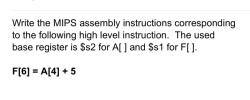 Write the MIPS assembly instructions corresponding to the following high level instruction. The used base register is $s2 for Al] and $s1 for F[]. and s 1 for F[6]A[4] +5
Write an ARM assembly language program to translate the following sequence of statements . Assume x...
Write an ARM assembly language program to translate the following sequence of statements . Assume x and y are memory locations that store two unsigned integers. Use the following: x is in R1, y is in R2, and z in R3. Make sure that your program works for any value of x and y. if (x > 15) { x = 1; if (y > 15) { y = 2; } else { y =...
Write an ARM assembly language program to translate the following sequence of statements . Assume x...
Write an ARM assembly language program to translate the following sequence of statements . Assume x and y are memory locations that store two unsigned integers. Use the following: x is in R1, y is in R2, and z in R3. Make sure that your program works for any value of x and y. if (x > 15) { x = 1; if (y > 15) { y = 2; } else { y =...
In this assignment, try to understand the assembly code instructions addv1.sim1. In #addv1.sim1 using only one...
In this assignment, try to understand the assembly code instructions addv1.sim1. In #addv1.sim1 using only one acc register, addition of two numbers have been done. For the assignment, you need to write assembly code, whose corresponding c code is as followings. int a = 0; int b = 5; int c = 10; a = (b*2)^c + c; exit(0); Only operations that are allowed is to use add, load, store, shift, and xor. addv1.sim1(txt file) #addv1.sim1 Add contents twice 005,...
Translate each of the following pseudo-instructions into MIPS instructions. You should Produce a minimal sequence of...
Translate each of the following pseudo-instructions into MIPS instructions. You should Produce a minimal sequence of MIPS instructions to accomplish the required computation. (8 Points) 1) bgt $t1, 100, Label # bgt means branch if greater than 2) ble $s2, 10, Next # ble means branch if less than or equal 3) ror $s0, $s4, 7 # ror means rotate right $s4 by 7 bits and store the result in $s0 4) neg $s5, $s4 # $s5 will have the...
Convert the following c code into instructions MIPS Assembly language. Assume a associated with $s0, i...
Convert the following c code into instructions MIPS Assembly language. Assume a associated with $s0, i with $s1, and j with $s2. if( i < 10) { if( j < 10) { a = 0; } else { a = 1;} } else { a = 2; }
Convert the following high-level language into MIPS instructions. Please write comments for each instructions. Assume a, b, c, d are associated with registers $s0, $s1, $s2, $s3, respectively. void ma...
Convert the following high-level language into MIPS instructions. Please write comments for each instructions. Assume a, b, c, d are associated with registers $s0, $s1, $s2, $s3, respectively. void main () { int a = 10, b = 20; int c = add(a, b); int d = sub(a, b); swap (a, b); } int add( int var1, int var2) { return (var1 + var2); } int sub(int var1, int var2) { return (var1 - var2); } void swap(int var1, int...
For the following C statement, write a minimal sequence of MIPS assembly instructions that does the...
For the following C statement, write a minimal sequence of MIPS assembly instructions that does the identical operation. Assume $t1 = A, $t2 = B, and $s1 is the base address of C. A = C[0] << 4;
 Exercise 1: For each of the following high-level language code snippets, write the SRO assembly code. Assume that the variables A, B, C, X. are in memory locations MA, MB, MC, MX, respectively. a) XA+ 2B- 4C; b) if (A <0) else if (A> 0) else c) for (int i 1; 10; i++) X A+B+C (Hint: Use branch instructions to set up the loop)
 Write the MIPS assembly instructions corresponding to the following high level instruction. The used base register is $s2 for Al] and $s1 for F[]. and s 1 for F[6]A[4] +5
Most questions answered within 3 hours.
-
Where is the error in this code sequence?
String s1 = "Hello";
String s2 = "ello";...
asked 11 months ago -
Financial data for Joel de Paris, Inc., for last year
follow:
Joel de Paris, Inc.
Balance...
asked 11 months ago -
Consider this reaction:
Al2(SO4)3 (aq)+ BaCl3
(aq) Al2Cl6 (aq)- +
3BaSO4(s) . What is the...
asked 11 months ago -
Suppose that Savneet is considering increasing her
recent random sample from 20 car rentals to 40...
asked 11 months ago -
Trucks arrive at an unloading terminal at an average rate of 120
per hour.
Trucks arrive...
asked 11 months ago -
Why are methanol and ethanol completely soluble in water while
octanol is not very little soluble....
asked 11 months ago -
A facilities manager at a university reads in a research report
that the mean amount of...
asked 11 months ago -
When the CuSO4 is rehydrated by adding water to the anhydrous
compound, is this an endothermic...
asked 11 months ago -
A ray of sunlight is passing from diamond into crown glass; the
angle of incidence is...
asked 11 months ago -
A block of mass 0.249 kg is placed on top of a light, vertical
spring of...
asked 11 months ago -
how do the kidneys compensate in the presences of acidosis
a) trigger hyperventilate
b) reserve acid...
asked 11 months ago -
Question 501 pts
The rental rate of capital to the firm increases. Which of the
following...
asked 11 months ago