Write assembly instructions to set Bit 3 of variable foo without changing other bits. Any quick...
Write assembly instructions to set Bit 3 of variable
foo without changing other bits.
Any quick response to this would be highly appreciated.
Homework Answers
Request Answer!
We need at least 10 more requests to produce the answer.
0 / 10 have requested this problem solution
The more requests, the faster the answer.
Add Answer to:
Write assembly instructions to set Bit 3 of variable
foo without changing other bits.
Any quick...
Write Nios II assembler instructions that will invert bits 3 to 0, set (turn on) bits...
Write Nios II assembler instructions that will invert bits 3 to 0, set (turn on) bits 11 to 8 and reset (turn off) bits 31 to 12 in register r4. All other bits in r4 should be left unchanged. Finish off this piece of code with a jump immediate to address 0x00000040
A- Using either “ANDA” or “ORAA” instructions, write an HCS12 code to clear bits 0, 2,5,...
 A- Using either “ANDA” or “ORAA” instructions, write an HCS12 code to clear bits 0, 2,5, and 7 of register A and leave all other bits unchanged. B- Using either “ANDB” or “ORAB” instructions, write an HCS12 code to set bits 0, 3, and 6 of register B and leave all other bits unchanged.
Code in assembly language please "Write an assembly 32 bit program that adds two numbers (other...
 Code in assembly language please
"Write an assembly 32 bit program that adds two numbers (other than 5 and 6) and stores the value to a variable called 'sum'. Also, use a block COMMENT to depict the name and description of the program, author of the program, and date."
Code in assembly language please
"Write an assembly 32 bit program that adds two numbers (other than 5 and 6) and stores the value to a variable called 'sum'. Also, use a block COMMENT to depict the name and description of the program, author of the program, and date."
Write a single 16-bit LC-3 instruction (in binary) that clears all the bits of R6 except...
 Write a single 16-bit LC-3
instruction (in binary) that clears all the bits of R6 except the
least significant two bits.
Write a single 16-bit LC-3 instruction (in binary) that clears all the bits of R6 except the least significant two bits. In other words, after your instruction executes, bits O and 1 of R6 will be unchanged, and the rest of R6 will be zero. Answer:
Write a single 16-bit LC-3
instruction (in binary) that clears all the bits of R6 except the
least significant two bits.
Write a single 16-bit LC-3 instruction (in binary) that clears all the bits of R6 except the least significant two bits. In other words, after your instruction executes, bits O and 1 of R6 will be unchanged, and the rest of R6 will be zero. Answer:
avr assembly please 3) Write an assembly program that is algorithmically equivalent to the following C++ code. Treat the variable y as a short int (16 bits) 1 int y; 2 for (int x = 2; x <= 20; x...
 avr
assembly please
3) Write an assembly program that is algorithmically equivalent to the following C++ code. Treat the variable y as a short int (16 bits) 1 int y; 2 for (int x = 2; x <= 20; x = x + 2) { 3 ¡f (x < 18) { 4 5 у 24 6 else f 7 8 9
3) Write an assembly program that is algorithmically equivalent to the following C++ code. Treat the variable y as...
avr
assembly please
3) Write an assembly program that is algorithmically equivalent to the following C++ code. Treat the variable y as a short int (16 bits) 1 int y; 2 for (int x = 2; x <= 20; x = x + 2) { 3 ¡f (x < 18) { 4 5 у 24 6 else f 7 8 9
3) Write an assembly program that is algorithmically equivalent to the following C++ code. Treat the variable y as...
PLEASE Solve problem 3. Thank you ction Reference 30% of all instructions are reads, 10% writes . All other instruction...
 PLEASE Solve problem 3. Thank you
ction Reference 30% of all instructions are reads, 10% writes . All other instructions take 1 cycle. A. Calculate CPI for this machine. B. Changing the L1 cache to 4 way set associative increases the hit rate to 95% in L1 but added complexity of hardware means we must reduce the clock rate to 2.2GHZ. What is the CPI in this case? Is this change worthwhile? Virtual memory 3 Assume a 48 bit virtual...
PLEASE Solve problem 3. Thank you
ction Reference 30% of all instructions are reads, 10% writes . All other instructions take 1 cycle. A. Calculate CPI for this machine. B. Changing the L1 cache to 4 way set associative increases the hit rate to 95% in L1 but added complexity of hardware means we must reduce the clock rate to 2.2GHZ. What is the CPI in this case? Is this change worthwhile? Virtual memory 3 Assume a 48 bit virtual...
#1. What is the value (in hex) of%ol after each set of instructions Which of the following logic ...
 Please answer the following questions and explain what they are
doing. Thanks!
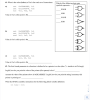
#1. What is the value (in hex) of%ol after each set of instructions Which of the following logic gate symbols represents set 0x89ABCDEF, %01 set 0x12345678, o2 xor %o1, %o2, %01 XNOR Value in %01 at this point is 0x -NOR NAND XOr b) set 0x89ABCDEF, 801 set 0x12345678, %02 and %01, %o2, %o1 Value in 9601 at this point is 0x set 0x89ABCDEF, o1 sra %01, 20,801...
Please answer the following questions and explain what they are
doing. Thanks!
#1. What is the value (in hex) of%ol after each set of instructions Which of the following logic gate symbols represents set 0x89ABCDEF, %01 set 0x12345678, o2 xor %o1, %o2, %01 XNOR Value in %01 at this point is 0x -NOR NAND XOr b) set 0x89ABCDEF, 801 set 0x12345678, %02 and %01, %o2, %o1 Value in 9601 at this point is 0x set 0x89ABCDEF, o1 sra %01, 20,801...
3. Write the shortest sequence of VHDL statements to multiply a 16 bit unsigned variable x...
3. Write the shortest sequence of VHDL statements to multiply a 16 bit unsigned variable x by constant 113 without using a multiplication operator
Write a PIC18Fxx2 assembly program that takes the variable A and save into B in inverted the 110010102, then the program finishes with B 010100112-The 1. bit order. For example, if A variable A s...
 Write a PIC18Fxx2 assembly program that takes the variable A and save into B in inverted the 110010102, then the program finishes with B 010100112-The 1. bit order. For example, if A variable A shall preserve the original value at the end of the program execution. The program shall be implemented using any of the loop and shift techniques discussed in class. 2. Write a PIC18Fxx2 assembly program that makes the calculus of the first eigth (8) terms of the...
 A- Using either “ANDA” or “ORAA” instructions, write an HCS12 code to clear bits 0, 2,5, and 7 of register A and leave all other bits unchanged. B- Using either “ANDB” or “ORAB” instructions, write an HCS12 code to set bits 0, 3, and 6 of register B and leave all other bits unchanged.
 Code in assembly language please
"Write an assembly 32 bit program that adds two numbers (other than 5 and 6) and stores the value to a variable called 'sum'. Also, use a block COMMENT to depict the name and description of the program, author of the program, and date."
Code in assembly language please
"Write an assembly 32 bit program that adds two numbers (other than 5 and 6) and stores the value to a variable called 'sum'. Also, use a block COMMENT to depict the name and description of the program, author of the program, and date."
 Write a single 16-bit LC-3
instruction (in binary) that clears all the bits of R6 except the
least significant two bits.
Write a single 16-bit LC-3 instruction (in binary) that clears all the bits of R6 except the least significant two bits. In other words, after your instruction executes, bits O and 1 of R6 will be unchanged, and the rest of R6 will be zero. Answer:
Write a single 16-bit LC-3
instruction (in binary) that clears all the bits of R6 except the
least significant two bits.
Write a single 16-bit LC-3 instruction (in binary) that clears all the bits of R6 except the least significant two bits. In other words, after your instruction executes, bits O and 1 of R6 will be unchanged, and the rest of R6 will be zero. Answer:
 avr
assembly please
3) Write an assembly program that is algorithmically equivalent to the following C++ code. Treat the variable y as a short int (16 bits) 1 int y; 2 for (int x = 2; x <= 20; x = x + 2) { 3 ¡f (x < 18) { 4 5 у 24 6 else f 7 8 9
3) Write an assembly program that is algorithmically equivalent to the following C++ code. Treat the variable y as...
avr
assembly please
3) Write an assembly program that is algorithmically equivalent to the following C++ code. Treat the variable y as a short int (16 bits) 1 int y; 2 for (int x = 2; x <= 20; x = x + 2) { 3 ¡f (x < 18) { 4 5 у 24 6 else f 7 8 9
3) Write an assembly program that is algorithmically equivalent to the following C++ code. Treat the variable y as...
 PLEASE Solve problem 3. Thank you
ction Reference 30% of all instructions are reads, 10% writes . All other instructions take 1 cycle. A. Calculate CPI for this machine. B. Changing the L1 cache to 4 way set associative increases the hit rate to 95% in L1 but added complexity of hardware means we must reduce the clock rate to 2.2GHZ. What is the CPI in this case? Is this change worthwhile? Virtual memory 3 Assume a 48 bit virtual...
PLEASE Solve problem 3. Thank you
ction Reference 30% of all instructions are reads, 10% writes . All other instructions take 1 cycle. A. Calculate CPI for this machine. B. Changing the L1 cache to 4 way set associative increases the hit rate to 95% in L1 but added complexity of hardware means we must reduce the clock rate to 2.2GHZ. What is the CPI in this case? Is this change worthwhile? Virtual memory 3 Assume a 48 bit virtual...
 Please answer the following questions and explain what they are
doing. Thanks!
#1. What is the value (in hex) of%ol after each set of instructions Which of the following logic gate symbols represents set 0x89ABCDEF, %01 set 0x12345678, o2 xor %o1, %o2, %01 XNOR Value in %01 at this point is 0x -NOR NAND XOr b) set 0x89ABCDEF, 801 set 0x12345678, %02 and %01, %o2, %o1 Value in 9601 at this point is 0x set 0x89ABCDEF, o1 sra %01, 20,801...
Please answer the following questions and explain what they are
doing. Thanks!
#1. What is the value (in hex) of%ol after each set of instructions Which of the following logic gate symbols represents set 0x89ABCDEF, %01 set 0x12345678, o2 xor %o1, %o2, %01 XNOR Value in %01 at this point is 0x -NOR NAND XOr b) set 0x89ABCDEF, 801 set 0x12345678, %02 and %01, %o2, %o1 Value in 9601 at this point is 0x set 0x89ABCDEF, o1 sra %01, 20,801...
 Write a PIC18Fxx2 assembly program that takes the variable A and save into B in inverted the 110010102, then the program finishes with B 010100112-The 1. bit order. For example, if A variable A shall preserve the original value at the end of the program execution. The program shall be implemented using any of the loop and shift techniques discussed in class. 2. Write a PIC18Fxx2 assembly program that makes the calculus of the first eigth (8) terms of the...
Most questions answered within 3 hours.
-
Where is the error in this code sequence?
String s1 = "Hello";
String s2 = "ello";...
asked 11 months ago -
Financial data for Joel de Paris, Inc., for last year
follow:
Joel de Paris, Inc.
Balance...
asked 11 months ago -
Consider this reaction:
Al2(SO4)3 (aq)+ BaCl3
(aq) Al2Cl6 (aq)- +
3BaSO4(s) . What is the...
asked 11 months ago -
Suppose that Savneet is considering increasing her
recent random sample from 20 car rentals to 40...
asked 11 months ago -
Trucks arrive at an unloading terminal at an average rate of 120
per hour.
Trucks arrive...
asked 11 months ago -
Why are methanol and ethanol completely soluble in water while
octanol is not very little soluble....
asked 11 months ago -
A facilities manager at a university reads in a research report
that the mean amount of...
asked 11 months ago -
When the CuSO4 is rehydrated by adding water to the anhydrous
compound, is this an endothermic...
asked 11 months ago -
A ray of sunlight is passing from diamond into crown glass; the
angle of incidence is...
asked 11 months ago -
A block of mass 0.249 kg is placed on top of a light, vertical
spring of...
asked 11 months ago -
how do the kidneys compensate in the presences of acidosis
a) trigger hyperventilate
b) reserve acid...
asked 11 months ago -
Question 501 pts
The rental rate of capital to the firm increases. Which of the
following...
asked 11 months ago