Stages of aerobic cellular respiration? Most ATP is made at what stage? What is the terminal...
Stages of aerobic cellular respiration? Most ATP is made at what stage? What is the terminal electron acceptor?
Homework Answers
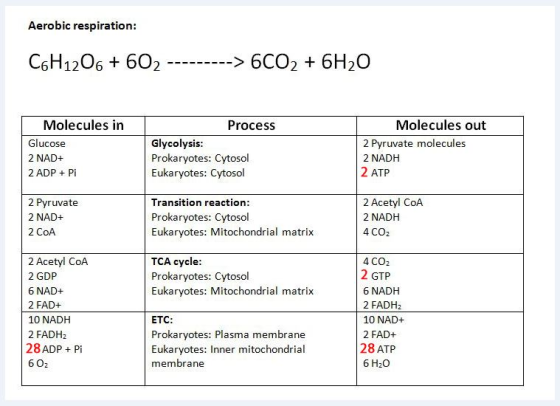
Four stages of aerobic respiration:
1. Glycolysis
2. Transition reaction
3. TCA cycle
4. Electron transport chain
Most ATP is made during the Electron transport chain.
See the image for the energetics and the location of each
process.
For this question, it is assumed that 1 NADH = 2.5 ATP and 1 FADH2
= 1.5 ATP
Terminal elecron acceptor = Molecular oxygen

Add Answer to:
Stages of aerobic cellular respiration? Most ATP is made at what
stage? What is the terminal...
How many ATP are formed via cellular aerobic respiration? ATP from glycolysis and the citric cycle?...
How many ATP are formed via cellular aerobic respiration? ATP from glycolysis and the citric cycle? ATP from the electron transport chain?
Chapter 5 (Cellular Respiration) With the aid of your notes and/or textbook, write the terms that...
 Chapter 5 (Cellular Respiration) With the aid of your notes and/or textbook, write the terms that correspond to the following definitions and descriptions Oxygen-requiring process that produces CO., H,0 and ATP. A series of enzyme catalyzed reactions that form pyruvate molecules from splitting glucose. Second stage of aerobic cellular respiration that produces CO, and electron camer molecules, and takes place in the mitochondrion. Type of cellular respiration that does not use oxygen in the production of ATP. Produces lactic acid...
* 3. Anaerobi Anaerobic respiration doesn't require oxygen, but aerobic respiration does. Which stages of cellular...
 * 3. Anaerobi Anaerobic respiration doesn't require oxygen, but aerobic respiration does. Which stages of cellular respiration are anaerobic? Which are aerobic? How do you know?
(name the items) produced in the first and second stages of respiration donate their to a...
 (name the items) produced in the first and second stages of respiration donate their to a bucket brigade known as the electron transport chain. In the 3rd stage of respiration, and/or In bacteria, the 3rd stage of respiration, takes place in the (location), where the electron carrier/bucket brigade molecules are located. The bucket brigade molecules are mostly (name the type of organic molecule). As the bucket brigade pass the electrons to electron acceptor"), accumulate outside the cell, they travel thru...
Cellular Respiration and Fermentation FIGURE 2 Stages of cellular respiration and fermentation. Celibalar respiration consists of...
 Cellular Respiration and Fermentation FIGURE 2 Stages of cellular respiration and fermentation. Celibalar respiration consists of ghycolysis, the citric acid cycle, and the electron transport chain. Ghycolysis is also a sage in fermenstation Glucese Cysosol Pyruvate Mtochondrion Ethanoi Co Before you begin today's lab topic, refer to the preceding paragraph and Figure 2 fermentation and cellular respiration by answering the following questions. as you review major pathways, reactants, and products of 1. Which processes are anaerobic? 2. Which processes are...
A. Make a table comparing the three main events of aerobic cellular respiration: glycolysis, Kreb's Cycle,...
 A. Make a table comparing the three main events of aerobic cellular respiration: glycolysis, Kreb's Cycle, and electron transport chain. For each stage list the input molecule, the products (including any energized electron carriers, NADH and/or FADH), the number of ATP generated in each stage for every one glucose molecule that begins the process, and the location in the cell.
J. Compare the net yield of ATP of cellular aerobic respiration and fermentation metabolic pathways
 J. Compare the net yield of ATP of cellular aerobic respiration and fermentation metabolic pathways
During aerobic respiration, which of the following answer choices correctly models the flow of electrons through cellular respiration?
 Question 6 During aerobic respiration, which of the following answer choices correctly models the flow of electrons through cellular respiration? Select only ONE answer choice. food → citric acid cycle ATP NAD+ food →NADH → electron transport chain → H2O glucose ATP → electron transport chain → NADH food → glycolysis →citric acid cycle → ATP → NADHQuestion 7 At the end of the Citric Acid Cycle, where is most of the energy that was contained in the chemical bonds of glucose? Select only ONE answer choice. In...
The amount of ATP produced during anaerobic respiration is _________ that produced during aerobic respiration, because...
The amount of ATP produced during anaerobic respiration is _________ that produced during aerobic respiration, because the difference in the standard reduction potential between NADH and the final electron acceptor is __________. a.) less than; larger b.) less than; smaller c.) greater than; larger d.) greater than; smaller
What is aerobic cellular respiration?
What is aerobic cellular respiration?
 Chapter 5 (Cellular Respiration) With the aid of your notes and/or textbook, write the terms that correspond to the following definitions and descriptions Oxygen-requiring process that produces CO., H,0 and ATP. A series of enzyme catalyzed reactions that form pyruvate molecules from splitting glucose. Second stage of aerobic cellular respiration that produces CO, and electron camer molecules, and takes place in the mitochondrion. Type of cellular respiration that does not use oxygen in the production of ATP. Produces lactic acid...
 * 3. Anaerobi Anaerobic respiration doesn't require oxygen, but aerobic respiration does. Which stages of cellular respiration are anaerobic? Which are aerobic? How do you know?
 (name the items) produced in the first and second stages of respiration donate their to a bucket brigade known as the electron transport chain. In the 3rd stage of respiration, and/or In bacteria, the 3rd stage of respiration, takes place in the (location), where the electron carrier/bucket brigade molecules are located. The bucket brigade molecules are mostly (name the type of organic molecule). As the bucket brigade pass the electrons to electron acceptor"), accumulate outside the cell, they travel thru...
 Cellular Respiration and Fermentation FIGURE 2 Stages of cellular respiration and fermentation. Celibalar respiration consists of ghycolysis, the citric acid cycle, and the electron transport chain. Ghycolysis is also a sage in fermenstation Glucese Cysosol Pyruvate Mtochondrion Ethanoi Co Before you begin today's lab topic, refer to the preceding paragraph and Figure 2 fermentation and cellular respiration by answering the following questions. as you review major pathways, reactants, and products of 1. Which processes are anaerobic? 2. Which processes are...
 A. Make a table comparing the three main events of aerobic cellular respiration: glycolysis, Kreb's Cycle, and electron transport chain. For each stage list the input molecule, the products (including any energized electron carriers, NADH and/or FADH), the number of ATP generated in each stage for every one glucose molecule that begins the process, and the location in the cell.
 J. Compare the net yield of ATP of cellular aerobic respiration and fermentation metabolic pathways
Most questions answered within 3 hours.
-
Where is the error in this code sequence?
String s1 = "Hello";
String s2 = "ello";...
asked 11 months ago -
Financial data for Joel de Paris, Inc., for last year
follow:
Joel de Paris, Inc.
Balance...
asked 11 months ago -
Consider this reaction:
Al2(SO4)3 (aq)+ BaCl3
(aq) Al2Cl6 (aq)- +
3BaSO4(s) . What is the...
asked 11 months ago -
Suppose that Savneet is considering increasing her
recent random sample from 20 car rentals to 40...
asked 11 months ago -
Trucks arrive at an unloading terminal at an average rate of 120
per hour.
Trucks arrive...
asked 11 months ago -
Why are methanol and ethanol completely soluble in water while
octanol is not very little soluble....
asked 11 months ago -
A facilities manager at a university reads in a research report
that the mean amount of...
asked 11 months ago -
When the CuSO4 is rehydrated by adding water to the anhydrous
compound, is this an endothermic...
asked 11 months ago -
A ray of sunlight is passing from diamond into crown glass; the
angle of incidence is...
asked 11 months ago -
A block of mass 0.249 kg is placed on top of a light, vertical
spring of...
asked 11 months ago -
how do the kidneys compensate in the presences of acidosis
a) trigger hyperventilate
b) reserve acid...
asked 11 months ago -
Question 501 pts
The rental rate of capital to the firm increases. Which of the
following...
asked 11 months ago