
Homework Answers
| input molecule | product | ATP | location | |
| Glycolysis | glucose | 2 NADH | 2 | cytosol |
| Kreb's cycle | acetyl-CoA | 6 NADH, 4 CO2, and 2FADH2 | 2 | mitochondrial matrix |
| ETC | FADH2, NADH, and oxygen | water | 28 | inner mitochondrial membrane |
1 NADH = 2.5 ATP
Add Answer to:
A. Make a table comparing the three main events of aerobic cellular respiration: glycolysis, Kreb's Cycle,...
During aerobic respiration, which of the following answer choices correctly models the flow of electrons through cellular respiration?
 Question 6 During aerobic respiration, which of the following answer choices correctly models the flow of electrons through cellular respiration? Select only ONE answer choice. food → citric acid cycle ATP NAD+ food →NADH → electron transport chain → H2O glucose ATP → electron transport chain → NADH food → glycolysis →citric acid cycle → ATP → NADHQuestion 7 At the end of the Citric Acid Cycle, where is most of the energy that was contained in the chemical bonds of glucose? Select only ONE answer choice. In...
How many ATP are formed via cellular aerobic respiration? ATP from glycolysis and the citric cycle?...
How many ATP are formed via cellular aerobic respiration? ATP from glycolysis and the citric cycle? ATP from the electron transport chain?
Place the events related to eukaryotic cellular respiration into the boxes corresponding to each location in...
 Place the events related to eukaryotic cellular respiration into the boxes corresponding to each location in the cell Production of most ATP occurs here Pyruvate is oxidized to acetyl CoA Glycolysis Initial splitting of glucose Electron transport chain Krebs cycle Cytoplasm Mitochondrial matrix Mitochondrial inner membrane
The phases of cellular respiration Place each phase of cellular respiration into the box that corresponds...
 The phases of cellular respiration Place each phase of cellular respiration into the box that corresponds to the location of that particular phase. Not all choices will be used: You must distinguish the four phases of cellular respiration from the choices given. Krebs cycle glycolysis production of most ATP preparatory (prep) reaction oxidation of glucose electron transport chain (ETC) Cytoplasm Mitochondrial matrix Cristae of mitochondria glycolysis preparatory (prep) reaction electron transport chain (ETC) Krebs cycle
Part A Cellular respiration requires fuel (glucose) and oxygen gas. The main process that produces these...
 Part A Cellular respiration requires fuel (glucose) and oxygen gas. The main process that produces these inputs is photosynthesis glycolysis the Citric Acid cycle electron transport Submit Request Answer Part B Which part(s) of cellular respiration require(s) oxygen gas? the Citric Acid cycle the electron transport chain glycolysis a, b, and c a and b, but not Submit Request Answer Part C What is/are the most important output(s) of glycolysis? MacBook Air Part C What is/are the most important output(s)...
Which of the following statements is not true? Glycolysis produces most of the ATP required by...
 Which of the following statements is not true? Glycolysis produces most of the ATP required by aerobic organisms like us Glycolysis produces pyruvate, which is consumed by the Krebs cycle Glycolysis occurs in the cytosol of the cell Glycolysis is the first stage of cellular respiration • The Krebs cycle reactions Takes place in the cytoplasm Converts glucose to pyruvate Generate ATP with the help of an enzyme complex called ATP synthase Yield ATP, NADH, and FADH2 • Which of...
Fill in this table indicating the major starting substrates and products of cellular respiration. Glycolysis Preparatory...
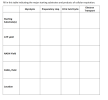 Fill in this table indicating the major starting substrates and products of cellular respiration. Glycolysis Preparatory step Citric Acid Cycle Electron Transport Starting Substrate(s) ATP yield NADH Yield FADH2 Yield Location
BIOL200, Exercise 11+12 Fill in the table below for cellular respiration and each stage of cellular...
 BIOL200, Exercise 11+12 Fill in the table below for cellular respiration and each stage of cellular respiration Stage Products Where Does it Occur Starting Molecules Co, released? (Y/N) 0, Used? (Y/N) Cellular Respiration Glycolysis Pyruvate Processing/Oxidation Krebs Cycle Oxidative Phosphorylation Electron Transport Chemiosmosis 1. What would happen if you stopped cellular respiration in an animal? Briefly explain your answer 4. What would happen to each of the following if we add a chemical that destroys the H+ gradient across the...
PRE-KREBS/TRANSITION PHASE: In the absence of oxygen the luyunde molecules from glycolysis are converted to lactic...
 PRE-KREBS/TRANSITION PHASE: In the absence of oxygen the luyunde molecules from glycolysis are converted to lactic acid. If oxygen is present, they are instead converted into 2 molecules of _which then enter the mitochondria to undergo anaerob metabolism. During this transition phase, no ATP is produced but are released. and Mitochoadrial CITRIC ACID CYCLE: The citric acid cycle occurs in the matrix Both of the molecules of Adel produced after glycolysis run through the citric acid cycle reactions. At the...
Q1: What are catabolism and anabolism (4 marks)? Q2: Under aerobic respiration, a molecule glucose is...
Q1: What are catabolism and anabolism (4 marks)? Q2: Under aerobic respiration, a molecule glucose is oxidized to generate 36 ATPs in eukaryote cell while 38 ATPs in prokaryote cell. Explain how this difference occurred (6 marks). Q3: Why aerobic respiration could produce more energy (ATP molecules) than anaerobic respiration and fermentation? By using glucose as the substrate, illustrate how ATP molecules are being produced in each case (15 marks). Q4: "Most microbes use carbohydrate (glucose) as the energy sources...
 Place the events related to eukaryotic cellular respiration into the boxes corresponding to each location in the cell Production of most ATP occurs here Pyruvate is oxidized to acetyl CoA Glycolysis Initial splitting of glucose Electron transport chain Krebs cycle Cytoplasm Mitochondrial matrix Mitochondrial inner membrane
 The phases of cellular respiration Place each phase of cellular respiration into the box that corresponds to the location of that particular phase. Not all choices will be used: You must distinguish the four phases of cellular respiration from the choices given. Krebs cycle glycolysis production of most ATP preparatory (prep) reaction oxidation of glucose electron transport chain (ETC) Cytoplasm Mitochondrial matrix Cristae of mitochondria glycolysis preparatory (prep) reaction electron transport chain (ETC) Krebs cycle
 Part A Cellular respiration requires fuel (glucose) and oxygen gas. The main process that produces these inputs is photosynthesis glycolysis the Citric Acid cycle electron transport Submit Request Answer Part B Which part(s) of cellular respiration require(s) oxygen gas? the Citric Acid cycle the electron transport chain glycolysis a, b, and c a and b, but not Submit Request Answer Part C What is/are the most important output(s) of glycolysis? MacBook Air Part C What is/are the most important output(s)...
 Which of the following statements is not true? Glycolysis produces most of the ATP required by aerobic organisms like us Glycolysis produces pyruvate, which is consumed by the Krebs cycle Glycolysis occurs in the cytosol of the cell Glycolysis is the first stage of cellular respiration • The Krebs cycle reactions Takes place in the cytoplasm Converts glucose to pyruvate Generate ATP with the help of an enzyme complex called ATP synthase Yield ATP, NADH, and FADH2 • Which of...
 Fill in this table indicating the major starting substrates and products of cellular respiration. Glycolysis Preparatory step Citric Acid Cycle Electron Transport Starting Substrate(s) ATP yield NADH Yield FADH2 Yield Location
 BIOL200, Exercise 11+12 Fill in the table below for cellular respiration and each stage of cellular respiration Stage Products Where Does it Occur Starting Molecules Co, released? (Y/N) 0, Used? (Y/N) Cellular Respiration Glycolysis Pyruvate Processing/Oxidation Krebs Cycle Oxidative Phosphorylation Electron Transport Chemiosmosis 1. What would happen if you stopped cellular respiration in an animal? Briefly explain your answer 4. What would happen to each of the following if we add a chemical that destroys the H+ gradient across the...
 PRE-KREBS/TRANSITION PHASE: In the absence of oxygen the luyunde molecules from glycolysis are converted to lactic acid. If oxygen is present, they are instead converted into 2 molecules of _which then enter the mitochondria to undergo anaerob metabolism. During this transition phase, no ATP is produced but are released. and Mitochoadrial CITRIC ACID CYCLE: The citric acid cycle occurs in the matrix Both of the molecules of Adel produced after glycolysis run through the citric acid cycle reactions. At the...
Most questions answered within 3 hours.
-
Where is the error in this code sequence?
String s1 = "Hello";
String s2 = "ello";...
asked 10 months ago -
Financial data for Joel de Paris, Inc., for last year
follow:
Joel de Paris, Inc.
Balance...
asked 10 months ago -
Consider this reaction:
Al2(SO4)3 (aq)+ BaCl3
(aq) Al2Cl6 (aq)- +
3BaSO4(s) . What is the...
asked 10 months ago -
Suppose that Savneet is considering increasing her
recent random sample from 20 car rentals to 40...
asked 10 months ago -
Trucks arrive at an unloading terminal at an average rate of 120
per hour.
Trucks arrive...
asked 10 months ago -
Why are methanol and ethanol completely soluble in water while
octanol is not very little soluble....
asked 10 months ago -
A facilities manager at a university reads in a research report
that the mean amount of...
asked 10 months ago -
When the CuSO4 is rehydrated by adding water to the anhydrous
compound, is this an endothermic...
asked 10 months ago -
A ray of sunlight is passing from diamond into crown glass; the
angle of incidence is...
asked 10 months ago -
A block of mass 0.249 kg is placed on top of a light, vertical
spring of...
asked 10 months ago -
how do the kidneys compensate in the presences of acidosis
a) trigger hyperventilate
b) reserve acid...
asked 10 months ago -
Question 501 pts
The rental rate of capital to the firm increases. Which of the
following...
asked 10 months ago