

Homework Answers
Add Answer to:
EEET 232-Digital Electronics II Lab Experiment 03 Report Date: Review Questions: Q1: Design a digital circuit...
EE252 100 Points Digital Design I Two's Complement Subtraction and Add / Subtract Circuits Homework 3....
 EE252 100 Points Digital Design I Two's Complement Subtraction and Add / Subtract Circuits Homework 3. (25 Pts) The following circuit uses two 7483 (4-bit adder) ICs, labeled 7483-1 and 7483-2, respectively. Answer the questions for EACH of the following THREE CASES: Case 1: D=0010, and E = 0110 Case 2: D = 1000, and E = 0101 Case 3: D = 1000, and E = 1001 a. (6 Pts - 2 Pts per Case) What are the binary inputs...
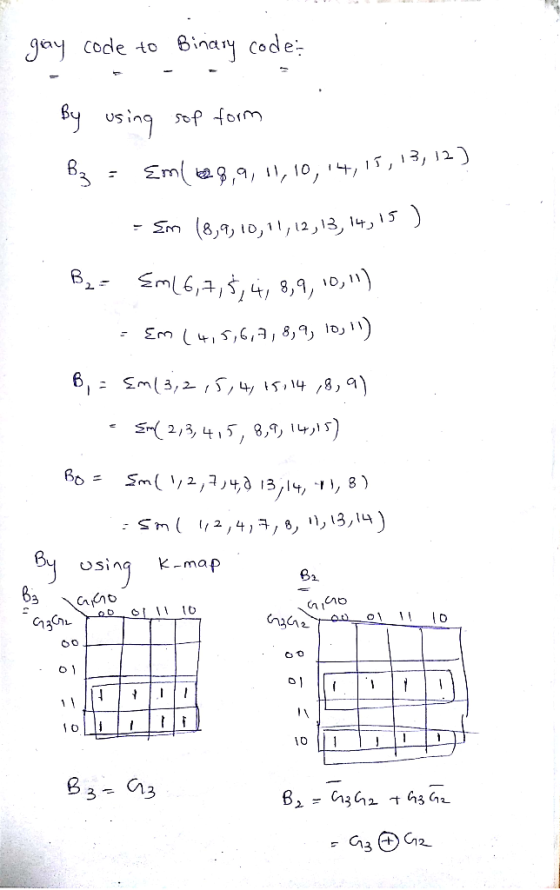
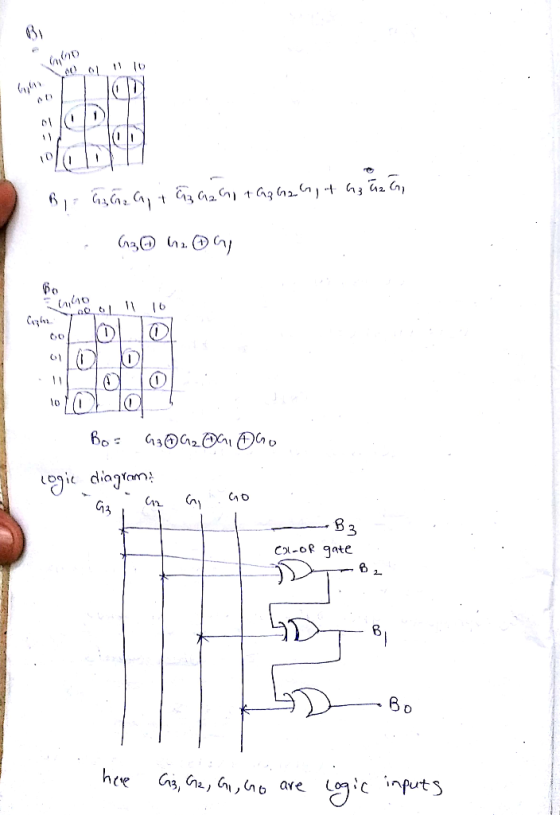
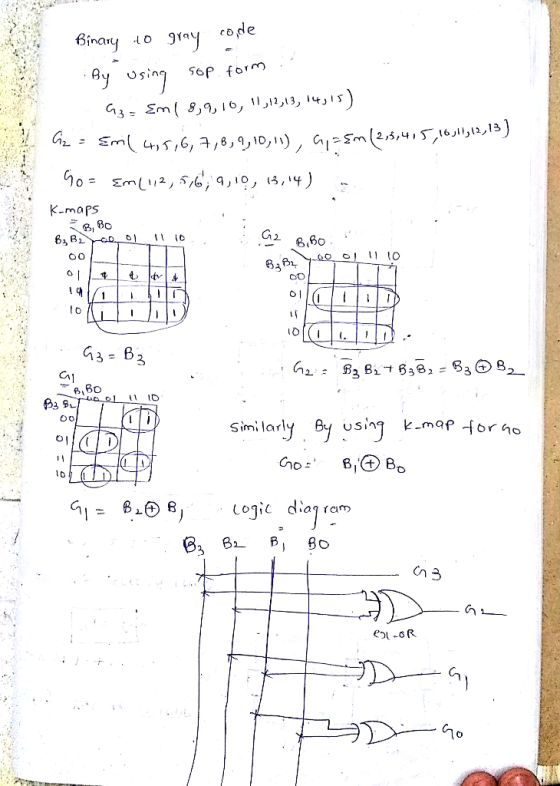
Can someone help me design a gate level circuit and model using HDL? It needs to...
Can someone help me design a gate level circuit and model using HDL? It needs to convert 3-bit gray code to a binary number representation 2) adds the gray code input to its binary representation3) includes a flag(output)to determine when an overflow occurs. For example 111 in gray code is 5 in base 10, the binary representation for 5 is 101, the sum is 1100, an overflow has occurred and the overflow bit is set to 1. You will show...
In this problem you will design a combinational circuit that identifies the largest prime factor of...
In this problem you will design a combinational circuit that identifies the largest prime factor of the numbers between 2 and 15 (inclusive). The input is a 4-bit number B = (b3,b2,b1,b0) and the output is a 4-bit number N = (n3,n2,n1,n0) The values 0 and 1 (inputs 0000 and 0001) are don't cares because they have no prime factor. For your reference, below is a table giving the largest prime factor of the numbers between 2 and 15. B...
3.4.1 Build and simulate the comparator circuit shown in Figure 3, in Multisim. The inputs A3,...
 3.4.1 Build and simulate the comparator circuit shown in Figure 3, in Multisim. The inputs A3, A2, A1, 40 act as the first 4-bit binary number, and B3, B2, B1, BO act as the second 4-bit binary number. Run your circuit for different setting of the inputs as in Table 3 and observe how the output Xchecks if the numbers are equal or not. Note: connect the eight inputs of this circuit to an 8-input DIP switch as shown in...
3. Finite State Machine. Using a ROM based finite state machine (FSM), design a bi-directional repetitive...
 3. Finite State Machine. Using a ROM based finite state machine (FSM), design a bi-directional repetitive 3-bit modulo-6 (0,1,2,3,4,5) counter (see Table 3). The design has one input named Dir and three outputs named B2, B1 and BO. The outputs (B2, B1 and BO) are dependent upon being in the present state only. After each clock pulse, when Dir is at logic "O', the outputs (B2, B1, BO) step through the count sequence in following order:- 0,1,2,3,4,5. After each clock...
task 1: In digital electronics and modern computer hardware, a flip-flop is sequential digital circuit used...
 task 1: In digital electronics and modern computer hardware, a flip-flop is sequential digital circuit used as a basic memory element. It has two stable states and can be used to store state information. One of its states represents '1' while the other represents '0'. The most common types of flip-flops are SR-flip-flop, JK-flip-flop, and D flip-flop. When used in a finite-state machine, the output and next state depend not only on its current input, but also on its current...
Finite state machine (FSM) counter design: Gray codes have a useful property in that consecutive numbers differ in only a single bit position. Table 1 lists a 3-bit modulo 8 Gray code representing the...
 Finite state machine (FSM) counter design: Gray
codes have a useful property in that consecutive numbers differ in
only a single bit position. Table 1 lists a 3-bit modulo 8 Gray
code representing the numbers 0 to 7. Design a 3-bit modulo 8 Gray
code counter FSM.
a) First design and sketch a 3-bit modulo 8 Gray code counter
FSM with no inputs and three outputs, the 3-bit signal
Q2:0. (A modulo N counter counts from 0 to N −...
Finite state machine (FSM) counter design: Gray
codes have a useful property in that consecutive numbers differ in
only a single bit position. Table 1 lists a 3-bit modulo 8 Gray
code representing the numbers 0 to 7. Design a 3-bit modulo 8 Gray
code counter FSM.
a) First design and sketch a 3-bit modulo 8 Gray code counter
FSM with no inputs and three outputs, the 3-bit signal
Q2:0. (A modulo N counter counts from 0 to N −...
Click Submit to complete this assessment Questions 10 points Design a digital circuit that reorders the...
 Click Submit to complete this assessment Questions 10 points Design a digital circuit that reorders the bits of a 4-bit binary number as follows: If the number is even, bits by bb bby become b, bobby. For example, 0110 becomes 1001 If the number is odd, bits bybb, b, bbecome bybob. For example, 1001 becomes 0110 Solve the following on paper, and then fill in the blanks below: NOTE: In parts 3 and 4, there is no need to draw...
Please solve the problems from 2_5 Digital system Problem 2 Design a combinational circuit with inputs...
 Please solve
the problems from 2_5
Digital
system
Problem 2 Design a combinational circuit with inputs a, b, c, d and outputs w, x, y, z. Assume that the inputs a, b, c d represent a 4-bit signed number (2s complement). The output is also a signed number in 2s complement which is 5 greater than the input if the input is less than 2, and is 2 less than the input if the input is greater than or equal...
Please solve
the problems from 2_5
Digital
system
Problem 2 Design a combinational circuit with inputs a, b, c, d and outputs w, x, y, z. Assume that the inputs a, b, c d represent a 4-bit signed number (2s complement). The output is also a signed number in 2s complement which is 5 greater than the input if the input is less than 2, and is 2 less than the input if the input is greater than or equal...
Preparation (Pre-lab) Before coming to the first lab session, complete the following tasks: Generate a truth...
 Preparation (Pre-lab) Before coming to the first lab session, complete the following tasks: Generate a truth table showing inputs vs outputs for the following circuit blocks in Part I: Comparator, Circuit A, and Circuit B. o Use the truth tables to produce minimized SOP (sum of products) for the Comparator, Circuit A and Circuit B. Part I - Simple Binary to BCD Conversion Design Specifications You are to design a circuit that converts a four-bit binary number V[3..0] = V[3]...
 EE252 100 Points Digital Design I Two's Complement Subtraction and Add / Subtract Circuits Homework 3. (25 Pts) The following circuit uses two 7483 (4-bit adder) ICs, labeled 7483-1 and 7483-2, respectively. Answer the questions for EACH of the following THREE CASES: Case 1: D=0010, and E = 0110 Case 2: D = 1000, and E = 0101 Case 3: D = 1000, and E = 1001 a. (6 Pts - 2 Pts per Case) What are the binary inputs...
 3.4.1 Build and simulate the comparator circuit shown in Figure 3, in Multisim. The inputs A3, A2, A1, 40 act as the first 4-bit binary number, and B3, B2, B1, BO act as the second 4-bit binary number. Run your circuit for different setting of the inputs as in Table 3 and observe how the output Xchecks if the numbers are equal or not. Note: connect the eight inputs of this circuit to an 8-input DIP switch as shown in...
 3. Finite State Machine. Using a ROM based finite state machine (FSM), design a bi-directional repetitive 3-bit modulo-6 (0,1,2,3,4,5) counter (see Table 3). The design has one input named Dir and three outputs named B2, B1 and BO. The outputs (B2, B1 and BO) are dependent upon being in the present state only. After each clock pulse, when Dir is at logic "O', the outputs (B2, B1, BO) step through the count sequence in following order:- 0,1,2,3,4,5. After each clock...
 task 1: In digital electronics and modern computer hardware, a flip-flop is sequential digital circuit used as a basic memory element. It has two stable states and can be used to store state information. One of its states represents '1' while the other represents '0'. The most common types of flip-flops are SR-flip-flop, JK-flip-flop, and D flip-flop. When used in a finite-state machine, the output and next state depend not only on its current input, but also on its current...
 Finite state machine (FSM) counter design: Gray
codes have a useful property in that consecutive numbers differ in
only a single bit position. Table 1 lists a 3-bit modulo 8 Gray
code representing the numbers 0 to 7. Design a 3-bit modulo 8 Gray
code counter FSM.
a) First design and sketch a 3-bit modulo 8 Gray code counter
FSM with no inputs and three outputs, the 3-bit signal
Q2:0. (A modulo N counter counts from 0 to N −...
Finite state machine (FSM) counter design: Gray
codes have a useful property in that consecutive numbers differ in
only a single bit position. Table 1 lists a 3-bit modulo 8 Gray
code representing the numbers 0 to 7. Design a 3-bit modulo 8 Gray
code counter FSM.
a) First design and sketch a 3-bit modulo 8 Gray code counter
FSM with no inputs and three outputs, the 3-bit signal
Q2:0. (A modulo N counter counts from 0 to N −...
 Click Submit to complete this assessment Questions 10 points Design a digital circuit that reorders the bits of a 4-bit binary number as follows: If the number is even, bits by bb bby become b, bobby. For example, 0110 becomes 1001 If the number is odd, bits bybb, b, bbecome bybob. For example, 1001 becomes 0110 Solve the following on paper, and then fill in the blanks below: NOTE: In parts 3 and 4, there is no need to draw...
 Please solve
the problems from 2_5
Digital
system
Problem 2 Design a combinational circuit with inputs a, b, c, d and outputs w, x, y, z. Assume that the inputs a, b, c d represent a 4-bit signed number (2s complement). The output is also a signed number in 2s complement which is 5 greater than the input if the input is less than 2, and is 2 less than the input if the input is greater than or equal...
Please solve
the problems from 2_5
Digital
system
Problem 2 Design a combinational circuit with inputs a, b, c, d and outputs w, x, y, z. Assume that the inputs a, b, c d represent a 4-bit signed number (2s complement). The output is also a signed number in 2s complement which is 5 greater than the input if the input is less than 2, and is 2 less than the input if the input is greater than or equal...
 Preparation (Pre-lab) Before coming to the first lab session, complete the following tasks: Generate a truth table showing inputs vs outputs for the following circuit blocks in Part I: Comparator, Circuit A, and Circuit B. o Use the truth tables to produce minimized SOP (sum of products) for the Comparator, Circuit A and Circuit B. Part I - Simple Binary to BCD Conversion Design Specifications You are to design a circuit that converts a four-bit binary number V[3..0] = V[3]...
Most questions answered within 3 hours.
-
Where is the error in this code sequence?
String s1 = "Hello";
String s2 = "ello";...
asked 1 year ago -
Financial data for Joel de Paris, Inc., for last year
follow:
Joel de Paris, Inc.
Balance...
asked 1 year ago -
Consider this reaction:
Al2(SO4)3 (aq)+ BaCl3
(aq) Al2Cl6 (aq)- +
3BaSO4(s) . What is the...
asked 1 year ago -
Suppose that Savneet is considering increasing her
recent random sample from 20 car rentals to 40...
asked 1 year ago -
Trucks arrive at an unloading terminal at an average rate of 120
per hour.
Trucks arrive...
asked 1 year ago -
Why are methanol and ethanol completely soluble in water while
octanol is not very little soluble....
asked 1 year ago -
A facilities manager at a university reads in a research report
that the mean amount of...
asked 1 year ago -
When the CuSO4 is rehydrated by adding water to the anhydrous
compound, is this an endothermic...
asked 1 year ago -
A ray of sunlight is passing from diamond into crown glass; the
angle of incidence is...
asked 1 year ago -
A block of mass 0.249 kg is placed on top of a light, vertical
spring of...
asked 1 year ago -
how do the kidneys compensate in the presences of acidosis
a) trigger hyperventilate
b) reserve acid...
asked 1 year ago -
Question 501 pts
The rental rate of capital to the firm increases. Which of the
following...
asked 1 year ago