Using IS-LM graph and explain what happens if we reduce taxes and increase the money supply....
Using IS-LM graph and explain what happens if we reduce taxes and increase the money supply. Make sure to include the Money graph and Kaynesian Cross
Homework Answers
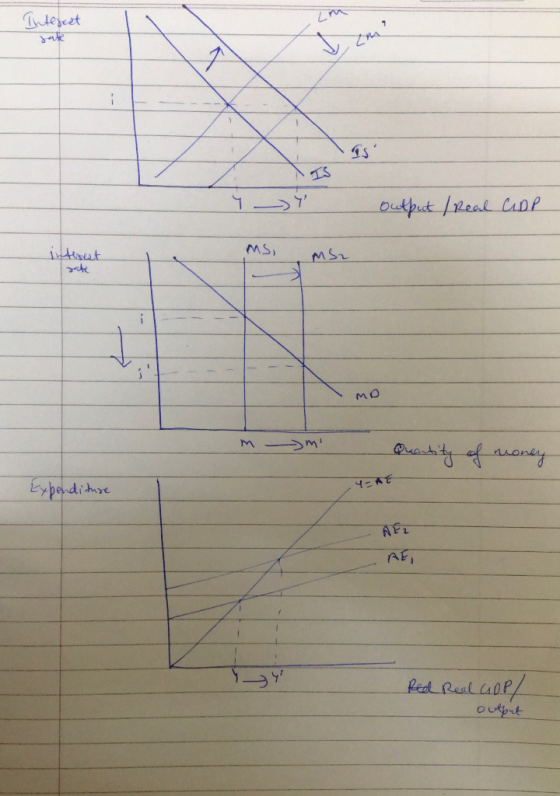
Decrease in taxes shifts IS rightward and increase in money supply shifts LM curve. At new equilibrium output increases and effect on interest rate indeterminate without knowing the magnitudes of shifts.
In the money graph, increase in money supply shifts MS curve rightward resulting in increase in equilibrium quantity of money and decrease in interest rate.
In the Keynesian Cross graph, decrease in taxes shifts the AE curve upward resulting in increase in equilibrium output.
Add Answer to:
Using IS-LM graph and explain what happens if we reduce taxes
and increase the money supply....
Using IS-LM, graph and explain the effects of a reduction in government spending of $800 trillion...
Using IS-LM, graph and explain the effects of a reduction in government spending of $800 trillion dollars and a MPC of .75. Make sure to include the Money graph and the Keynesian Cross
IS-LM What combination of policies would best reduce inflation? a) Increase taxes, sell government bonds b)...
 IS-LM What combination of policies would best reduce inflation? a) Increase taxes, sell government bonds b) Decrease taxes, buy government bonds c) Decrease taxes, lower the reserve ratio d) Decrease government spending, lower the discount rate e) Increase government spending, raise the discount rate Use the IS-LM model. Your policy instruments are: Taxes, Government Spending, and the Money Supply. Describe a policy or set of policies that achieve the following objectives. Your answer should include a diagram to show how...
According to the IS-LM model, what happens in the short run to the interest rate, income,...
According to the IS-LM model, what happens in the short run to the interest rate, income, consumption, and investment under the following circumstances? Be sure your answer includes an appropriate graph. The government increases taxes. ___________________________________________________________________________________________________________________________________________________________________________________________________________________________________________________________________________________________________________________________ The price level decreases. ___________________________________________________________________________________________________________________________________________________________________________________________________________________________________________________________________________________________________________________________ The central bank increases the money supply. ___________________________________________________________________________________________________________________________________________________________________________________________________________________________________________________________________________________________________________________________ The government decreases government purchases. ___________________________________________________________________________________________________________________________________________________________________________________________________________________________________________________________________________________________________________________________
Draw the money market graph, label the money demand and supply and show and explain what...
Draw the money market graph, label the money demand and supply and show and explain what happens to interest rates and money with federal reserve open market operations.
Please box answers! Thank you. 11. Monetary policy and the LM curve Aa Aa The following graph shows the demand and supply of real money balances in a hypothetical economy. Use the black point (X point...
 Please box answers! Thank
you.
11. Monetary policy and the LM curve Aa Aa The following graph shows the demand and supply of real money balances in a hypothetical economy. Use the black point (X point) to indicate the equilibrium in this market. Dashed drop lines will automatically extend to both axes. REAL INTEREST RATE [Percent) 10 Equilibrium Supply New Supply New Equilibrium Demand 3 0 10 20 30 40 50 60 70 80 90 100 REAL MONEY BALANCES Help...
Please box answers! Thank
you.
11. Monetary policy and the LM curve Aa Aa The following graph shows the demand and supply of real money balances in a hypothetical economy. Use the black point (X point) to indicate the equilibrium in this market. Dashed drop lines will automatically extend to both axes. REAL INTEREST RATE [Percent) 10 Equilibrium Supply New Supply New Equilibrium Demand 3 0 10 20 30 40 50 60 70 80 90 100 REAL MONEY BALANCES Help...
Explain what happens to the interest rate if the money supply increases or decreases and the...
Explain what happens to the interest rate if the money supply increases or decreases and the money demand remains unchanged. Explain what happens to the interest rate if the money demand increases or decreases and the money supply remains unchanged.
Using the IS-LM and Aggregate Supply-Aggregate Demand (AS-AD) models of Chapter 12 with a flat short-run...
 Using the IS-LM and Aggregate Supply-Aggregate Demand (AS-AD) models of Chapter 12 with a flat short-run AS curve (that is, completely sticky prices), suppose the economy is at the natural rate of unemployment and so, at long-run equilibrium. Suddenly, taxes are reduced with no change in government spending. Tell me (or show on a graph) what happens to the IS and/or LM curves. Show on a different graph what happens on the AS-AD diagram in the short-run (drawing in the...
1.A. Graph an increase in the money supply and the most likely effect this will have...
1.A. Graph an increase in the money supply and the most likely effect this will have on the AD/AS model. Explain briefly the link between the two graphs. 2.B. Graph an increase in aggregate supply. What effect is this likely to have on the Phillips curve? 3. Finally, use an AD/AS diagram to show what will happen if workers with adaptive expectations demand and receive a 10% wage increase while the chair of the Fed carries through with monetary policies...
1. Explain, with the aid of a diagram, what happens to the money supply, money demand,...
1. Explain, with the aid of a diagram, what happens to the money supply, money demand, the value of money, and the price level if the Central Bank increases the money supply.
1) Explain: Who has control of the money supply in the US Economy? What happens to...
1) Explain: Who has control of the money supply in the US Economy? What happens to the interest rate if the money supply increases or decreases and the demand for money remains unchanged? 2) What are the "Tools" of the Federal Reserve? How are they used to increase the money Supply? How are they used to decrease the money supply? When would you use these policies? No less than 150 words each
 IS-LM What combination of policies would best reduce inflation? a) Increase taxes, sell government bonds b) Decrease taxes, buy government bonds c) Decrease taxes, lower the reserve ratio d) Decrease government spending, lower the discount rate e) Increase government spending, raise the discount rate Use the IS-LM model. Your policy instruments are: Taxes, Government Spending, and the Money Supply. Describe a policy or set of policies that achieve the following objectives. Your answer should include a diagram to show how...
 Please box answers! Thank
you.
11. Monetary policy and the LM curve Aa Aa The following graph shows the demand and supply of real money balances in a hypothetical economy. Use the black point (X point) to indicate the equilibrium in this market. Dashed drop lines will automatically extend to both axes. REAL INTEREST RATE [Percent) 10 Equilibrium Supply New Supply New Equilibrium Demand 3 0 10 20 30 40 50 60 70 80 90 100 REAL MONEY BALANCES Help...
Please box answers! Thank
you.
11. Monetary policy and the LM curve Aa Aa The following graph shows the demand and supply of real money balances in a hypothetical economy. Use the black point (X point) to indicate the equilibrium in this market. Dashed drop lines will automatically extend to both axes. REAL INTEREST RATE [Percent) 10 Equilibrium Supply New Supply New Equilibrium Demand 3 0 10 20 30 40 50 60 70 80 90 100 REAL MONEY BALANCES Help...
 Using the IS-LM and Aggregate Supply-Aggregate Demand (AS-AD) models of Chapter 12 with a flat short-run AS curve (that is, completely sticky prices), suppose the economy is at the natural rate of unemployment and so, at long-run equilibrium. Suddenly, taxes are reduced with no change in government spending. Tell me (or show on a graph) what happens to the IS and/or LM curves. Show on a different graph what happens on the AS-AD diagram in the short-run (drawing in the...
Most questions answered within 3 hours.
-
Where is the error in this code sequence?
String s1 = "Hello";
String s2 = "ello";...
asked 10 months ago -
Financial data for Joel de Paris, Inc., for last year
follow:
Joel de Paris, Inc.
Balance...
asked 10 months ago -
Consider this reaction:
Al2(SO4)3 (aq)+ BaCl3
(aq) Al2Cl6 (aq)- +
3BaSO4(s) . What is the...
asked 10 months ago -
Suppose that Savneet is considering increasing her
recent random sample from 20 car rentals to 40...
asked 10 months ago -
Trucks arrive at an unloading terminal at an average rate of 120
per hour.
Trucks arrive...
asked 10 months ago -
Why are methanol and ethanol completely soluble in water while
octanol is not very little soluble....
asked 10 months ago -
A facilities manager at a university reads in a research report
that the mean amount of...
asked 10 months ago -
When the CuSO4 is rehydrated by adding water to the anhydrous
compound, is this an endothermic...
asked 10 months ago -
A ray of sunlight is passing from diamond into crown glass; the
angle of incidence is...
asked 10 months ago -
A block of mass 0.249 kg is placed on top of a light, vertical
spring of...
asked 10 months ago -
how do the kidneys compensate in the presences of acidosis
a) trigger hyperventilate
b) reserve acid...
asked 10 months ago -
Question 501 pts
The rental rate of capital to the firm increases. Which of the
following...
asked 10 months ago