
![*[n] y[n]=> [n- 1] Unit delay y[n] x[n] Unit delay FIGURE 1.63 For Problem 1.42.](http://img.homeworklib.com/questions/ee961740-c301-11eb-b396-c364c8b4006a.png?x-oss-process=image/resize,w_560)
Homework Answers
Request Answer!
We need at least 10 more requests to produce the answer.
0 / 10 have requested this problem solution
The more requests, the faster the answer.
Add Answer to:
SECTION 1.8—APPLICATIONS 1.42 The unit delay element is shown in Figure 1.63a. Determine the input-output relation...
Consider the system simulation diagram of Figure 1. This figure shows a simulation diagram form used in the area of automatic control where x[n] is the input, y[n] is the output, and D is the unit shi...
 Consider the system simulation diagram of Figure 1. This figure
shows a simulation diagram form used in the area of automatic
control where x[n] is the input, y[n] is the output, and D is the
unit shift (or delay) operator.
1. Suppose x[n] = 0.8 nµ[n] and assuming zero initial conditions
(i.e y[−1] = y[−2] = 0), write a MATLAB program that solves for
y[n], 0 ≤ n ≤ 10. Plot both the input signal x[n] and the output
signal...
Consider the system simulation diagram of Figure 1. This figure
shows a simulation diagram form used in the area of automatic
control where x[n] is the input, y[n] is the output, and D is the
unit shift (or delay) operator.
1. Suppose x[n] = 0.8 nµ[n] and assuming zero initial conditions
(i.e y[−1] = y[−2] = 0), write a MATLAB program that solves for
y[n], 0 ≤ n ≤ 10. Plot both the input signal x[n] and the output
signal...
For the circuit in Figure 1, determine the output voltage eo in relation to the input e 10.0 20.0...
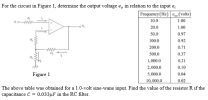 For the circuit in Figure 1, determine the output voltage eo in relation to the input e 10.0 20.0 50.0 100.0 200.0 500.0 1,000.0 2,000.0 5,000.0 10,000.0 1.00 1.00 0.97 0.92 0.71 0.37 0.21 0.10 0.04 0.02 Figure 1 The above table was obtained for a 1.0-volt sine-wane input. Find the value of the resistor R if the capacitance C0.033uF in the RC filter
For the circuit in Figure 1, determine the output voltage eo in relation to the input...
For the circuit in Figure 1, determine the output voltage eo in relation to the input e 10.0 20.0 50.0 100.0 200.0 500.0 1,000.0 2,000.0 5,000.0 10,000.0 1.00 1.00 0.97 0.92 0.71 0.37 0.21 0.10 0.04 0.02 Figure 1 The above table was obtained for a 1.0-volt sine-wane input. Find the value of the resistor R if the capacitance C0.033uF in the RC filter
For the circuit in Figure 1, determine the output voltage eo in relation to the input...
A cascaded system that consists of an LTI system and a delay system is shown in...
 A cascaded system that consists of an LTI system and a delay system is shown in Figure Q4(b). The input signal X(t) and impulse response of the LTI system, h(t) are given as the following: x(t) = 6-2&u(t) h(t) = e-fu(t) Determine: The Fourier transform of y(t). (3 marks) The Fourier transform of z(t). (3 marks) A basic modulator circuit is shown in Figure Q4(c). Modulation is a multiplication between input signal, m(t), and a carrier signal, c(t). The process...
4. When the closed-loop system shown is subjected to a unit-step input, the system output responds...
 4. When the closed-loop system shown is subjected to a unit-step input, the system output responds as shown in the Figure below. Determine the values of K and T from the response curve. 0.254 (seconds)
5. A DT system having input x[n] and output yIn] is described by the difference equation...
 5. A DT system having input x[n] and output yIn] is described by the difference equation J?nJ 0.8 IJln 2] x[n]-0.75x(n-l]. Assuming that x[n]-n(0.75)" u[n], use transfomn methods to determine the output y[n]. The property of DTFTs glnl Lm?G(e'?) then > / G(er) should help in obtaining the DTFT of the input. (20 pts.) ds2
Hi,i need the step for this question..thanks A figure 1 below, show a multiple-input single-output (MISO)...
 Hi,i need the step for this question..thanks
A figure 1 below, show a multiple-input single-output (MISO) sampling system sampling period, T - 15. Determine whether the signal y(t) belongs to the system classifications below against the input signals x (t) and x (t). X(t) = X(t)- y(t) - Sampling Block, Ts y[n] Multiplier Block Sampling System Figure 1 Given that: Input signal x (t) = 2sin (0.5t) Input signal x (t) = 2u(t) Intermediate output signal y(t) = x (t)x(t)...
Hi,i need the step for this question..thanks
A figure 1 below, show a multiple-input single-output (MISO) sampling system sampling period, T - 15. Determine whether the signal y(t) belongs to the system classifications below against the input signals x (t) and x (t). X(t) = X(t)- y(t) - Sampling Block, Ts y[n] Multiplier Block Sampling System Figure 1 Given that: Input signal x (t) = 2sin (0.5t) Input signal x (t) = 2u(t) Intermediate output signal y(t) = x (t)x(t)...
Q2 (a) Given the signal x(t) and system h(t) as presented in Figure Q2(a). Determine the...
 Q2 (a) Given the signal x(t) and system h(t) as presented in Figure Q2(a). Determine the output y(t) using the graphical representation of convolution integral. (7 marks) x(1) h(t) 1 e-'u(t) e-2 (1) 0 Figure Q2(a) Q2 (b) Consider a system as shown in Figure Q2(b). t2 - 1 x(t) y(t) Advance by 1 second Х Figure Q2(b) Find the input-output relation between x(t) and y(t). (i) (1 mark) Examine whether the system is time variant or time invariant. (5...
(2) Consider the causal discrete-time LTI system with an input r (n) and an output y(n)...
 (2) Consider the causal discrete-time LTI system with an input r (n) and an output y(n) as shown in Figure 1, where K 6 (constant), system #1 is described by its impulse response: h(n) = -36(n) + 0.48(n- 1)+8.26(n-2), and system # 2 has the difference equation given by: y(n)+0.1y(n-1)+0.3y(n-2)- 2a(n). (a) Determine the corresponding difference equation of the system #1. Hence, write its fre- quency response. (b) Find the frequency response of system #2. 1 system #1 system #2...
for the plot, provide the matlab code. 3. Let the input signal x[n] (defined for -<n...
 for the plot, provide the matlab code.
3. Let the input signal x[n] (defined for -<n < oo) to the system be x[n] = 3 cos( 0.05πn) + 4 cos( 0.45πn) + cos( 0.95 n) and the transfer function be 1-re-je a) Plot this signal as a function of n. b) Determine and plot the output y[n] produced by the system due to the input analyzed in part a) of this problem. Do this first with r 0.05 and then...
for the plot, provide the matlab code.
3. Let the input signal x[n] (defined for -<n < oo) to the system be x[n] = 3 cos( 0.05πn) + 4 cos( 0.45πn) + cos( 0.95 n) and the transfer function be 1-re-je a) Plot this signal as a function of n. b) Determine and plot the output y[n] produced by the system due to the input analyzed in part a) of this problem. Do this first with r 0.05 and then...
please answer all parts. 4.30 In the SMD system shown in Fig. P4.30, vx(t) is the input velocity of the platform and vy(t) is the output velocity of the 100 kg mass. v(t) 100 kg Ns 100 100 S 100...
 please answer all parts.
4.30 In the SMD system shown in Fig. P4.30, vx(t) is the input velocity of the platform and vy(t) is the output velocity of the 100 kg mass. v(t) 100 kg Ns 100 100 S 100 kg 100 N Sv() 100 Figure P4.30: SMD system of Problem 4.30. APPLICATIONS OF THE LAPLACE TRANSFORM PTER 4 (a) Draw the equivalent s-domain circuit. (c) Determine the frequency response. Hint: Use two node equations.
4.30 In the SMD system...
please answer all parts.
4.30 In the SMD system shown in Fig. P4.30, vx(t) is the input velocity of the platform and vy(t) is the output velocity of the 100 kg mass. v(t) 100 kg Ns 100 100 S 100 kg 100 N Sv() 100 Figure P4.30: SMD system of Problem 4.30. APPLICATIONS OF THE LAPLACE TRANSFORM PTER 4 (a) Draw the equivalent s-domain circuit. (c) Determine the frequency response. Hint: Use two node equations.
4.30 In the SMD system...
 Consider the system simulation diagram of Figure 1. This figure
shows a simulation diagram form used in the area of automatic
control where x[n] is the input, y[n] is the output, and D is the
unit shift (or delay) operator.
1. Suppose x[n] = 0.8 nµ[n] and assuming zero initial conditions
(i.e y[−1] = y[−2] = 0), write a MATLAB program that solves for
y[n], 0 ≤ n ≤ 10. Plot both the input signal x[n] and the output
signal...
Consider the system simulation diagram of Figure 1. This figure
shows a simulation diagram form used in the area of automatic
control where x[n] is the input, y[n] is the output, and D is the
unit shift (or delay) operator.
1. Suppose x[n] = 0.8 nµ[n] and assuming zero initial conditions
(i.e y[−1] = y[−2] = 0), write a MATLAB program that solves for
y[n], 0 ≤ n ≤ 10. Plot both the input signal x[n] and the output
signal...
 For the circuit in Figure 1, determine the output voltage eo in relation to the input e 10.0 20.0 50.0 100.0 200.0 500.0 1,000.0 2,000.0 5,000.0 10,000.0 1.00 1.00 0.97 0.92 0.71 0.37 0.21 0.10 0.04 0.02 Figure 1 The above table was obtained for a 1.0-volt sine-wane input. Find the value of the resistor R if the capacitance C0.033uF in the RC filter
For the circuit in Figure 1, determine the output voltage eo in relation to the input...
For the circuit in Figure 1, determine the output voltage eo in relation to the input e 10.0 20.0 50.0 100.0 200.0 500.0 1,000.0 2,000.0 5,000.0 10,000.0 1.00 1.00 0.97 0.92 0.71 0.37 0.21 0.10 0.04 0.02 Figure 1 The above table was obtained for a 1.0-volt sine-wane input. Find the value of the resistor R if the capacitance C0.033uF in the RC filter
For the circuit in Figure 1, determine the output voltage eo in relation to the input...
 A cascaded system that consists of an LTI system and a delay system is shown in Figure Q4(b). The input signal X(t) and impulse response of the LTI system, h(t) are given as the following: x(t) = 6-2&u(t) h(t) = e-fu(t) Determine: The Fourier transform of y(t). (3 marks) The Fourier transform of z(t). (3 marks) A basic modulator circuit is shown in Figure Q4(c). Modulation is a multiplication between input signal, m(t), and a carrier signal, c(t). The process...
 4. When the closed-loop system shown is subjected to a unit-step input, the system output responds as shown in the Figure below. Determine the values of K and T from the response curve. 0.254 (seconds)
 5. A DT system having input x[n] and output yIn] is described by the difference equation J?nJ 0.8 IJln 2] x[n]-0.75x(n-l]. Assuming that x[n]-n(0.75)" u[n], use transfomn methods to determine the output y[n]. The property of DTFTs glnl Lm?G(e'?) then > / G(er) should help in obtaining the DTFT of the input. (20 pts.) ds2
 Hi,i need the step for this question..thanks
A figure 1 below, show a multiple-input single-output (MISO) sampling system sampling period, T - 15. Determine whether the signal y(t) belongs to the system classifications below against the input signals x (t) and x (t). X(t) = X(t)- y(t) - Sampling Block, Ts y[n] Multiplier Block Sampling System Figure 1 Given that: Input signal x (t) = 2sin (0.5t) Input signal x (t) = 2u(t) Intermediate output signal y(t) = x (t)x(t)...
Hi,i need the step for this question..thanks
A figure 1 below, show a multiple-input single-output (MISO) sampling system sampling period, T - 15. Determine whether the signal y(t) belongs to the system classifications below against the input signals x (t) and x (t). X(t) = X(t)- y(t) - Sampling Block, Ts y[n] Multiplier Block Sampling System Figure 1 Given that: Input signal x (t) = 2sin (0.5t) Input signal x (t) = 2u(t) Intermediate output signal y(t) = x (t)x(t)...
 Q2 (a) Given the signal x(t) and system h(t) as presented in Figure Q2(a). Determine the output y(t) using the graphical representation of convolution integral. (7 marks) x(1) h(t) 1 e-'u(t) e-2 (1) 0 Figure Q2(a) Q2 (b) Consider a system as shown in Figure Q2(b). t2 - 1 x(t) y(t) Advance by 1 second Х Figure Q2(b) Find the input-output relation between x(t) and y(t). (i) (1 mark) Examine whether the system is time variant or time invariant. (5...
 (2) Consider the causal discrete-time LTI system with an input r (n) and an output y(n) as shown in Figure 1, where K 6 (constant), system #1 is described by its impulse response: h(n) = -36(n) + 0.48(n- 1)+8.26(n-2), and system # 2 has the difference equation given by: y(n)+0.1y(n-1)+0.3y(n-2)- 2a(n). (a) Determine the corresponding difference equation of the system #1. Hence, write its fre- quency response. (b) Find the frequency response of system #2. 1 system #1 system #2...
 for the plot, provide the matlab code.
3. Let the input signal x[n] (defined for -<n < oo) to the system be x[n] = 3 cos( 0.05πn) + 4 cos( 0.45πn) + cos( 0.95 n) and the transfer function be 1-re-je a) Plot this signal as a function of n. b) Determine and plot the output y[n] produced by the system due to the input analyzed in part a) of this problem. Do this first with r 0.05 and then...
for the plot, provide the matlab code.
3. Let the input signal x[n] (defined for -<n < oo) to the system be x[n] = 3 cos( 0.05πn) + 4 cos( 0.45πn) + cos( 0.95 n) and the transfer function be 1-re-je a) Plot this signal as a function of n. b) Determine and plot the output y[n] produced by the system due to the input analyzed in part a) of this problem. Do this first with r 0.05 and then...
 please answer all parts.
4.30 In the SMD system shown in Fig. P4.30, vx(t) is the input velocity of the platform and vy(t) is the output velocity of the 100 kg mass. v(t) 100 kg Ns 100 100 S 100 kg 100 N Sv() 100 Figure P4.30: SMD system of Problem 4.30. APPLICATIONS OF THE LAPLACE TRANSFORM PTER 4 (a) Draw the equivalent s-domain circuit. (c) Determine the frequency response. Hint: Use two node equations.
4.30 In the SMD system...
please answer all parts.
4.30 In the SMD system shown in Fig. P4.30, vx(t) is the input velocity of the platform and vy(t) is the output velocity of the 100 kg mass. v(t) 100 kg Ns 100 100 S 100 kg 100 N Sv() 100 Figure P4.30: SMD system of Problem 4.30. APPLICATIONS OF THE LAPLACE TRANSFORM PTER 4 (a) Draw the equivalent s-domain circuit. (c) Determine the frequency response. Hint: Use two node equations.
4.30 In the SMD system...
Most questions answered within 3 hours.
-
Where is the error in this code sequence?
String s1 = "Hello";
String s2 = "ello";...
asked 11 months ago -
Financial data for Joel de Paris, Inc., for last year
follow:
Joel de Paris, Inc.
Balance...
asked 11 months ago -
Consider this reaction:
Al2(SO4)3 (aq)+ BaCl3
(aq) Al2Cl6 (aq)- +
3BaSO4(s) . What is the...
asked 11 months ago -
Suppose that Savneet is considering increasing her
recent random sample from 20 car rentals to 40...
asked 11 months ago -
Trucks arrive at an unloading terminal at an average rate of 120
per hour.
Trucks arrive...
asked 11 months ago -
Why are methanol and ethanol completely soluble in water while
octanol is not very little soluble....
asked 11 months ago -
A facilities manager at a university reads in a research report
that the mean amount of...
asked 11 months ago -
When the CuSO4 is rehydrated by adding water to the anhydrous
compound, is this an endothermic...
asked 11 months ago -
A ray of sunlight is passing from diamond into crown glass; the
angle of incidence is...
asked 11 months ago -
A block of mass 0.249 kg is placed on top of a light, vertical
spring of...
asked 11 months ago -
how do the kidneys compensate in the presences of acidosis
a) trigger hyperventilate
b) reserve acid...
asked 11 months ago -
Question 501 pts
The rental rate of capital to the firm increases. Which of the
following...
asked 11 months ago