 Only questoin 4 but it refers
to question 3 which is why i put question 3 as well.
Only questoin 4 but it refers
to question 3 which is why i put question 3 as well.
Homework Answers
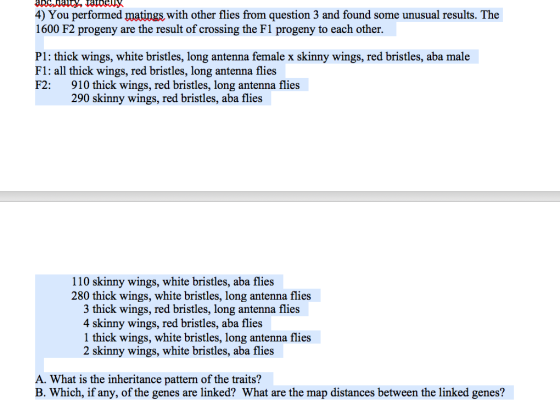
B. There is incomplete linkage has occurred.
910 thick wings (T), red bristles (R), long antenna flies (L) – T R L (wild type)
110 skinny wings (t), white bristles (r), aba flies (l) – t r l (wild type)
290 skinny wings, red bristles, aba flies – t R l (double cross over [D.C.O])
280 thick wings, white bristles, long antenna flies – T r L (double cross over [D.C.O])
4 skinny wings, red bristles, long antenna flies – t R L (single cross over [S.C.O] I)
2 skinny wings, white bristles, long antenna flies – t r L (single cross over [S.C.O] I)
3 thick wings, red bristles, aba flies – T R l (single cross over [S.C.O] II)
1 thick wings, white bristles, aba flies – T r l (single cross over [S.C.O] II)
Total progeny – [ 910 + 110 + 290 + 280 + 4 + 2 + 3 + 1] = 1600
Frequency of double cross over – [(570/1600)*100] = 35.625
Frequency of S.C.O I – [(6/1600)*100] = 0.375
Frequency of S.C.O II – [(4/1600)*100] = 0.25
Map distance between T and R is – S.C.O I + D.C.O = 35.625 + 0.375 = 36 m.u
Map distance between R and L – S.C.O II + D.C.O = 35.625 + 0.25 = 35.875 m.u
T---------------36 m.u-----------R-----------35.875 m.u-----------L
Add Answer to:
Only questoin 4 but it refers
to question 3 which is why i put question 3...
The female has a wood stick-like body and short antenna, T The male has a leaf-like...
The female has a wood stick-like body and short antenna, T The male has a leaf-like body and fanned antenna. All the flies in the F1 generation have a wood stick-like body and a fanned antenna. Associate the alleles with the appropriate letter, with “B” an “b” for body type and “A” and “a” for antenna type. The uppercases “B” and “A” indicate the dominant allele, the lowercases “b” and “a” the recessive allele. You next cross F1 females with...
Bio215 Problem Questions Hassanaton MULTIPLE CHOICE 1) Pea plants were particularly well suited for use in...
 Bio215 Problem Questions Hassanaton MULTIPLE CHOICE 1) Pea plants were particularly well suited for use in Mendel's breeding experiments for all of the following reasons exep that ) peas show easily observed variations in a number of characters, such as pea shape and flower color. B) it is possible to completely control matings between different per plants. C) it is possible to obtain large numbers of progeny from any given cross. D) peas have an unusually long generation time. E)...
need help with question 2, 4, 6 a.&b. 2. For a (fictitious) haploid fungus, the starting...
 need help with question 2, 4, 6 a.&b.
2. For a (fictitious) haploid fungus, the starting point in the biosynthesis of the amino acid arginine is Compound X, which is always present in, and absorbed from the environment. The arginine biosynthetic pathway is: Enzyme B → Compound Y Compound z Enzyme C Compound X Enzyme A arginine A mutant strain of genotype a (lacking enzyme A) is crossed to a mutant strain of genotype c (lacking enzyme C). What proportion...
need help with question 2, 4, 6 a.&b.
2. For a (fictitious) haploid fungus, the starting point in the biosynthesis of the amino acid arginine is Compound X, which is always present in, and absorbed from the environment. The arginine biosynthetic pathway is: Enzyme B → Compound Y Compound z Enzyme C Compound X Enzyme A arginine A mutant strain of genotype a (lacking enzyme A) is crossed to a mutant strain of genotype c (lacking enzyme C). What proportion...
Use the information gathered in the X-Linked Inheritance Animation to answer the following question. Since the...
Use the information gathered in the X-Linked Inheritance Animation to answer the following question. Since the white-eye trait is X-linked recessive, what result would you expect when crossing a heterozygous red-eyed female with a white-eyed male? 1) all red-eyed males with half of the females having white and half of the females having red eyes 2)all red-eyed females and all white-eyed males 3)all red-eyed females with half of the males having white and half of the males having red eyes...
all of them please Question 10 (1 point) In Drosophila, the mutant black (b) has a...
 all of them please
Question 10 (1 point) In Drosophila, the mutant black (b) has a black body and the wild-type (b+) has a gray body; the mutant vestigial (v) has wings that are short and crumpled compared the long wild-type wings (V+). These genes are linked and are located on the X- chromosome. A cross between a female fly and a black, vestigial winged male fly produced the following progeny: gray (b+), normal (v+) 20 gray (b+), vestigial (v)...
all of them please
Question 10 (1 point) In Drosophila, the mutant black (b) has a black body and the wild-type (b+) has a gray body; the mutant vestigial (v) has wings that are short and crumpled compared the long wild-type wings (V+). These genes are linked and are located on the X- chromosome. A cross between a female fly and a black, vestigial winged male fly produced the following progeny: gray (b+), normal (v+) 20 gray (b+), vestigial (v)...
P1: wispy whisker, pink eye, hairy female #1 x thick whisker, brown eye, hairless male #A...
 P1: wispy whisker, pink eye, hairy female #1 x thick whisker, brown eye, hairless male #A F1: all wispy whisker, brown eye, hairy rodents F2: 910 wispy whisker, brown eye, hairy rodents 290 thick whisker, brown eye, hairless rodents 110 thick whisker, pink eye, hairless rodents 280 wispy whisker, pink eye, hairy rodents 3 wispy whisker, brown eye, hairless rodents 4 thick whisker, brown eye, hairy rodents 1 wispy whisker, pink eye, hairless rodents 2 thick whisker, pink eye, hairy...
7.) Haemophilia is an X-linked recessive disorder. If a male haemophiliac mates with a normal (non-haemophiliac)...
7.) Haemophilia is an X-linked recessive disorder. If a male haemophiliac mates with a normal (non-haemophiliac) homozygous woman, would the progeny be affected? a. All males would be carriers. All females would be normal. b. All males would be normal. Half of the females would be carriers and half of the females would have haemophilia. c. All males would be normal. All females would be carriers. d. Half of each sex would be normal and half of each sex would...
Fun-filled Genetics activity Set Psa plants were particularly well suited for use in Mendel's breeding experiments...
 Fun-filled Genetics activity Set Psa plants were particularly well suited for use in Mendel's breeding experiments for all of the following m e thal Al was show easily terved various in a number of characters, such as a shape and flower color, it is powible to completely control tingshotween different pe plants, it is possible to a large numbers of progeny from any given cross. Dipeas have unusually long generation time, many of the observable characters that vary in pea...
Question 4 (1 point) Continue Consider a mating between a single F2 male that is phenotypically...
 Question 4 (1 point) Continue Consider a mating between a single F2 male that is phenotypically wild-type (i.e., red eyes and tan body) and a single, phenotypically wild-type F2 female. What is the probability that ALL of the resulting F3 progeny will be true breeding and have red eyes and tan bodies? 1/6 01/12 1/256 1/36 1/8 1/64 1/18 1/32 Question 3 (1 point) Saved In flies (Drosophila), loss of function mutations in the X-linked white gene cause a recessive...
Question 3. The vermillion mutation in flies is X-linked, while the brown mutation is autosomal. Which...
 Question 3. The vermillion mutation in flies is X-linked, while the brown mutation is autosomal. Which of the following phenotypes will be observed in the Fl progeny from a cross between a vermillion-eyed female and a brown-eyed male? Option F1 daughters F1 sons Wild type Brown Wild type Vermillion c) Wild type Wild type (d) Brown Vermillion Vermillion Brown Question 6. DEFICIENCY MAPPING VIA COMPLEMENTATION In two mutagenesis experiments, one in which saturation mutagenesis was used with EMS and the...
 Bio215 Problem Questions Hassanaton MULTIPLE CHOICE 1) Pea plants were particularly well suited for use in Mendel's breeding experiments for all of the following reasons exep that ) peas show easily observed variations in a number of characters, such as pea shape and flower color. B) it is possible to completely control matings between different per plants. C) it is possible to obtain large numbers of progeny from any given cross. D) peas have an unusually long generation time. E)...
 need help with question 2, 4, 6 a.&b.
2. For a (fictitious) haploid fungus, the starting point in the biosynthesis of the amino acid arginine is Compound X, which is always present in, and absorbed from the environment. The arginine biosynthetic pathway is: Enzyme B → Compound Y Compound z Enzyme C Compound X Enzyme A arginine A mutant strain of genotype a (lacking enzyme A) is crossed to a mutant strain of genotype c (lacking enzyme C). What proportion...
need help with question 2, 4, 6 a.&b.
2. For a (fictitious) haploid fungus, the starting point in the biosynthesis of the amino acid arginine is Compound X, which is always present in, and absorbed from the environment. The arginine biosynthetic pathway is: Enzyme B → Compound Y Compound z Enzyme C Compound X Enzyme A arginine A mutant strain of genotype a (lacking enzyme A) is crossed to a mutant strain of genotype c (lacking enzyme C). What proportion...
 all of them please
Question 10 (1 point) In Drosophila, the mutant black (b) has a black body and the wild-type (b+) has a gray body; the mutant vestigial (v) has wings that are short and crumpled compared the long wild-type wings (V+). These genes are linked and are located on the X- chromosome. A cross between a female fly and a black, vestigial winged male fly produced the following progeny: gray (b+), normal (v+) 20 gray (b+), vestigial (v)...
all of them please
Question 10 (1 point) In Drosophila, the mutant black (b) has a black body and the wild-type (b+) has a gray body; the mutant vestigial (v) has wings that are short and crumpled compared the long wild-type wings (V+). These genes are linked and are located on the X- chromosome. A cross between a female fly and a black, vestigial winged male fly produced the following progeny: gray (b+), normal (v+) 20 gray (b+), vestigial (v)...
 P1: wispy whisker, pink eye, hairy female #1 x thick whisker, brown eye, hairless male #A F1: all wispy whisker, brown eye, hairy rodents F2: 910 wispy whisker, brown eye, hairy rodents 290 thick whisker, brown eye, hairless rodents 110 thick whisker, pink eye, hairless rodents 280 wispy whisker, pink eye, hairy rodents 3 wispy whisker, brown eye, hairless rodents 4 thick whisker, brown eye, hairy rodents 1 wispy whisker, pink eye, hairless rodents 2 thick whisker, pink eye, hairy...
 Fun-filled Genetics activity Set Psa plants were particularly well suited for use in Mendel's breeding experiments for all of the following m e thal Al was show easily terved various in a number of characters, such as a shape and flower color, it is powible to completely control tingshotween different pe plants, it is possible to a large numbers of progeny from any given cross. Dipeas have unusually long generation time, many of the observable characters that vary in pea...
 Question 4 (1 point) Continue Consider a mating between a single F2 male that is phenotypically wild-type (i.e., red eyes and tan body) and a single, phenotypically wild-type F2 female. What is the probability that ALL of the resulting F3 progeny will be true breeding and have red eyes and tan bodies? 1/6 01/12 1/256 1/36 1/8 1/64 1/18 1/32 Question 3 (1 point) Saved In flies (Drosophila), loss of function mutations in the X-linked white gene cause a recessive...
 Question 3. The vermillion mutation in flies is X-linked, while the brown mutation is autosomal. Which of the following phenotypes will be observed in the Fl progeny from a cross between a vermillion-eyed female and a brown-eyed male? Option F1 daughters F1 sons Wild type Brown Wild type Vermillion c) Wild type Wild type (d) Brown Vermillion Vermillion Brown Question 6. DEFICIENCY MAPPING VIA COMPLEMENTATION In two mutagenesis experiments, one in which saturation mutagenesis was used with EMS and the...
Most questions answered within 3 hours.
-
Where is the error in this code sequence?
String s1 = "Hello";
String s2 = "ello";...
asked 10 months ago -
Financial data for Joel de Paris, Inc., for last year
follow:
Joel de Paris, Inc.
Balance...
asked 10 months ago -
Consider this reaction:
Al2(SO4)3 (aq)+ BaCl3
(aq) Al2Cl6 (aq)- +
3BaSO4(s) . What is the...
asked 10 months ago -
Suppose that Savneet is considering increasing her
recent random sample from 20 car rentals to 40...
asked 10 months ago -
Trucks arrive at an unloading terminal at an average rate of 120
per hour.
Trucks arrive...
asked 10 months ago -
Why are methanol and ethanol completely soluble in water while
octanol is not very little soluble....
asked 10 months ago -
A facilities manager at a university reads in a research report
that the mean amount of...
asked 10 months ago -
When the CuSO4 is rehydrated by adding water to the anhydrous
compound, is this an endothermic...
asked 10 months ago -
A ray of sunlight is passing from diamond into crown glass; the
angle of incidence is...
asked 10 months ago -
A block of mass 0.249 kg is placed on top of a light, vertical
spring of...
asked 10 months ago -
how do the kidneys compensate in the presences of acidosis
a) trigger hyperventilate
b) reserve acid...
asked 10 months ago -
Question 501 pts
The rental rate of capital to the firm increases. Which of the
following...
asked 10 months ago