
Homework Answers
For radiation heat transfer between two very long concentric cylinders
(from heat transfer data book)
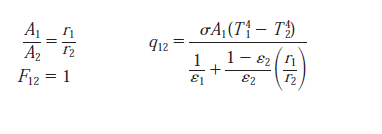
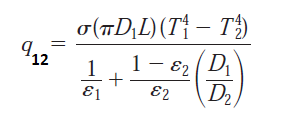
therefore


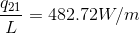
note: the negative sign shows the heat transfer from outer cylinder (2) to inner cylinder (1)
therefore
Add Answer to:
Question 2 3 points Save Ans Two very long concentric cylinders shown in the figure are...
Question 1 2 points Save Answer Two very large parallel plates shown in the figure maintained...
 Question 1 2 points Save Answer Two very large parallel plates shown in the figure maintained at uniform tomperatures. Determine the netrade of radiation heat transfer between the two plates (in Watt) Assume Th=763 K and p = 0.7 T, 400K E -0.9
Assume all the surfaces given in the following figure having an emissivity- 0.20The surfaces are maintained at uniform temperatures as indicated on the figure. If IW-4M determine i The view facto...
 Assume all the surfaces given in the following figure having an emissivity- 0.20The surfaces are maintained at uniform temperatures as indicated on the figure. If IW-4M determine i The view factor of surface 1 on surface 3, Fi ii The net rate of radiation heat transfer between surface 1 and 3, Qn I" T,-300 K 4m T,-400 K 3 m T- 500K 2 m
Assume all the surfaces given in the following figure having an emissivity- 0.20The surfaces are maintained...
Assume all the surfaces given in the following figure having an emissivity- 0.20The surfaces are maintained at uniform temperatures as indicated on the figure. If IW-4M determine i The view factor of surface 1 on surface 3, Fi ii The net rate of radiation heat transfer between surface 1 and 3, Qn I" T,-300 K 4m T,-400 K 3 m T- 500K 2 m
Assume all the surfaces given in the following figure having an emissivity- 0.20The surfaces are maintained...
The capacitance per unit length of a very long coaxial cable, made of two concentric cylinders,...
The capacitance per unit length of a very long coaxial cable, made of two concentric cylinders, is 50 pF/m. What is the radius of the outer cylinder if the radius of the inner one is 1.0 mm? (k = 1/4??0 = 8.99 � 109 N ? m2/C2) Answer 0.50 mm 3.0 mm 4.0 mm 2.0 mm 1.0 mm
3. Two gray-diffuse spheres have properties and temperatures shown below. R and R2 are 0.1 m and 0.3 m respectively. (i...
 3. Two gray-diffuse spheres have properties and temperatures shown below. R and R2 are 0.1 m and 0.3 m respectively. (i) Compute heat transfer rate of sphere 1, q W]. Also, to minimize the heat loss, you decide to put a radiation shield in between the two spheres. (ii) Where do you prefer to place the radiation shield, i.e., close to sphere 1 or sphere 2 or right in the middle? (iii Somehow you place the radiation shield with R3...
T, = 700K E 0.8 RI T, =900K 2 R2 E20.5 3. Two gray-diffuse spheres have...
 T, = 700K E 0.8 RI T, =900K 2 R2 E20.5 3. Two gray-diffuse spheres have properties and temperatures shown below. R and R2 are 0.1 m and 0.3 m respectively. (i) Compute heat transfer rate of sphere 1, q W]. Also, to minimize the heat loss, you decide to put a radiation shield in between the two spheres. (ii) Where do you prefer to place the radiation shield, i.e., close to sphere 1 or sphere 2 or right in...
heat transfer Consider the picture shown below. The very long cylindrical rod (surface 1) acts as...
 heat transfer
Consider the picture shown below. The very long cylindrical rod (surface 1) acts as a black surface 1 m in diameter which is maintained at 1000 K. The rod is surrounded by a very thin cylindrical shield with inner surface 3-1 and outer surface 3-2. The diameter of this shield is 2 m; and is so thin that the inner and outer surface areas are essentially the same. The shield has an emissivity of 0.3 on both sides....
heat transfer
Consider the picture shown below. The very long cylindrical rod (surface 1) acts as a black surface 1 m in diameter which is maintained at 1000 K. The rod is surrounded by a very thin cylindrical shield with inner surface 3-1 and outer surface 3-2. The diameter of this shield is 2 m; and is so thin that the inner and outer surface areas are essentially the same. The shield has an emissivity of 0.3 on both sides....
Question 2 1. Two perfectly conducting cylinders ra and rb form an inductor of length d, as shown...
 Question 2 1. Two perfectly conducting cylinders ra and rb form an inductor of length d, as shown in the figure below. The total current I flowing on the surface r-α of the inner cylinder is returned through the outer conductor r - b. The medium between the two conductors has magnetic permeability m a) Find the magnetic field intensity H everywhere, disregarding "edge effects" (i.e. assuming that the a, b and hence, it can be considered as infinite) length...
A simplified representation for cooling in very large- scale integration (VLSI) of microelectronics is shown in...
 A simplified representation for cooling in very large- scale integration (VLSI) of microelectronics is shown in the sketch below. A silicon chip is mounted in a dielectric substrate, and one surface of the system is convectively cooled, while the reminding surfaces are well insulated from the surrounding. The problem is rendered two dimensional by assuming the system to be very large in the direction perpendicular to the paper. Under steady state (1) and transient (2) operation electronic power dissipation in...
Chenical reaction, Figure 1: Two end of the rods are maintained at different temperatures A chemically...
 Chenical reaction, Figure 1: Two end of the rods are maintained at different temperatures A chemically reacting mixture is stored in a thin-walled spherical container of radius 1 200 mm, and the exothermic reaction generates heat at a uniform, but temperature-dependent volumetric rate of q exp( A/T ), where如= 500 W/m3. A = 75 K. and To IS the mixture teinperature in kelvins. The vessel is enclosed by an insulating material of outer radius r2, thermal conductivity k, and emissivity...
Two-Dimensional Steady and Transient Conduction - Cooling a very large scale microelectronic chip, A simplified representation...
 Two-Dimensional Steady and Transient Conduction - Cooling a very
large scale microelectronic chip,
A simplified
representation for cooling in very large-scale integration (VLSI)
of microelectronics is shown in the sketch below. A silicon chip is
mounted in a dielectric substrate, and one surface of the system is
convectively cooled, while the reminding surfaces are well
insulated from the surrounding. The problem is rendered two
dimensional by assuming the system to be very large in the
direction perpendicular to the paper....
Two-Dimensional Steady and Transient Conduction - Cooling a very
large scale microelectronic chip,
A simplified
representation for cooling in very large-scale integration (VLSI)
of microelectronics is shown in the sketch below. A silicon chip is
mounted in a dielectric substrate, and one surface of the system is
convectively cooled, while the reminding surfaces are well
insulated from the surrounding. The problem is rendered two
dimensional by assuming the system to be very large in the
direction perpendicular to the paper....
 Question 1 2 points Save Answer Two very large parallel plates shown in the figure maintained at uniform tomperatures. Determine the netrade of radiation heat transfer between the two plates (in Watt) Assume Th=763 K and p = 0.7 T, 400K E -0.9
 Assume all the surfaces given in the following figure having an emissivity- 0.20The surfaces are maintained at uniform temperatures as indicated on the figure. If IW-4M determine i The view factor of surface 1 on surface 3, Fi ii The net rate of radiation heat transfer between surface 1 and 3, Qn I" T,-300 K 4m T,-400 K 3 m T- 500K 2 m
Assume all the surfaces given in the following figure having an emissivity- 0.20The surfaces are maintained...
Assume all the surfaces given in the following figure having an emissivity- 0.20The surfaces are maintained at uniform temperatures as indicated on the figure. If IW-4M determine i The view factor of surface 1 on surface 3, Fi ii The net rate of radiation heat transfer between surface 1 and 3, Qn I" T,-300 K 4m T,-400 K 3 m T- 500K 2 m
Assume all the surfaces given in the following figure having an emissivity- 0.20The surfaces are maintained...
 3. Two gray-diffuse spheres have properties and temperatures shown below. R and R2 are 0.1 m and 0.3 m respectively. (i) Compute heat transfer rate of sphere 1, q W]. Also, to minimize the heat loss, you decide to put a radiation shield in between the two spheres. (ii) Where do you prefer to place the radiation shield, i.e., close to sphere 1 or sphere 2 or right in the middle? (iii Somehow you place the radiation shield with R3...
 T, = 700K E 0.8 RI T, =900K 2 R2 E20.5 3. Two gray-diffuse spheres have properties and temperatures shown below. R and R2 are 0.1 m and 0.3 m respectively. (i) Compute heat transfer rate of sphere 1, q W]. Also, to minimize the heat loss, you decide to put a radiation shield in between the two spheres. (ii) Where do you prefer to place the radiation shield, i.e., close to sphere 1 or sphere 2 or right in...
 heat transfer
Consider the picture shown below. The very long cylindrical rod (surface 1) acts as a black surface 1 m in diameter which is maintained at 1000 K. The rod is surrounded by a very thin cylindrical shield with inner surface 3-1 and outer surface 3-2. The diameter of this shield is 2 m; and is so thin that the inner and outer surface areas are essentially the same. The shield has an emissivity of 0.3 on both sides....
heat transfer
Consider the picture shown below. The very long cylindrical rod (surface 1) acts as a black surface 1 m in diameter which is maintained at 1000 K. The rod is surrounded by a very thin cylindrical shield with inner surface 3-1 and outer surface 3-2. The diameter of this shield is 2 m; and is so thin that the inner and outer surface areas are essentially the same. The shield has an emissivity of 0.3 on both sides....
 Question 2 1. Two perfectly conducting cylinders ra and rb form an inductor of length d, as shown in the figure below. The total current I flowing on the surface r-α of the inner cylinder is returned through the outer conductor r - b. The medium between the two conductors has magnetic permeability m a) Find the magnetic field intensity H everywhere, disregarding "edge effects" (i.e. assuming that the a, b and hence, it can be considered as infinite) length...
 A simplified representation for cooling in very large- scale integration (VLSI) of microelectronics is shown in the sketch below. A silicon chip is mounted in a dielectric substrate, and one surface of the system is convectively cooled, while the reminding surfaces are well insulated from the surrounding. The problem is rendered two dimensional by assuming the system to be very large in the direction perpendicular to the paper. Under steady state (1) and transient (2) operation electronic power dissipation in...
 Chenical reaction, Figure 1: Two end of the rods are maintained at different temperatures A chemically reacting mixture is stored in a thin-walled spherical container of radius 1 200 mm, and the exothermic reaction generates heat at a uniform, but temperature-dependent volumetric rate of q exp( A/T ), where如= 500 W/m3. A = 75 K. and To IS the mixture teinperature in kelvins. The vessel is enclosed by an insulating material of outer radius r2, thermal conductivity k, and emissivity...
 Two-Dimensional Steady and Transient Conduction - Cooling a very
large scale microelectronic chip,
A simplified
representation for cooling in very large-scale integration (VLSI)
of microelectronics is shown in the sketch below. A silicon chip is
mounted in a dielectric substrate, and one surface of the system is
convectively cooled, while the reminding surfaces are well
insulated from the surrounding. The problem is rendered two
dimensional by assuming the system to be very large in the
direction perpendicular to the paper....
Two-Dimensional Steady and Transient Conduction - Cooling a very
large scale microelectronic chip,
A simplified
representation for cooling in very large-scale integration (VLSI)
of microelectronics is shown in the sketch below. A silicon chip is
mounted in a dielectric substrate, and one surface of the system is
convectively cooled, while the reminding surfaces are well
insulated from the surrounding. The problem is rendered two
dimensional by assuming the system to be very large in the
direction perpendicular to the paper....
Most questions answered within 3 hours.
-
Where is the error in this code sequence?
String s1 = "Hello";
String s2 = "ello";...
asked 10 months ago -
Financial data for Joel de Paris, Inc., for last year
follow:
Joel de Paris, Inc.
Balance...
asked 10 months ago -
Consider this reaction:
Al2(SO4)3 (aq)+ BaCl3
(aq) Al2Cl6 (aq)- +
3BaSO4(s) . What is the...
asked 10 months ago -
Suppose that Savneet is considering increasing her
recent random sample from 20 car rentals to 40...
asked 10 months ago -
Trucks arrive at an unloading terminal at an average rate of 120
per hour.
Trucks arrive...
asked 10 months ago -
Why are methanol and ethanol completely soluble in water while
octanol is not very little soluble....
asked 10 months ago -
A facilities manager at a university reads in a research report
that the mean amount of...
asked 10 months ago -
When the CuSO4 is rehydrated by adding water to the anhydrous
compound, is this an endothermic...
asked 10 months ago -
A ray of sunlight is passing from diamond into crown glass; the
angle of incidence is...
asked 10 months ago -
A block of mass 0.249 kg is placed on top of a light, vertical
spring of...
asked 10 months ago -
how do the kidneys compensate in the presences of acidosis
a) trigger hyperventilate
b) reserve acid...
asked 10 months ago -
Question 501 pts
The rental rate of capital to the firm increases. Which of the
following...
asked 10 months ago