Feedback inhibition is a common means of biochemical regulation
Feedback inhibition is a common means of biochemical regulation
Homework Answers
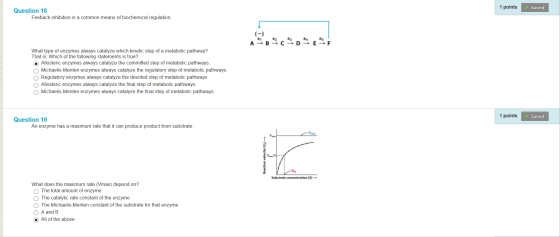
18. In feedback inhibition, the allosteric enzymes always catalyze the committed step of a metabolic pathway.
In metabolic pathways which are regulated by feedback inhibition , the first step is the committed step which determines the rate of the entire pathway. It is regulated by the end product of the pathway, i.e. the entire pathway is operated when there is a need for the synthesis of the end product. If the end product is available the pathway is slowed down or stops completely. The first committed step is regulated by the product itself.
19. All the above - option is correct.
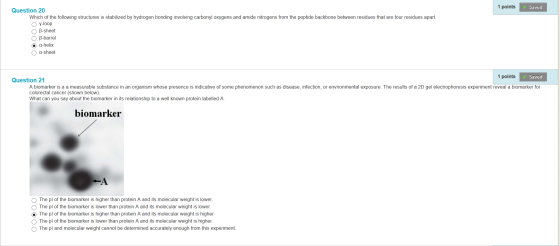
20. Alpha helix is the correct one as it is formed due to H-bonding between 1st and 5th amino acid.
21. The correct option is - The pI of the biomarker is lower than protein A and its molecular weight is higher. Biomarker spot is observed towards lower pH range to that of protein A. It is observed below the biomarker hence biomarker's mole wt is higher than protein A.
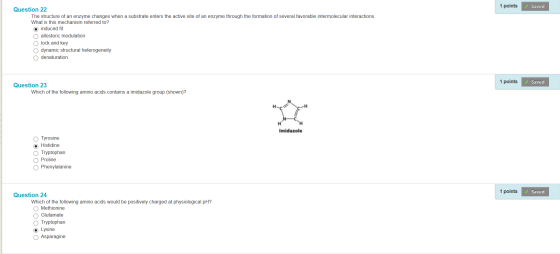
22. Induced fit is the correct one.
23. Histidine
24. Lysine
In feedback inhibition, the inhibitor of the biochemical pathway is Multiple Choice Ο the final product...
 In feedback inhibition, the inhibitor of the biochemical pathway is Multiple Choice Ο the final product of the biochemical pathway. Ο a substance that is produced towards the middle of the biochemical pathway. Ο the product of the enzyme inhibited. Ο the substrate of the enzyme inhibited. Ο O a product of another biochemical pathway.
a. Describe how feedback inhibition is used in regulation. Name 2 enzymes in 2 different pathways...
a. Describe how feedback inhibition is used in regulation. Name 2 enzymes in 2 different pathways regulated by feedback inhibition. b. What enzymes are responsible for synthesizing and degrading fructose 2,6-bisphosphate? How is fructose 2,6-bisphosphate used as a regulatory molecule?
4 4pts. Match the following phrases with either OPERONS or FEEDBACK INHIBITION. Do this by writing...
 4 4pts. Match the following phrases with either OPERONS or FEEDBACK INHIBITION. Do this by writing two lists, one with OPERONS at the top and the other with FEEDBACK INHIBITION. • Regulation at the protein level • Conserves energy, nucleotides, amino acids • Regulation at the DNA or gene level • Conserves some energy • Goes into effect fairly quickly . Eventually shuts down gene expression • Uses end product to regulate enzymes . Can allow bacteria to respond to...
6 Cells also regulate enzyme function using dhac inhibition in this type of regulation, metabolic pathway...
 6 Cells also regulate enzyme function using dhac inhibition in this type of regulation, metabolic pathway etabolic pathway will inhibit the function of an eneme in an early phase of the metabolic path produces it. lon. In this type of regulation, the end product of a early phase of the metabolic pathway that What is the advantage of using feedback inhibition to regulate enzymes for cells? b. Cellular respiration is the process of generating ATP by breaking down sugar completely...
Which is not involved in the regulation of glycogen phosphorylase? A) Allosteric inhibition of phosphorylase by...
Which is not involved in the regulation of glycogen phosphorylase? A) Allosteric inhibition of phosphorylase by ATP B) Indirect, positive regulation by glucagon C) Phosphorylation of phosphorylase by protein kinase A (PKA) D) Direct and indirect regulation by protein phosphatase 1 (PP1) E) Indirect, negative regulation by protein phosphatase 2B (PP2B)
Feedback inhibition is defined as a mechanism of down-regulating enzyme activity by the accumulation of a...
Feedback inhibition is defined as a mechanism of down-regulating enzyme activity by the accumulation of a product earlier in the pathway. True or False, please explain
Can you use an example to describe feedback inhibition of an enzyme. Why is this useful...
Can you use an example to describe feedback inhibition of an enzyme. Why is this useful for a cell?
Explain what “Feedback Inhibition" is (define it) and how it helps an organism to conserve energy...
 Explain what “Feedback Inhibition" is (define it) and how it helps an organism to conserve energy and other resources. Give a detailed answer.
Which of the following is true regarding feedback inhibition? (All/more than one may be correct) A....
Which of the following is true regarding feedback inhibition? (All/more than one may be correct) A. Enzymes are inhibited B. The final product of metabolic pathway is the inhibitor C. Inhibition occurs early in the metabolic pathway
Please help me with this questions 11. Define active site and substrate 12. Classify enzyme 13. Difference between lock and key and induced fit model 14. Difference between, alleosteric regulation...
 Please help me with this questions
11. Define active site and substrate 12. Classify enzyme 13. Difference between lock and key and induced fit model 14. Difference between, alleosteric regulation feedback inhibition, competitive and noncompetitive inhibition? 15. What the affect of high temp or PH change on enzyme
11. Define active site and substrate 12. Classify enzyme 13. Difference between lock and key and induced fit model 14. Difference between, alleosteric regulation feedback inhibition, competitive and noncompetitive inhibition? 15. What...
Please help me with this questions
11. Define active site and substrate 12. Classify enzyme 13. Difference between lock and key and induced fit model 14. Difference between, alleosteric regulation feedback inhibition, competitive and noncompetitive inhibition? 15. What the affect of high temp or PH change on enzyme
11. Define active site and substrate 12. Classify enzyme 13. Difference between lock and key and induced fit model 14. Difference between, alleosteric regulation feedback inhibition, competitive and noncompetitive inhibition? 15. What...
 In feedback inhibition, the inhibitor of the biochemical pathway is Multiple Choice Ο the final product of the biochemical pathway. Ο a substance that is produced towards the middle of the biochemical pathway. Ο the product of the enzyme inhibited. Ο the substrate of the enzyme inhibited. Ο O a product of another biochemical pathway.
 4 4pts. Match the following phrases with either OPERONS or FEEDBACK INHIBITION. Do this by writing two lists, one with OPERONS at the top and the other with FEEDBACK INHIBITION. • Regulation at the protein level • Conserves energy, nucleotides, amino acids • Regulation at the DNA or gene level • Conserves some energy • Goes into effect fairly quickly . Eventually shuts down gene expression • Uses end product to regulate enzymes . Can allow bacteria to respond to...
 6 Cells also regulate enzyme function using dhac inhibition in this type of regulation, metabolic pathway etabolic pathway will inhibit the function of an eneme in an early phase of the metabolic path produces it. lon. In this type of regulation, the end product of a early phase of the metabolic pathway that What is the advantage of using feedback inhibition to regulate enzymes for cells? b. Cellular respiration is the process of generating ATP by breaking down sugar completely...
 Explain what “Feedback Inhibition" is (define it) and how it helps an organism to conserve energy and other resources. Give a detailed answer.
 Please help me with this questions
11. Define active site and substrate 12. Classify enzyme 13. Difference between lock and key and induced fit model 14. Difference between, alleosteric regulation feedback inhibition, competitive and noncompetitive inhibition? 15. What the affect of high temp or PH change on enzyme
11. Define active site and substrate 12. Classify enzyme 13. Difference between lock and key and induced fit model 14. Difference between, alleosteric regulation feedback inhibition, competitive and noncompetitive inhibition? 15. What...
Please help me with this questions
11. Define active site and substrate 12. Classify enzyme 13. Difference between lock and key and induced fit model 14. Difference between, alleosteric regulation feedback inhibition, competitive and noncompetitive inhibition? 15. What the affect of high temp or PH change on enzyme
11. Define active site and substrate 12. Classify enzyme 13. Difference between lock and key and induced fit model 14. Difference between, alleosteric regulation feedback inhibition, competitive and noncompetitive inhibition? 15. What...
Most questions answered within 3 hours.
-
Where is the error in this code sequence?
String s1 = "Hello";
String s2 = "ello";...
asked 10 months ago -
Financial data for Joel de Paris, Inc., for last year
follow:
Joel de Paris, Inc.
Balance...
asked 10 months ago -
Consider this reaction:
Al2(SO4)3 (aq)+ BaCl3
(aq) Al2Cl6 (aq)- +
3BaSO4(s) . What is the...
asked 10 months ago -
Suppose that Savneet is considering increasing her
recent random sample from 20 car rentals to 40...
asked 10 months ago -
Trucks arrive at an unloading terminal at an average rate of 120
per hour.
Trucks arrive...
asked 10 months ago -
Why are methanol and ethanol completely soluble in water while
octanol is not very little soluble....
asked 10 months ago -
A facilities manager at a university reads in a research report
that the mean amount of...
asked 10 months ago -
When the CuSO4 is rehydrated by adding water to the anhydrous
compound, is this an endothermic...
asked 10 months ago -
A ray of sunlight is passing from diamond into crown glass; the
angle of incidence is...
asked 10 months ago -
A block of mass 0.249 kg is placed on top of a light, vertical
spring of...
asked 10 months ago -
how do the kidneys compensate in the presences of acidosis
a) trigger hyperventilate
b) reserve acid...
asked 10 months ago -
Question 501 pts
The rental rate of capital to the firm increases. Which of the
following...
asked 10 months ago