
Homework Answers
Request Answer!
We need at least 10 more requests to produce the answer.
0 / 10 have requested this problem solution
The more requests, the faster the answer.
Add Answer to:
(10 Points) Realize F, and F, using a PLA. Fi(a,b,c,d) = m(1,2,4,5,6, 8, 10, 12, 14)...
Given four-input Boolean functions, F1 (A,B,C,D) = Σm(4, 5, 10, 11, 12)
Given four-input Boolean functions, F1 (A,B,C,D) = Σm(4, 5, 10, 11, 12) F2 (A,B,C,D) = Σm(0, 1, 3, 4, 8, 11) F3 (A,B,C,D) = Σm(0, 4, 10, 12, 14) (a) Realize F1, F2 and F3 using a ROM. (b) Realize F1, F2 and F3 using a PLA of minimum size. Show the PLA table and location of switches.
7.10 (4 marks) Find a minimum two-level, multiple-output AND-OR gate circuit to realize these functions. fi(a,...
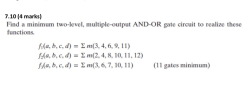 7.10 (4 marks) Find a minimum two-level, multiple-output AND-OR gate circuit to realize these functions. fi(a, b, c, d) = m(3, 4, 6, 9, 11) f(a, b, c, d) = 2 m(2, 4, 8, 10, 11, 12) f(a,b,c,d) = m(3, 6, 7, 10, 11) (11 gates minimum)
Design a PLA that implements the followingthree boolean function A(w,x,y,z) = ?m(4, 5, 7, 12, 13,...
Design a PLA that implements the followingthree boolean function A(w,x,y,z) = ?m(4, 5, 7, 12, 13, 15) B(w,x,y,z) = ?m(0, 1, 4, 5, 8, 9, 11, 12, 13, 15) C(w,x,y,z) = ?m(0, 1, 2, 3, 6, 7, 8, 9, 10, 11, 14) a) Use Karnaugh Maps to optimal each function and its complement. b)Select the three optimal functions to use in the PLA. C)Optimize the equation(s) using Karnaugh Map(s). d.Draw the circuit (Don't forget the clock).
Procedure Given the following switching functions with four inputs, a, b, c, and d and three...
 Procedure Given the following switching functions with four inputs, a, b, c, and d and three outputs, F2, F1, Fo, F2 (a, b,c,d) = Em (3,4,6,9, 11) F (a, b, c, d) =m (2, 4, 8, 10, 11, 12) Fo (a, b, c, d) =ăm (4, 6, 9, 14, 15) 1. Design the switching functions using 8:1 MUXs. 2. Design the switching using 4:16 Decoder and minimal logic gates. 3. Design the switching functions using a ROM. 4. Design a...
Groups 2-4 4-6 6-8 2-4 4-6 6-8 8-10 10-12 12-14 14-16 16-18 18-20 f f 102...
 Groups 2-4 4-6 6-8 2-4 4-6 6-8 8-10 10-12 12-14 14-16 16-18 18-20 f f 102 18 40 24 47 80 21 15 66 Find a) Arithmetic mean b) Median c) Mode d) Differentiate between Arithmetic mean, Harmonic mean, and Geometric mean using 2 applications of each.
Question #7 12 points Implement the following functions using: X(A,B,C,D) = X (3,7,11,14,15) Y(A, B,C,D) =...
 Question #7 12 points Implement the following functions using: X(A,B,C,D) = X (3,7,11,14,15) Y(A, B,C,D) = {(3,4,5,7,11,15) Z(A, B, C,D) = {(1,5, 14, 15) a) a single 16 x 3 ROM (use dot notation to indicate the ROM contents) b) a 4 x 4 x 3 PLA (use dot notation)
Activity a m b Immediate Predecessor(s) A 2 6 8 - B 10 11 12 -...
Activity a m b Immediate Predecessor(s) A 2 6 8 - B 10 11 12 - C 1 2 3 - D 6 7 8 C E 2 4 6 B, D F 1 2 3 A, E G 7 11 13 A, E H 11 12 13 F I 5 7 9 G J 14 16 18 C K 4 8 12 H, I a) find expected time and variance
write the answers in the PLA map given in the question please solve the question completely and show the steps ... thumb up will be given Show how to program the two PLAs to realize the following fun...
 write the answers in the PLA map given in the question
please solve the question completely and show the steps ...
thumb up will be given
Show how to program the two PLAs to realize the following functions of 5 variables (A, B, C, D, E) without using additional logic gates. Indicate all inputs, outputs and necessary connections. (15 points) ICO: 7] F1 = (A,B,C + ABC + ABC') D'E, F2 = (ABC, + A,B,C), DE P4/4
Show how to...
write the answers in the PLA map given in the question
please solve the question completely and show the steps ...
thumb up will be given
Show how to program the two PLAs to realize the following functions of 5 variables (A, B, C, D, E) without using additional logic gates. Indicate all inputs, outputs and necessary connections. (15 points) ICO: 7] F1 = (A,B,C + ABC + ABC') D'E, F2 = (ABC, + A,B,C), DE P4/4
Show how to...
1. For the following function: f(a, b, c, d) =>m(0, 1, 4, 8, 10, 15)d(2,5,7, 11,...
 1. For the following function: f(a, b, c, d) =>m(0, 1, 4, 8, 10, 15)d(2,5,7, 11, 13, 14) a. Complete the K-map cdlab 00 01 11 10 00 10 b. List all prime implicants c. List all essential prime implicants d. Simplify the function based on your K-map in the sum of product format
1. (15 pts) Simplify the following Boolean functions using K-maps: a. F(x,y,z) = (1,4,5,6,7) b. F(x,...
 1. (15 pts) Simplify the following Boolean functions using K-maps: a. F(x,y,z) = (1,4,5,6,7) b. F(x, y, z) = (xy + xyz + xyz c. F(A,B,C,D) = 20,2,4,5,6,7,8,10,13,15) d. F(A,B,C,D) = A'B'C'D' + AB'C + B'CD' + ABCD' + BC'D e. F(A,B,C,D,E) = (0,1,4,5,16,17,21,25,29) 2. (12 pts) Consider the combinational logic circuit below and answer the following: a. Derive the Boolean expressions for Fi and F2 as functions of A, B, C, and D. b. List the complete truth table...
 7.10 (4 marks) Find a minimum two-level, multiple-output AND-OR gate circuit to realize these functions. fi(a, b, c, d) = m(3, 4, 6, 9, 11) f(a, b, c, d) = 2 m(2, 4, 8, 10, 11, 12) f(a,b,c,d) = m(3, 6, 7, 10, 11) (11 gates minimum)
 Procedure Given the following switching functions with four inputs, a, b, c, and d and three outputs, F2, F1, Fo, F2 (a, b,c,d) = Em (3,4,6,9, 11) F (a, b, c, d) =m (2, 4, 8, 10, 11, 12) Fo (a, b, c, d) =ăm (4, 6, 9, 14, 15) 1. Design the switching functions using 8:1 MUXs. 2. Design the switching using 4:16 Decoder and minimal logic gates. 3. Design the switching functions using a ROM. 4. Design a...
 Groups 2-4 4-6 6-8 2-4 4-6 6-8 8-10 10-12 12-14 14-16 16-18 18-20 f f 102 18 40 24 47 80 21 15 66 Find a) Arithmetic mean b) Median c) Mode d) Differentiate between Arithmetic mean, Harmonic mean, and Geometric mean using 2 applications of each.
 Question #7 12 points Implement the following functions using: X(A,B,C,D) = X (3,7,11,14,15) Y(A, B,C,D) = {(3,4,5,7,11,15) Z(A, B, C,D) = {(1,5, 14, 15) a) a single 16 x 3 ROM (use dot notation to indicate the ROM contents) b) a 4 x 4 x 3 PLA (use dot notation)
 write the answers in the PLA map given in the question
please solve the question completely and show the steps ...
thumb up will be given
Show how to program the two PLAs to realize the following functions of 5 variables (A, B, C, D, E) without using additional logic gates. Indicate all inputs, outputs and necessary connections. (15 points) ICO: 7] F1 = (A,B,C + ABC + ABC') D'E, F2 = (ABC, + A,B,C), DE P4/4
Show how to...
write the answers in the PLA map given in the question
please solve the question completely and show the steps ...
thumb up will be given
Show how to program the two PLAs to realize the following functions of 5 variables (A, B, C, D, E) without using additional logic gates. Indicate all inputs, outputs and necessary connections. (15 points) ICO: 7] F1 = (A,B,C + ABC + ABC') D'E, F2 = (ABC, + A,B,C), DE P4/4
Show how to...
 1. For the following function: f(a, b, c, d) =>m(0, 1, 4, 8, 10, 15)d(2,5,7, 11, 13, 14) a. Complete the K-map cdlab 00 01 11 10 00 10 b. List all prime implicants c. List all essential prime implicants d. Simplify the function based on your K-map in the sum of product format
 1. (15 pts) Simplify the following Boolean functions using K-maps: a. F(x,y,z) = (1,4,5,6,7) b. F(x, y, z) = (xy + xyz + xyz c. F(A,B,C,D) = 20,2,4,5,6,7,8,10,13,15) d. F(A,B,C,D) = A'B'C'D' + AB'C + B'CD' + ABCD' + BC'D e. F(A,B,C,D,E) = (0,1,4,5,16,17,21,25,29) 2. (12 pts) Consider the combinational logic circuit below and answer the following: a. Derive the Boolean expressions for Fi and F2 as functions of A, B, C, and D. b. List the complete truth table...
Most questions answered within 3 hours.
-
Where is the error in this code sequence?
String s1 = "Hello";
String s2 = "ello";...
asked 10 months ago -
Financial data for Joel de Paris, Inc., for last year
follow:
Joel de Paris, Inc.
Balance...
asked 10 months ago -
Consider this reaction:
Al2(SO4)3 (aq)+ BaCl3
(aq) Al2Cl6 (aq)- +
3BaSO4(s) . What is the...
asked 10 months ago -
Suppose that Savneet is considering increasing her
recent random sample from 20 car rentals to 40...
asked 10 months ago -
Trucks arrive at an unloading terminal at an average rate of 120
per hour.
Trucks arrive...
asked 10 months ago -
Why are methanol and ethanol completely soluble in water while
octanol is not very little soluble....
asked 10 months ago -
A facilities manager at a university reads in a research report
that the mean amount of...
asked 10 months ago -
When the CuSO4 is rehydrated by adding water to the anhydrous
compound, is this an endothermic...
asked 10 months ago -
A ray of sunlight is passing from diamond into crown glass; the
angle of incidence is...
asked 10 months ago -
A block of mass 0.249 kg is placed on top of a light, vertical
spring of...
asked 10 months ago -
how do the kidneys compensate in the presences of acidosis
a) trigger hyperventilate
b) reserve acid...
asked 10 months ago -
Question 501 pts
The rental rate of capital to the firm increases. Which of the
following...
asked 10 months ago