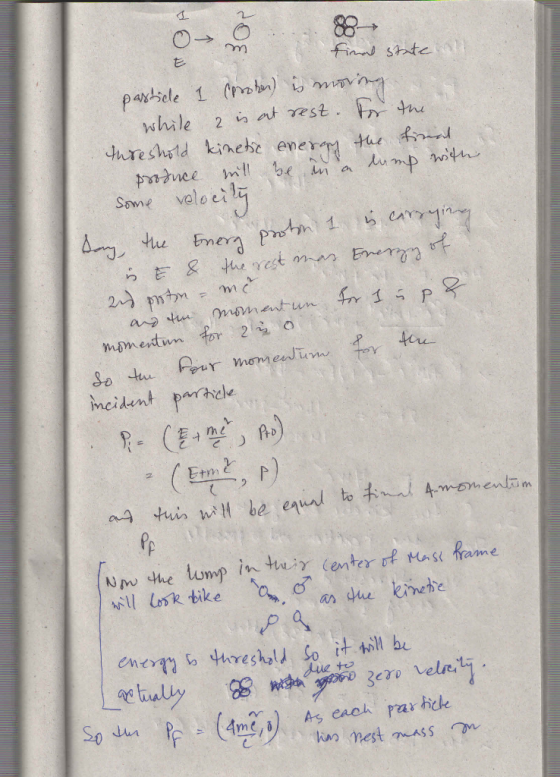
The discovery of the antiproton p (a particle with the same rest energy as a proton,...
The discovery of the antiproton p (a particle with the same rest
energy as a proton, 938 MeV, but with the opposite electric charge)
took place in 1956 through the following reaction: p + p → p+p+p+¯
p, in which accelerated protons were incident on a target of
protons at rest in the laboratory. The minimum incident kinetic
energy needed to produce the reaction is called the threshold
kinetic energy, for which the final particles move together as if
they were a single unit. Find the threshold kinetic energy to
produce antiprotons in this reaction.
Homework Answers
 please
give a thumbs up.
please
give a thumbs up.
Add Answer to:
The discovery of the antiproton p (a particle with the same rest
energy as a proton,...
can you helpme of third one problem Show that the threshold kinetic energy in the Laboratory...
 can you helpme of third one problem
Show that the threshold kinetic energy in the Laboratory for the production of n pions in the collision of protons with a hydrogen target is given by T= 2nm (1 + nm,/4mp) where m, and mp are respectively the pion and proton masses. A gamma ray interacts with a stationary proton and produces a neutral pion according to the scheme y + p → P +7° Calculate the threshold energy given Mp =...
can you helpme of third one problem
Show that the threshold kinetic energy in the Laboratory for the production of n pions in the collision of protons with a hydrogen target is given by T= 2nm (1 + nm,/4mp) where m, and mp are respectively the pion and proton masses. A gamma ray interacts with a stationary proton and produces a neutral pion according to the scheme y + p → P +7° Calculate the threshold energy given Mp =...
3. (10 pts) High energy particle accelerators convert part of the energy of colliding particles into...
 3. (10 pts) High energy particle accelerators convert part of the energy of colliding particles into the masses of particles produced in the collisions. Consider a collision of two protons that produces two charged kaons. The mass of the proton is mp- 938.3 MeV/c2, and the mass of each kaon is mK 493.7 MeV/c2. The reaction is a) The total energy (kinetic energy and rest energy) and total momentum is conserved. Suppose one of the protons is at rest in...
There was a "bevatron" designed to accelerate a proton to such a high speed that when...
 There was a "bevatron" designed to accelerate a proton to such a high speed that when it collided with a proton at rest, two proton-antiproton pairs were created. That is, some of the accelerated proton's kinetic energy was enough to be converted into the mass of the new particles: p + p rightarrow (p + p) + (p + p). If the four particles on the right move along together as a single particle of rest mass M = 4m_p,...
In addition to its rest energy, a moving proton (p') has kinetic energy. This proton collides...
In addition to its rest energy, a moving proton (p') has kinetic energy. This proton collides with a stationary proton (p), and the reaction forms a stationary neutron (n), a stationary proton (p), and a stationary pion (π+), according to the following reaction: p' + p → n + p + π+. The rest energy of each proton is 938.3 MeV, and the rest energy of the neutron is 939.6 MeV. The rest energy of the pion is 139.6 MeV....
An proton-antiproton pair is produced by a 2.05×1032.05×103 MeV photon. What is the kinetic energy of...
An proton-antiproton pair is produced by a 2.05×1032.05×103 MeV photon. What is the kinetic energy of the antiproton if the kinetic energy of the proton is 86.90 MeV? Use the following Joules-to-electron-Volts conversion 1eV = 1.602 × 10⁻¹⁹ J. The rest mass of a proton is 1.67×10−271.67×10⁻²⁷ kg. _______________ MeV
10. An proton-antiproton pair is produced by a 2.10×1032.10×103 MeV photon. What is the kinetic energy...
10. An proton-antiproton pair is produced by a 2.10×1032.10×103 MeV photon. What is the kinetic energy of the antiproton if the kinetic energy of the proton is 55.95 MeV? Use the following Joules-to-electron-Volts conversion 1eV = 1.602 × 10⁻¹⁹ J. The rest mass of a proton is 1.67×10−271.67×10⁻²⁷ kg. MeV
Threshold for pi meson production* A high energy photon (γ-ray) collides with a proton at rest....
Threshold for pi meson production* A high energy photon (γ-ray) collides with a proton at rest. A neu- tral pi meson (π0) is produced according to the reaction γ + p → p+π0. What is the minimum energy the γ-ray must have for this reac- tion to occur? The rest mass of a proton is 938 MeV, and the rest mass of a π0 is 135 MeV.
5. A proton of mass at rest is bombarded from an accelerator beam by an antiproton of equal mass, the two particles...
 5. A proton of mass at rest is bombarded from an accelerator beam by an antiproton of equal mass, the two particles annihilating each other into a pair of photons with momenta p, P Show that the angle between directions of flight of the photons is given by -me(A+ p.) PiP cos θ = 1 Show further that the angles 0,, 0, the scattered photons make with the incident beam obey cos = CP.P where Po, Eo are the momentum...
2. The ratio between the kinetic energy of a particle and its rest mass energy is...
 2. The ratio between the kinetic energy of a particle and its rest mass energy is called the reduced kinetic energy of a particle. Find the expression which relates the radius of a proton synchrocyclotron to the reduced energy of the accelerated proton of maximum energy. Find the radius of a proton synchrocyclotron which works with a magnetic field of 2 Tesla and accelerates protons up to 650MeV?
In a proton linear accelerator, protons are accelerated to have a kinetic energy of 530 MeV....
In a proton linear accelerator, protons are accelerated to have a kinetic energy of 530 MeV. What is the speed of these protons? (The rest mass of a proton is 1.67 × 10 − 27 kg.)
 can you helpme of third one problem
Show that the threshold kinetic energy in the Laboratory for the production of n pions in the collision of protons with a hydrogen target is given by T= 2nm (1 + nm,/4mp) where m, and mp are respectively the pion and proton masses. A gamma ray interacts with a stationary proton and produces a neutral pion according to the scheme y + p → P +7° Calculate the threshold energy given Mp =...
can you helpme of third one problem
Show that the threshold kinetic energy in the Laboratory for the production of n pions in the collision of protons with a hydrogen target is given by T= 2nm (1 + nm,/4mp) where m, and mp are respectively the pion and proton masses. A gamma ray interacts with a stationary proton and produces a neutral pion according to the scheme y + p → P +7° Calculate the threshold energy given Mp =...
 3. (10 pts) High energy particle accelerators convert part of the energy of colliding particles into the masses of particles produced in the collisions. Consider a collision of two protons that produces two charged kaons. The mass of the proton is mp- 938.3 MeV/c2, and the mass of each kaon is mK 493.7 MeV/c2. The reaction is a) The total energy (kinetic energy and rest energy) and total momentum is conserved. Suppose one of the protons is at rest in...
 There was a "bevatron" designed to accelerate a proton to such a high speed that when it collided with a proton at rest, two proton-antiproton pairs were created. That is, some of the accelerated proton's kinetic energy was enough to be converted into the mass of the new particles: p + p rightarrow (p + p) + (p + p). If the four particles on the right move along together as a single particle of rest mass M = 4m_p,...
 5. A proton of mass at rest is bombarded from an accelerator beam by an antiproton of equal mass, the two particles annihilating each other into a pair of photons with momenta p, P Show that the angle between directions of flight of the photons is given by -me(A+ p.) PiP cos θ = 1 Show further that the angles 0,, 0, the scattered photons make with the incident beam obey cos = CP.P where Po, Eo are the momentum...
 2. The ratio between the kinetic energy of a particle and its rest mass energy is called the reduced kinetic energy of a particle. Find the expression which relates the radius of a proton synchrocyclotron to the reduced energy of the accelerated proton of maximum energy. Find the radius of a proton synchrocyclotron which works with a magnetic field of 2 Tesla and accelerates protons up to 650MeV?
Most questions answered within 3 hours.
-
Where is the error in this code sequence?
String s1 = "Hello";
String s2 = "ello";...
asked 11 months ago -
Financial data for Joel de Paris, Inc., for last year
follow:
Joel de Paris, Inc.
Balance...
asked 11 months ago -
Consider this reaction:
Al2(SO4)3 (aq)+ BaCl3
(aq) Al2Cl6 (aq)- +
3BaSO4(s) . What is the...
asked 11 months ago -
Suppose that Savneet is considering increasing her
recent random sample from 20 car rentals to 40...
asked 11 months ago -
Trucks arrive at an unloading terminal at an average rate of 120
per hour.
Trucks arrive...
asked 11 months ago -
Why are methanol and ethanol completely soluble in water while
octanol is not very little soluble....
asked 11 months ago -
A facilities manager at a university reads in a research report
that the mean amount of...
asked 11 months ago -
When the CuSO4 is rehydrated by adding water to the anhydrous
compound, is this an endothermic...
asked 11 months ago -
A ray of sunlight is passing from diamond into crown glass; the
angle of incidence is...
asked 11 months ago -
A block of mass 0.249 kg is placed on top of a light, vertical
spring of...
asked 11 months ago -
how do the kidneys compensate in the presences of acidosis
a) trigger hyperventilate
b) reserve acid...
asked 11 months ago -
Question 501 pts
The rental rate of capital to the firm increases. Which of the
following...
asked 11 months ago