Positive charge is spread uniformly over the surface of a spherical balloon 70 cm in radius,...
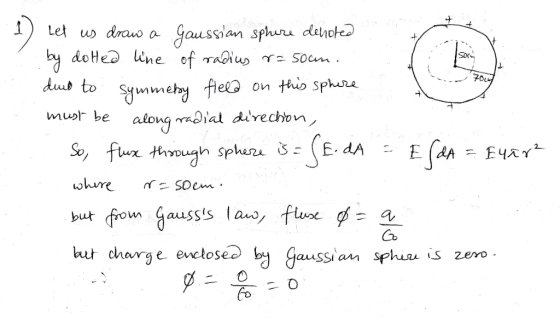
Positive charge is spread uniformly over the surface of a spherical balloon 70 cm in radius, resulting in an electric field of 42 kN/C at the balloon's surface.
1. Find the field strength 50 cm from the balloon's center in kN/C
2. Find the field strength 180 cm from the center. in kN/C
3. What is the net charge on the balloon? in uC
Homework Answers
 ***************************************************************************************************
This concludes the answers. If you need any more clarification,
modification or correction, feel free to ask.....
Add Answer to:
Positive charge is spread uniformly over the surface of a
spherical balloon 70 cm in radius,...
A spherical balloon has a radius o R-70 cm, and its surface has been charged uniform...
 A spherical balloon has a radius o R-70 cm, and its surface has been charged uniform a) Calculate the field strength ri 54 cm from the balloon's centre b) Calculate the field strength r2-191 cm from the balloon's centre (c)Calculate the net charge on the balloon. You measure the elec c field to be = at he balloons sur ace where N PAPER SOLUTION Solve the problem on paper first, including all four IDEA steps. You will become a better...
A spherical rubber balloon carries a total charge Qdistributed uniformly over its surface. At t=0, the radius of...
A spherical rubber balloon carries a total charge Qdistributed uniformly over its surface. At t=0, the radius of the balloon is R. The balloon is then slowly inflated until its radius reaches 2R at the time t0.Determine the electric field due to this charge as a function of time (a) at the surface of the balloon, (b) at the surface of radius R, and (c) at the surface of radius 2R. Ignore any effect on the electric field due to the material of the balloon and...
A charge of -5.00 nC is spread uniformly over the surface of one face of a...
A charge of -5.00 nC is spread uniformly over the surface of one face of a nonconducting disk of radius 1.00 cm A) Find the magnitude of the electric field this disk produces at a point P on the axis of the disk a distance of 2.50 cm from its center. B) Suppose that the charge were all pushed away from the center and distributed uniformly on the outer rim of the disk. Find the magnitude of the electric field...
A charge of -5.00 nC is spread uniformly over the surface of one face of a...
A charge of -5.00 nC is spread uniformly over the surface of one face of a nonconducting disk of radius 1.10 cm . A. Find the magnitude of the electric field this disk produces at a point P on the axis of the disk a distance of 2.00 cm from its center. B. Suppose that the charge were all pushed away from the center and distributed uniformly on the outer rim of the disk. Find the magnitude of the electric...
A charge of -6.03 nC is spread uniformly over the surface of one face of a nonconducting disk of radius 0.79 cm. Find th...
A charge of -6.03 nC is spread uniformly over the surface of one face of a nonconducting disk of radius 0.79 cm. Find the magnitude of the electric field this disk produces at a point P on the axis of the disk a distance of 1.52 cm from its center. (Give your answer in scientific notation using N/C as unit)
A charge of -20 HC is distributed uniformly over the surface of a spherical conductor of...
 A charge of -20 HC is distributed uniformly over the surface of a spherical conductor of radius 12.0 cm. Determine the electric field (in N/C) due to this charge at the following distances from the center of the sphere. (Enter the radial component of the electric field.) (a) 7.0 cm N/C) (b) 9.0 cm Nc) N/C (c 22.0 cm
A spherical shell 35 cm in diameter carries 83μC distributed uniformly over its surface. A 4.0...
A spherical shell 35 cm in diameter carries 83μC distributed uniformly over its surface. A 4.0 μC point charge is located at the shell’s center. Find the electric field strength 6.4 cm from the center.
A charge of 10.0 pC is distributed uniformly on a spherical surface (radius = 2.0 cm),...
 A charge of 10.0 pC is distributed uniformly on a spherical surface (radius = 2.0 cm), and a second point charge of -10.0 PC is located at the center of the sphere. Determine the magnitude of the electric field a) 5.0 cm from the center of the sphere. b) 1.0 cm from the center of the sphere. c) What is the potential difference between two points mentioned in parts (a) and (b)?
A charge Q is distributed uniformly on the surface of a spherical conducting shell of radius...
 A charge Q is distributed uniformly on the surface of a spherical conducting shell of radius 10 cm. The magnitude of electric field on the surface is 106V/m. What is the magnitude of electric field 20 cm from the center of the shell? What is the surface charge density in Cm2 of the spherical shell in problem 4?
All Parts please Exercise 21.49 A charge of -9.00 nC is spread uniformly over the surface...
 All Parts please
Exercise 21.49 A charge of -9.00 nC is spread uniformly over the surface of one face of a nonconducting disk of radius 1.30 cm Part A Find the magnitude of the electric field this disk produces at a point Pon the axis of the disk a distance of 3.00 cm from its center. N/C Submit My Answers Give U Part B Suppose that the charge were all pushed away from the center and distributed uniformly on the...
All Parts please
Exercise 21.49 A charge of -9.00 nC is spread uniformly over the surface of one face of a nonconducting disk of radius 1.30 cm Part A Find the magnitude of the electric field this disk produces at a point Pon the axis of the disk a distance of 3.00 cm from its center. N/C Submit My Answers Give U Part B Suppose that the charge were all pushed away from the center and distributed uniformly on the...
 A spherical balloon has a radius o R-70 cm, and its surface has been charged uniform a) Calculate the field strength ri 54 cm from the balloon's centre b) Calculate the field strength r2-191 cm from the balloon's centre (c)Calculate the net charge on the balloon. You measure the elec c field to be = at he balloons sur ace where N PAPER SOLUTION Solve the problem on paper first, including all four IDEA steps. You will become a better...
 A charge of -20 HC is distributed uniformly over the surface of a spherical conductor of radius 12.0 cm. Determine the electric field (in N/C) due to this charge at the following distances from the center of the sphere. (Enter the radial component of the electric field.) (a) 7.0 cm N/C) (b) 9.0 cm Nc) N/C (c 22.0 cm
 A charge of 10.0 pC is distributed uniformly on a spherical surface (radius = 2.0 cm), and a second point charge of -10.0 PC is located at the center of the sphere. Determine the magnitude of the electric field a) 5.0 cm from the center of the sphere. b) 1.0 cm from the center of the sphere. c) What is the potential difference between two points mentioned in parts (a) and (b)?
 A charge Q is distributed uniformly on the surface of a spherical conducting shell of radius 10 cm. The magnitude of electric field on the surface is 106V/m. What is the magnitude of electric field 20 cm from the center of the shell? What is the surface charge density in Cm2 of the spherical shell in problem 4?
 All Parts please
Exercise 21.49 A charge of -9.00 nC is spread uniformly over the surface of one face of a nonconducting disk of radius 1.30 cm Part A Find the magnitude of the electric field this disk produces at a point Pon the axis of the disk a distance of 3.00 cm from its center. N/C Submit My Answers Give U Part B Suppose that the charge were all pushed away from the center and distributed uniformly on the...
All Parts please
Exercise 21.49 A charge of -9.00 nC is spread uniformly over the surface of one face of a nonconducting disk of radius 1.30 cm Part A Find the magnitude of the electric field this disk produces at a point Pon the axis of the disk a distance of 3.00 cm from its center. N/C Submit My Answers Give U Part B Suppose that the charge were all pushed away from the center and distributed uniformly on the...
Most questions answered within 3 hours.
-
Where is the error in this code sequence?
String s1 = "Hello";
String s2 = "ello";...
asked 10 months ago -
Financial data for Joel de Paris, Inc., for last year
follow:
Joel de Paris, Inc.
Balance...
asked 10 months ago -
Consider this reaction:
Al2(SO4)3 (aq)+ BaCl3
(aq) Al2Cl6 (aq)- +
3BaSO4(s) . What is the...
asked 10 months ago -
Suppose that Savneet is considering increasing her
recent random sample from 20 car rentals to 40...
asked 10 months ago -
Trucks arrive at an unloading terminal at an average rate of 120
per hour.
Trucks arrive...
asked 10 months ago -
Why are methanol and ethanol completely soluble in water while
octanol is not very little soluble....
asked 10 months ago -
A facilities manager at a university reads in a research report
that the mean amount of...
asked 10 months ago -
When the CuSO4 is rehydrated by adding water to the anhydrous
compound, is this an endothermic...
asked 10 months ago -
A ray of sunlight is passing from diamond into crown glass; the
angle of incidence is...
asked 10 months ago -
A block of mass 0.249 kg is placed on top of a light, vertical
spring of...
asked 10 months ago -
how do the kidneys compensate in the presences of acidosis
a) trigger hyperventilate
b) reserve acid...
asked 10 months ago -
Question 501 pts
The rental rate of capital to the firm increases. Which of the
following...
asked 10 months ago