
Homework Answers
Overall cell reaction is:
Fe2+ (aq.) + S2- (aq.) ---------> FeS (s) , E0cell = - 0.44 - ( - 1.01 ) = 0.57 V
For the reverse reaction,
FeS (s) ----------> Fe2+ (aq.) + S2- (aq.), E0cell = - 0.57 V
deltaG0 = - n F E0cell = - 2 * 96500 * ( - 0.57 ) = 110010 J = 110.0 kJ
And
deltaG0 = - R T lnK
lnK = 110.0 / ( - 0.008314 * 298.15)
K = 5.21 * 10-20
Now,
Ksp of FeS = [Fe2+][S2-]
Ksp = S * S
S = sqrt. (Ksp)
S = sqrt. ( 5.21 * 10-20)
S = Solubility of FeS = COnc. of F2+ = conc. of S2- = 2.28 * 10-10
So, (c)
Add Answer to:
7. What is the concentration of Fe2+ ions in a saturated solution of FeS at 25°C?...
Need help with pS Calculate Eº for the half-reaction, FeS(s) +2e=Fe(s) + S2-(aq) given that the...
 Need help with pS
Calculate Eº for the half-reaction, FeS(s) +2e=Fe(s) + S2-(aq) given that the solubility product for FeS at 25°C is 8.0 x 10⁻¹⁹ and the standard reduction potential of the half-reaction Fe? + (aq) +2e = Fe(s) is -0.440 V. -0.974 Fes- Construct the line notation of a cell that consists of a saturated calomel reference electrode, the FeS half-reaction, and an iron indicator electrode, which can be used to measure the s2-concentration of the solution. HGO)...
Need help with pS
Calculate Eº for the half-reaction, FeS(s) +2e=Fe(s) + S2-(aq) given that the solubility product for FeS at 25°C is 8.0 x 10⁻¹⁹ and the standard reduction potential of the half-reaction Fe? + (aq) +2e = Fe(s) is -0.440 V. -0.974 Fes- Construct the line notation of a cell that consists of a saturated calomel reference electrode, the FeS half-reaction, and an iron indicator electrode, which can be used to measure the s2-concentration of the solution. HGO)...
Please do not answer if you are not sure, thank you Calculate E degree for the...
 Please do not answer if you are not sure, thank you
Calculate E degree for the following half-reaction, FeS(s) + 2e^- Fe(s) + S^2- (aq) given that the solubility product for FeS at 25 degree C is 8.0 times 10^-19 and the standard reduction potential of the half-reaction shown below is -0.440 V. Fe2+ (aq) + 2e^- Fe(s) E degree_FeS = Construct the line notation of a cell that consists of a saturated calomel reference electrode, the FeS half-reaction shown...
Please do not answer if you are not sure, thank you
Calculate E degree for the following half-reaction, FeS(s) + 2e^- Fe(s) + S^2- (aq) given that the solubility product for FeS at 25 degree C is 8.0 times 10^-19 and the standard reduction potential of the half-reaction shown below is -0.440 V. Fe2+ (aq) + 2e^- Fe(s) E degree_FeS = Construct the line notation of a cell that consists of a saturated calomel reference electrode, the FeS half-reaction shown...
Question 3 Calculate the E if the concentration of Zn2+ = 1.5 M and Fe2+ =...
 Question 3 Calculate the E if the concentration of Zn2+ = 1.5 M and Fe2+ = 0.5 M. Zn (S) + Fe2+ (aq) — Zn2+ (aq) + Fe (s) -0.44 0.83 Fe2+ (aq) + 2e — Fe(s) Zn (aq) + 2e2 Zn(s) 2 H,0() + 2e H2(g) + 2OH(aq) AP(aq) + 3e Al(s) Na (aq) + e L" (aq) + e -1.66 -2.71 3.05 Question 4
What is the OH ion concentration in a 4.8 x 10⁻² M KOH solution? 2.1 x...
 What is the OH ion concentration in a 4.8 x 10⁻² M KOH solution? 2.1 x 10⁻¹³ M 4.8 x 10⁻² M 1.0 x 10⁻⁷ M 4.8 x 10⁻¹² M What is E' for the following balanced reaction? Fe(s) + Cu2+(aq) Fe2+ (aq) + Cu(s) Standard Reduction Potential Half-reaction Fe2+ (aq) + 2e Fe(s) Cu2+ (aq) + 2e Cu(s) -0.44 40.34 O +.010 +0.78 0 -0.78 -0.1
it would be helpful if you could explain it in words too. thanks (35) Consider an...
 it
would be helpful if you could explain it in words too. thanks
(35) Consider an electrochemical cell based on the following overall reaction, not only 1970s azi W (8) Fe(s) + 2Ag (aq) → Fe2(aq) + 2Ag(s) BUD ) Fe?*(aq) + 2e Fe(s), E° = -0.44 v (e) (pl) (p) @t E° -0.80 V Ag (aq) +e → Ag, (0)35 (p) (p) (2) d Calculate the cell potential (E cell in V) for this reaction at 25°C when the...
it
would be helpful if you could explain it in words too. thanks
(35) Consider an electrochemical cell based on the following overall reaction, not only 1970s azi W (8) Fe(s) + 2Ag (aq) → Fe2(aq) + 2Ag(s) BUD ) Fe?*(aq) + 2e Fe(s), E° = -0.44 v (e) (pl) (p) @t E° -0.80 V Ag (aq) +e → Ag, (0)35 (p) (p) (2) d Calculate the cell potential (E cell in V) for this reaction at 25°C when the...
Using the Nernst equation calculate the cell voltage for: Fe(s) + Cd2+(aq) → Fe2+(aq) + Cd(s)...
Using the Nernst equation calculate the cell voltage for: Fe(s) + Cd2+(aq) → Fe2+(aq) + Cd(s) when the [Fe2+] = 0.20 M and [Cd2+] = 1.5 M. Potentially useful information: Fe2+ + 2e− → Fe(s); ε0 = -0.44 V Cd2+ + 2e− → Cd(s); ε0 = -0.40 V
Using the Nernst equation calculate the cell voltage for: Fe(s) + Cd2+(aq) → Fe2+(aq) + Cd(s)...
Using the Nernst equation calculate the cell voltage for: Fe(s) + Cd2+(aq) → Fe2+(aq) + Cd(s) when the [Fe2+] = 0.16 M and [Cd2+] = 1.8 M. Potentially useful information: Fe2+ + 2e− → Fe(s); ε0 = -0.44 V Cd2+ + 2e− → Cd(s); ε0 = -0.40 V - - - - - - - - - - - - - - - - - - - - - - - - - - - For the hypothetical reaction: A+...
What is the concentration of iron(II) ions in a saturated solution of iron(II) sulfide? Ksp(FeS) =...
What is the concentration of iron(II) ions in a saturated solution of iron(II) sulfide? Ksp(FeS) = (3.765x10^-19) Note: Your answer is assumed to be reduced to the highest power possible. Your Answer: Question 68 options: x10 Answer units
9) A sol'n in an electrolytic cell contains the ions Cu2+, Fe2+ & Zn2+. If the voltage (initially...
 9) A sol'n in an electrolytic cell contains the ions Cu2+, Fe2+ & Zn2+. If the voltage (initially very low) is turned up, in which order will the metals be plated out onto the cathode? Cu2+(aq)2e-Cu(s); E0.34V Fe"(aq) + 2e-→ Fe(s);E"--0.44V Zn2+(aq) + 2e-→ Zn(s): E。--0.76V 10) How long will it take to produce a sol'n of pH 2.00 by electrolysis of 500 mL of 0.100 M AgN03(aq) at 0.240 Amperes? Anode: 2H2O(l) → 4H-(aq) + O2(g) + 4e-, E°...
You are given a solution and are informed that the concentration of the species is [Fe...
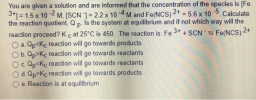 You are given a solution and are informed that the concentration of the species is [Fe 3+1 = 1.5 x 10⁻² M, [SCN ] = 2.2 x 10 -4 M and Fe(NCS) 2+ = 5,6 x 10⁻⁵. Calculate the reaction quotient, Q p. Is the system at equilibrium and if not which way will the reaction proceed? Kc at 25°C is 450. The reaction is: Fe 3+ + SCN = Fe(NCS) 2+ O a. Qp<Kc reaction will go towards products...
 Need help with pS
Calculate Eº for the half-reaction, FeS(s) +2e=Fe(s) + S2-(aq) given that the solubility product for FeS at 25°C is 8.0 x 10⁻¹⁹ and the standard reduction potential of the half-reaction Fe? + (aq) +2e = Fe(s) is -0.440 V. -0.974 Fes- Construct the line notation of a cell that consists of a saturated calomel reference electrode, the FeS half-reaction, and an iron indicator electrode, which can be used to measure the s2-concentration of the solution. HGO)...
Need help with pS
Calculate Eº for the half-reaction, FeS(s) +2e=Fe(s) + S2-(aq) given that the solubility product for FeS at 25°C is 8.0 x 10⁻¹⁹ and the standard reduction potential of the half-reaction Fe? + (aq) +2e = Fe(s) is -0.440 V. -0.974 Fes- Construct the line notation of a cell that consists of a saturated calomel reference electrode, the FeS half-reaction, and an iron indicator electrode, which can be used to measure the s2-concentration of the solution. HGO)...
 Please do not answer if you are not sure, thank you
Calculate E degree for the following half-reaction, FeS(s) + 2e^- Fe(s) + S^2- (aq) given that the solubility product for FeS at 25 degree C is 8.0 times 10^-19 and the standard reduction potential of the half-reaction shown below is -0.440 V. Fe2+ (aq) + 2e^- Fe(s) E degree_FeS = Construct the line notation of a cell that consists of a saturated calomel reference electrode, the FeS half-reaction shown...
Please do not answer if you are not sure, thank you
Calculate E degree for the following half-reaction, FeS(s) + 2e^- Fe(s) + S^2- (aq) given that the solubility product for FeS at 25 degree C is 8.0 times 10^-19 and the standard reduction potential of the half-reaction shown below is -0.440 V. Fe2+ (aq) + 2e^- Fe(s) E degree_FeS = Construct the line notation of a cell that consists of a saturated calomel reference electrode, the FeS half-reaction shown...
 Question 3 Calculate the E if the concentration of Zn2+ = 1.5 M and Fe2+ = 0.5 M. Zn (S) + Fe2+ (aq) — Zn2+ (aq) + Fe (s) -0.44 0.83 Fe2+ (aq) + 2e — Fe(s) Zn (aq) + 2e2 Zn(s) 2 H,0() + 2e H2(g) + 2OH(aq) AP(aq) + 3e Al(s) Na (aq) + e L" (aq) + e -1.66 -2.71 3.05 Question 4
 What is the OH ion concentration in a 4.8 x 10⁻² M KOH solution? 2.1 x 10⁻¹³ M 4.8 x 10⁻² M 1.0 x 10⁻⁷ M 4.8 x 10⁻¹² M What is E' for the following balanced reaction? Fe(s) + Cu2+(aq) Fe2+ (aq) + Cu(s) Standard Reduction Potential Half-reaction Fe2+ (aq) + 2e Fe(s) Cu2+ (aq) + 2e Cu(s) -0.44 40.34 O +.010 +0.78 0 -0.78 -0.1
 it
would be helpful if you could explain it in words too. thanks
(35) Consider an electrochemical cell based on the following overall reaction, not only 1970s azi W (8) Fe(s) + 2Ag (aq) → Fe2(aq) + 2Ag(s) BUD ) Fe?*(aq) + 2e Fe(s), E° = -0.44 v (e) (pl) (p) @t E° -0.80 V Ag (aq) +e → Ag, (0)35 (p) (p) (2) d Calculate the cell potential (E cell in V) for this reaction at 25°C when the...
it
would be helpful if you could explain it in words too. thanks
(35) Consider an electrochemical cell based on the following overall reaction, not only 1970s azi W (8) Fe(s) + 2Ag (aq) → Fe2(aq) + 2Ag(s) BUD ) Fe?*(aq) + 2e Fe(s), E° = -0.44 v (e) (pl) (p) @t E° -0.80 V Ag (aq) +e → Ag, (0)35 (p) (p) (2) d Calculate the cell potential (E cell in V) for this reaction at 25°C when the...
 9) A sol'n in an electrolytic cell contains the ions Cu2+, Fe2+ & Zn2+. If the voltage (initially very low) is turned up, in which order will the metals be plated out onto the cathode? Cu2+(aq)2e-Cu(s); E0.34V Fe"(aq) + 2e-→ Fe(s);E"--0.44V Zn2+(aq) + 2e-→ Zn(s): E。--0.76V 10) How long will it take to produce a sol'n of pH 2.00 by electrolysis of 500 mL of 0.100 M AgN03(aq) at 0.240 Amperes? Anode: 2H2O(l) → 4H-(aq) + O2(g) + 4e-, E°...
 You are given a solution and are informed that the concentration of the species is [Fe 3+1 = 1.5 x 10⁻² M, [SCN ] = 2.2 x 10 -4 M and Fe(NCS) 2+ = 5,6 x 10⁻⁵. Calculate the reaction quotient, Q p. Is the system at equilibrium and if not which way will the reaction proceed? Kc at 25°C is 450. The reaction is: Fe 3+ + SCN = Fe(NCS) 2+ O a. Qp<Kc reaction will go towards products...
Most questions answered within 3 hours.
-
Where is the error in this code sequence?
String s1 = "Hello";
String s2 = "ello";...
asked 11 months ago -
Financial data for Joel de Paris, Inc., for last year
follow:
Joel de Paris, Inc.
Balance...
asked 11 months ago -
Consider this reaction:
Al2(SO4)3 (aq)+ BaCl3
(aq) Al2Cl6 (aq)- +
3BaSO4(s) . What is the...
asked 11 months ago -
Suppose that Savneet is considering increasing her
recent random sample from 20 car rentals to 40...
asked 11 months ago -
Trucks arrive at an unloading terminal at an average rate of 120
per hour.
Trucks arrive...
asked 11 months ago -
Why are methanol and ethanol completely soluble in water while
octanol is not very little soluble....
asked 11 months ago -
A facilities manager at a university reads in a research report
that the mean amount of...
asked 11 months ago -
When the CuSO4 is rehydrated by adding water to the anhydrous
compound, is this an endothermic...
asked 11 months ago -
A ray of sunlight is passing from diamond into crown glass; the
angle of incidence is...
asked 11 months ago -
A block of mass 0.249 kg is placed on top of a light, vertical
spring of...
asked 11 months ago -
how do the kidneys compensate in the presences of acidosis
a) trigger hyperventilate
b) reserve acid...
asked 11 months ago -
Question 501 pts
The rental rate of capital to the firm increases. Which of the
following...
asked 11 months ago