(ATMega 128) With Vref =1.28 V, find the Vin for the following outputs: a) D7-D0 =...
(ATMega 128) With Vref =1.28 V, find the Vin for the following outputs: a) D7-D0 = 11111111 b) D7-D0 = 10011001 c) D7-D0 = 1101100
Homework Answers
Request Answer!
We need at least 10 more requests to produce the answer.
0 / 10 have requested this problem solution
The more requests, the faster the answer.
Add Answer to:
(ATMega 128) With Vref =1.28 V, find the Vin for the following
outputs: a) D7-D0 =...
3. For the following circuit, determine Vab when Vin +10 V and when Vin= -10 V....
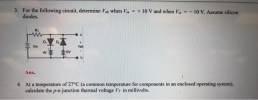 3. For the following circuit, determine Vab when Vin +10 V and when Vin= -10 V. Assume silicon diodes. Rt D. D Vin Vab h Ans. 4. At a temperature of 27°C (a common temperature for components in an enclosed operating system), calculate the p-n junction thermal voltage Pr in millivolts.
2 kn in Vo a) If Vin 5 V, assuming the op-amp is in the linear region, find Vo and io. Jt THE U...
 2 kn in Vo a) If Vin 5 V, assuming the op-amp is in the linear region, find Vo and io. Jt THE UNIVERSITY OF ALABAMA (b) What is the minimum value of Vcc for the op-amp to stay in the linear region when the input is Vin 5V? (c) Now suppose Vcc 10 V and Vin 3 sin(wt) V. Plot Vo(t) and be sure to label all critical points, including axes.
2 kn in Vo a) If Vin 5...
2 kn in Vo a) If Vin 5 V, assuming the op-amp is in the linear region, find Vo and io. Jt THE UNIVERSITY OF ALABAMA (b) What is the minimum value of Vcc for the op-amp to stay in the linear region when the input is Vin 5V? (c) Now suppose Vcc 10 V and Vin 3 sin(wt) V. Plot Vo(t) and be sure to label all critical points, including axes.
2 kn in Vo a) If Vin 5...
Using ideal op-amps, design operational amplifier circuits that will yield the following outputs
Using ideal op-amps, design operational amplifier circuits that will yield the following outputs: (a) Vo = 20 Vin (b) Vo = -Vin (c) Vo = Vin (d) Vo = -10Vi1 - 16Vi2
An 8-bit ADC has an 18.00-V reference. a. Find the outputs for input of 3.6 V...
An 8-bit ADC has an 18.00-V reference. a. Find the outputs for input of 3.6 V and 86.7 V. b. What range of inputs could have caused the output to become B7H?
2. Sketch Vout VS Vin and Vout if Vin-10sin(2TT60t) for each of the following circuits. You may a...
 2. Sketch Vout VS Vin and Vout if Vin-10sin(2TT60t) for each of the following circuits. You may assume that the forward diode drops for the diodes equals zero Vout s v out Vin 5 V Vout out 3. Repeat problem 2 but with forward diode drops equal to 0.7 V 4. What are the primary mechanisms for current flow in a. A forward biased diode. b. A reverse biased diode not in breakdown. c. A reverse biased diode in breakdown...
If (W/L)1 = (W/L)2 = (W/L) and VIN = 0.9 V, calculate ID and the range...
 If (W/L)1 = (W/L)2 = (W/L) and
VIN = 0.9 V, calculate ID and the range of VB for which both
transistors are in saturation.
2. For the circuit shown below, (W/L) = 50. a. If (W/L)1 = (W/L)2 = (W/L) and Vin = 0.9 V, calculate lo and the range of Ve for which both transistors are in saturation. b. If 4*(W/L)1 = (W/L)2 = (W/L) and Vin = 0.9 V, calculate lp and the range of Ve for...
If (W/L)1 = (W/L)2 = (W/L) and
VIN = 0.9 V, calculate ID and the range of VB for which both
transistors are in saturation.
2. For the circuit shown below, (W/L) = 50. a. If (W/L)1 = (W/L)2 = (W/L) and Vin = 0.9 V, calculate lo and the range of Ve for which both transistors are in saturation. b. If 4*(W/L)1 = (W/L)2 = (W/L) and Vin = 0.9 V, calculate lp and the range of Ve for...
In the circuit below, the input voltage is Vin-Vinegakcos(wt), R-20 ΚΩandC15nFw l. in al Show that the output voltage is VotVcos (wt-), where V-V n peak/V1 + (RC) b) Show that this result justifies c...
 In the circuit below, the input voltage is Vin-Vinegakcos(wt), R-20 ΚΩandC15nFw l. in al Show that the output voltage is VotVcos (wt-), where V-V n peak/V1 + (RC) b) Show that this result justifies calling this circuit a high-pass filter+ c) Find an expression for the phase constant δ in terms of R,C and d) At what frequency is Vi (1/V2) Vin peak? That particular frequency is known as the 3dB frequency, or f3dB, of the circuit
In the circuit...
In the circuit below, the input voltage is Vin-Vinegakcos(wt), R-20 ΚΩandC15nFw l. in al Show that the output voltage is VotVcos (wt-), where V-V n peak/V1 + (RC) b) Show that this result justifies calling this circuit a high-pass filter+ c) Find an expression for the phase constant δ in terms of R,C and d) At what frequency is Vi (1/V2) Vin peak? That particular frequency is known as the 3dB frequency, or f3dB, of the circuit
In the circuit...
- US+ U S The Values for L and C Inputs V, and I outputs to...
 - US+ U S The Values for L and C Inputs V, and I outputs to and i Giveni R, =12, R₂=202, R3=352, L=H, C = 15 Find: a) state-space representation b) Stability c) controllability d) observability رم
1. Consider a series RLC circuit with input voltage source Vin and the output voltage V,...
 1. Consider a series RLC circuit with input voltage source Vin and the output voltage V, taken as the resistor voltage. Assume the values are R = 10 kN, L = 10 mH, and C = 100 pF. a) Find the maximum output voltage and the frequency that it occurs. b) Determine the bandwidth and the quality factor and discuss the value of the quality factor.
V in Figure 1: Op-amp circuit 1 V in V out Figure 2: Op-amp circuit 2 1 Assume that the op amp is ideal, and that it ha...
 V in Figure 1: Op-amp circuit 1 V in V out Figure 2: Op-amp circuit 2 1 Assume that the op amp is ideal, and that it has infinite power supplies (i.e. it won't clip) If VIN varies with time, like ViI(t). You can assume that at t-0, the capacitor is discharged and VIN(0)-OV. Find the following in terms of R, C, and VIn(t) for each circuit above. a Vourt) b The current into the capacitor Ic() from the V-...
 3. For the following circuit, determine Vab when Vin +10 V and when Vin= -10 V. Assume silicon diodes. Rt D. D Vin Vab h Ans. 4. At a temperature of 27°C (a common temperature for components in an enclosed operating system), calculate the p-n junction thermal voltage Pr in millivolts.
 2 kn in Vo a) If Vin 5 V, assuming the op-amp is in the linear region, find Vo and io. Jt THE UNIVERSITY OF ALABAMA (b) What is the minimum value of Vcc for the op-amp to stay in the linear region when the input is Vin 5V? (c) Now suppose Vcc 10 V and Vin 3 sin(wt) V. Plot Vo(t) and be sure to label all critical points, including axes.
2 kn in Vo a) If Vin 5...
2 kn in Vo a) If Vin 5 V, assuming the op-amp is in the linear region, find Vo and io. Jt THE UNIVERSITY OF ALABAMA (b) What is the minimum value of Vcc for the op-amp to stay in the linear region when the input is Vin 5V? (c) Now suppose Vcc 10 V and Vin 3 sin(wt) V. Plot Vo(t) and be sure to label all critical points, including axes.
2 kn in Vo a) If Vin 5...
 2. Sketch Vout VS Vin and Vout if Vin-10sin(2TT60t) for each of the following circuits. You may assume that the forward diode drops for the diodes equals zero Vout s v out Vin 5 V Vout out 3. Repeat problem 2 but with forward diode drops equal to 0.7 V 4. What are the primary mechanisms for current flow in a. A forward biased diode. b. A reverse biased diode not in breakdown. c. A reverse biased diode in breakdown...
 If (W/L)1 = (W/L)2 = (W/L) and
VIN = 0.9 V, calculate ID and the range of VB for which both
transistors are in saturation.
2. For the circuit shown below, (W/L) = 50. a. If (W/L)1 = (W/L)2 = (W/L) and Vin = 0.9 V, calculate lo and the range of Ve for which both transistors are in saturation. b. If 4*(W/L)1 = (W/L)2 = (W/L) and Vin = 0.9 V, calculate lp and the range of Ve for...
If (W/L)1 = (W/L)2 = (W/L) and
VIN = 0.9 V, calculate ID and the range of VB for which both
transistors are in saturation.
2. For the circuit shown below, (W/L) = 50. a. If (W/L)1 = (W/L)2 = (W/L) and Vin = 0.9 V, calculate lo and the range of Ve for which both transistors are in saturation. b. If 4*(W/L)1 = (W/L)2 = (W/L) and Vin = 0.9 V, calculate lp and the range of Ve for...
 In the circuit below, the input voltage is Vin-Vinegakcos(wt), R-20 ΚΩandC15nFw l. in al Show that the output voltage is VotVcos (wt-), where V-V n peak/V1 + (RC) b) Show that this result justifies calling this circuit a high-pass filter+ c) Find an expression for the phase constant δ in terms of R,C and d) At what frequency is Vi (1/V2) Vin peak? That particular frequency is known as the 3dB frequency, or f3dB, of the circuit
In the circuit...
In the circuit below, the input voltage is Vin-Vinegakcos(wt), R-20 ΚΩandC15nFw l. in al Show that the output voltage is VotVcos (wt-), where V-V n peak/V1 + (RC) b) Show that this result justifies calling this circuit a high-pass filter+ c) Find an expression for the phase constant δ in terms of R,C and d) At what frequency is Vi (1/V2) Vin peak? That particular frequency is known as the 3dB frequency, or f3dB, of the circuit
In the circuit...
 - US+ U S The Values for L and C Inputs V, and I outputs to and i Giveni R, =12, R₂=202, R3=352, L=H, C = 15 Find: a) state-space representation b) Stability c) controllability d) observability رم
 1. Consider a series RLC circuit with input voltage source Vin and the output voltage V, taken as the resistor voltage. Assume the values are R = 10 kN, L = 10 mH, and C = 100 pF. a) Find the maximum output voltage and the frequency that it occurs. b) Determine the bandwidth and the quality factor and discuss the value of the quality factor.
 V in Figure 1: Op-amp circuit 1 V in V out Figure 2: Op-amp circuit 2 1 Assume that the op amp is ideal, and that it has infinite power supplies (i.e. it won't clip) If VIN varies with time, like ViI(t). You can assume that at t-0, the capacitor is discharged and VIN(0)-OV. Find the following in terms of R, C, and VIn(t) for each circuit above. a Vourt) b The current into the capacitor Ic() from the V-...
Most questions answered within 3 hours.
-
Where is the error in this code sequence?
String s1 = "Hello";
String s2 = "ello";...
asked 10 months ago -
Financial data for Joel de Paris, Inc., for last year
follow:
Joel de Paris, Inc.
Balance...
asked 10 months ago -
Consider this reaction:
Al2(SO4)3 (aq)+ BaCl3
(aq) Al2Cl6 (aq)- +
3BaSO4(s) . What is the...
asked 10 months ago -
Suppose that Savneet is considering increasing her
recent random sample from 20 car rentals to 40...
asked 10 months ago -
Trucks arrive at an unloading terminal at an average rate of 120
per hour.
Trucks arrive...
asked 10 months ago -
Why are methanol and ethanol completely soluble in water while
octanol is not very little soluble....
asked 10 months ago -
A facilities manager at a university reads in a research report
that the mean amount of...
asked 10 months ago -
When the CuSO4 is rehydrated by adding water to the anhydrous
compound, is this an endothermic...
asked 10 months ago -
A ray of sunlight is passing from diamond into crown glass; the
angle of incidence is...
asked 10 months ago -
A block of mass 0.249 kg is placed on top of a light, vertical
spring of...
asked 10 months ago -
how do the kidneys compensate in the presences of acidosis
a) trigger hyperventilate
b) reserve acid...
asked 10 months ago -
Question 501 pts
The rental rate of capital to the firm increases. Which of the
following...
asked 10 months ago