
Homework Answers

Add Answer to:
Human blood is buffered by O bicarbonate. O carbamite. O sulfate. O glucose. o phosphate. acer
2. Blood is buffered using a bicarbonate system primarily to accommodate the formation of CO2 in...
2. Blood is buffered using a bicarbonate system primarily to accommodate the formation of CO2 in the tissues. The overall pK for the reaction below is 6.35: CO2 + H2O H2CO3 H+ + HCO3 During acidosis, treatment can consist of IV administration of NaHC03. If the pH of blood is typically 7.4, and the total concentration of carbonic acid/ bicarb is 0.05M, what is the concentration of conjugate base and acid in blood?
Write chemical formulas for the compounds sodium bicarbonate, calcium phosphate and sodium aluminum sulfate. Express your...
Write chemical formulas for the compounds sodium bicarbonate, calcium phosphate and sodium aluminum sulfate. Express your answers as chemical formulas separated by commas.
8. Human blood contains two buffer systems, one based on phosphate species and one on carbonate...
 8. Human blood contains two buffer systems, one based on phosphate species and one on carbonate species. At the temperature of human blood, the K, values for phosphoric acid are 1.3x10,2.3x10 and 6x10-12, respectively. The Ka values for carbonic acid are 8x10⁻⁷ and 1.6x10⁻¹⁰ a. If blood has a normal pH of 7.4, draw the principle phosphate and carbonate species present? b. What is the ratio between the two phosphate species?
3) A normal blood sugar level in a human being is 85 mg of glucose per...
3) A normal blood sugar level in a human being is 85 mg of glucose per dL of blood. One drop of blood has volume 5.0 x 10² mL. How many glucose molecules are present in one drop of blood?
Human blood contains a buffer of carbonic acid (H 2CO 3) and bicarbonate anion (HCO 3-)...
Human blood contains a buffer of carbonic acid (H 2CO 3) and bicarbonate anion (HCO 3-) in order to maintain blood pH between 7.35 and 7.45, as a value higher than 7.8 or lower than 6.8 can lead to death. Carbonic acid is about 0.108 percent and the density is 1.67 g/mL. Determine the molarity of carbonic acid in blood.
Imagine an individual is suffering from low blood glucose levels and glucose can be clinically administered....
Imagine an individual is suffering from low blood glucose levels and glucose can be clinically administered. If we can intravenously supply glucose-6-phosphate to muscle cells instead of glucose, knowing that there is a cost associated with converting glucose to glucose-6-phosphate (1 ATP spend), would it be best to administer glucose-6-phosphate directly, instead of glucose to a patient in need? Would this be effective? Explain why or why not. Note: this patient is suffering from general (i.e. total body) low blood...
Most oxygen is transported in the blood O bound to hemoglobin. as part of the bicarbonate...
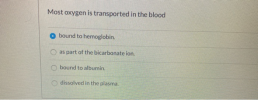 Most oxygen is transported in the blood O bound to hemoglobin. as part of the bicarbonate ion. bound to albumin. dissolved in the plasma.
Normal human blood plasma, glucose concentration is ~5mM. Explain (state pathway(s) and key enzyme(s) in processing...
Normal human blood plasma, glucose concentration is ~5mM. Explain (state pathway(s) and key enzyme(s) in processing glucose in muscle cells) the fate(s) of glucose once it is delivered by blood plasma to myocytes (muscle cells).
The osmotic pressure of human blood is 7.60 atm. What mass of glucose, C6H12O6, is required...
The osmotic pressure of human blood is 7.60 atm. What mass of glucose, C6H12O6, is required to make a 2.00 L aqueous solution for intravenous feeding if the solution must have the same osmotic pressure as blood at body temperature, 37 degrees C? Show all work.
One female human has blood type AB+. A male human has blood type O-. One of...
One female human has blood type AB+. A male human has blood type O-. One of their children is blood type A-. The female human above remarries and has children with a male that has blood type B+. Assuming that the male human is heterozygous at both relevant loci, what is the probability of having a child that has blood type B-. Express as a percentage.
 8. Human blood contains two buffer systems, one based on phosphate species and one on carbonate species. At the temperature of human blood, the K, values for phosphoric acid are 1.3x10,2.3x10 and 6x10-12, respectively. The Ka values for carbonic acid are 8x10⁻⁷ and 1.6x10⁻¹⁰ a. If blood has a normal pH of 7.4, draw the principle phosphate and carbonate species present? b. What is the ratio between the two phosphate species?
 Most oxygen is transported in the blood O bound to hemoglobin. as part of the bicarbonate ion. bound to albumin. dissolved in the plasma.
Most questions answered within 3 hours.
-
Where is the error in this code sequence?
String s1 = "Hello";
String s2 = "ello";...
asked 10 months ago -
Financial data for Joel de Paris, Inc., for last year
follow:
Joel de Paris, Inc.
Balance...
asked 10 months ago -
Consider this reaction:
Al2(SO4)3 (aq)+ BaCl3
(aq) Al2Cl6 (aq)- +
3BaSO4(s) . What is the...
asked 10 months ago -
Suppose that Savneet is considering increasing her
recent random sample from 20 car rentals to 40...
asked 10 months ago -
Trucks arrive at an unloading terminal at an average rate of 120
per hour.
Trucks arrive...
asked 10 months ago -
Why are methanol and ethanol completely soluble in water while
octanol is not very little soluble....
asked 10 months ago -
A facilities manager at a university reads in a research report
that the mean amount of...
asked 10 months ago -
When the CuSO4 is rehydrated by adding water to the anhydrous
compound, is this an endothermic...
asked 10 months ago -
A ray of sunlight is passing from diamond into crown glass; the
angle of incidence is...
asked 10 months ago -
A block of mass 0.249 kg is placed on top of a light, vertical
spring of...
asked 10 months ago -
how do the kidneys compensate in the presences of acidosis
a) trigger hyperventilate
b) reserve acid...
asked 10 months ago -
Question 501 pts
The rental rate of capital to the firm increases. Which of the
following...
asked 10 months ago