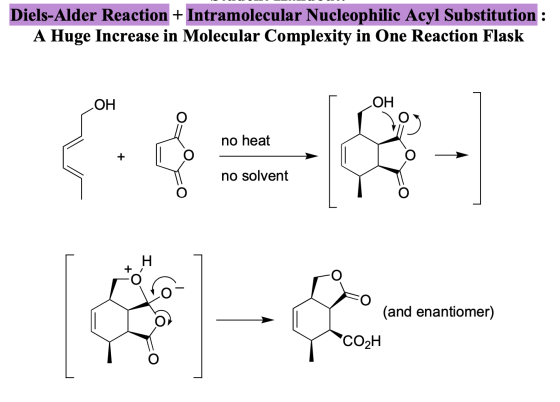
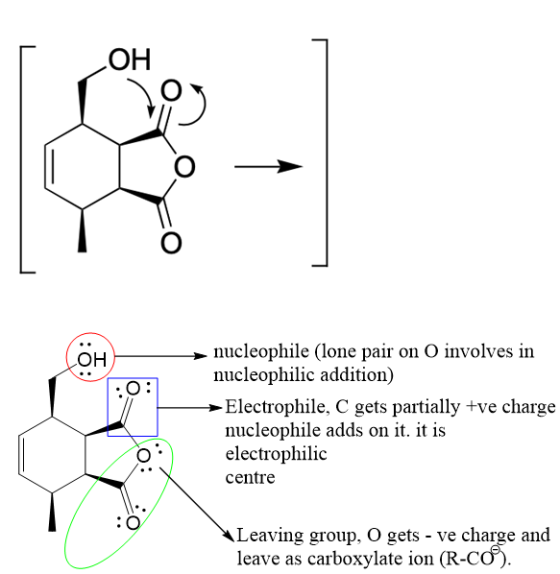
For the nucleophilic-substitution part (The second part. First part is the Diels-Alder Reaction) indicate which is the nucleophile (by putting a circle around it) and which is the electrophilic part (by putting a square around it) and which part is a leaving group (by putting oval shape around it.)
Homework Answers
Add Answer to:
For the nucleophilic-substitution
part (The second part. First part is the Diels-Alder Reaction)
indicate which is...
The two reactants shown below are combined to bring about a nucleophilic substitution reaction. Which letter...
 The two reactants shown below are combined to bring about a nucleophilic substitution reaction. Which letter designates the electrophilic carbon at which substitution occurs? (If no reaction occurs enter the letter corresponding to "none.") Which letter corresponds to the leaving group? Which letter designates the nucleophile?
The two reactants shown below are combined to bring about a nucleophilic substitution reaction. CH3 +...
 The two reactants shown below are combined to bring about a nucleophilic substitution reaction. CH3 + H2O Otos i. H30+ e. "OTos f. OH g. H2O h. "OS j. CH3OH k. none Which letter designates the electrophilic carbon at which substitution occurs? (If no reaction occurs enter the letter corresponding to "none.") Which letter corresponds to the leaving group? 1:1 1 .deicotill 1:1.00 Which letter corresponds to the leaving group? O Which letter designates the nucleophile?
The two reactants shown below are combined to bring about a nucleophilic substitution reaction. F +...
 The two reactants shown below are combined to bring about a nucleophilic substitution reaction. F + Nal IT g. HI h. Nat i. none f. HF Which letter designates the electrophilic carbon at which substitution occurs? (If no reaction occurs enter the letter corresponding to "none.") Which letter corresponds to the leaving group? Which letter designates the nucleophile? Submit Answer Try Another Version 1 item attempt remaining
Help with these! ( H 7. Acyl Substitution Practice. Show the first couple of mechanistic steps...
 Help with these!
( H 7. Acyl Substitution Practice. Show the first couple of mechanistic steps in a Fischer Esterification. Show the final product h︿cu2 wheu . (3) (a) show first intermediate using H+ 해 ..0-CH2CH3 (b) show intermediate after electrophile & nucleophile bond (c) draw final product (More steps) a. Identify (circle and label). (4) the nucleophilic atom, electrophilic atom, and leaving group in the reaction below 0 b. Why is the reaction above expected to go faster than...
Help with these!
( H 7. Acyl Substitution Practice. Show the first couple of mechanistic steps in a Fischer Esterification. Show the final product h︿cu2 wheu . (3) (a) show first intermediate using H+ 해 ..0-CH2CH3 (b) show intermediate after electrophile & nucleophile bond (c) draw final product (More steps) a. Identify (circle and label). (4) the nucleophilic atom, electrophilic atom, and leaving group in the reaction below 0 b. Why is the reaction above expected to go faster than...
A scientist proposes a nucleophilic substitution reaction in which the reactant, anion nucleophile has a pKabH...
A scientist proposes a nucleophilic substitution reaction in which the reactant, anion nucleophile has a pKabH of -8.5 and the product anion (which was the leaving group) has a pKabH of -7.2. The proposed reaction represents a _____ pKabH unit climb. Report your answer to the nearest tenth of a unit.
In an experiment designed to identify a conjugated diene from Eucalyptus oil through a Diels-Alder reaction,...
In an experiment designed to identify a conjugated diene from Eucalyptus oil through a Diels-Alder reaction, it was concluded that the diene was alpha-phellandrene. The final part of the experiment asks for the following: Construct molecular models for malice anhydride and the diene. By moving their bonds around, find a way to connect them to make a model representing one form of the adduct. Disconnect and reconnect the diene and dienophile units until you have made models representing all possible...
PLEASE ANSWER ALL PARTS Part B Which of the following reactions would benefit the most from...
 PLEASE ANSWER ALL PARTS
Part B Which of the following reactions would benefit the most from general-acid catalysis? View Available Hint(s) O the reaction of an acyl chloride with water O nucleophilic substitution of an alkyl halide by an amine O nucleophilic addition of water to an ester O nucleophilic substitution of an alkyl chloride by iodide O nucleophilic substitution of an alkyl chloride by water Submit Part E Which of the following is not a true statement? O A...
PLEASE ANSWER ALL PARTS
Part B Which of the following reactions would benefit the most from general-acid catalysis? View Available Hint(s) O the reaction of an acyl chloride with water O nucleophilic substitution of an alkyl halide by an amine O nucleophilic addition of water to an ester O nucleophilic substitution of an alkyl chloride by iodide O nucleophilic substitution of an alkyl chloride by water Submit Part E Which of the following is not a true statement? O A...
Questions 2-10 please!! 1) A substitution reaction is: [2] a) A reaction during which an OH...
 Questions 2-10 please!!
1) A substitution reaction is: [2] a) A reaction during which an OH group of a molecule is replaced by a halogen. b) A reaction during which water is the leaving group. c) A reaction during which a functional group of a molecule is replaced by an electrophile. d) A reaction during which a functional group of a molecule is replaced by another functional group. V 12 2) Substitution reactions are classified either as electrophilic or nucleophilic...
Questions 2-10 please!!
1) A substitution reaction is: [2] a) A reaction during which an OH group of a molecule is replaced by a halogen. b) A reaction during which water is the leaving group. c) A reaction during which a functional group of a molecule is replaced by an electrophile. d) A reaction during which a functional group of a molecule is replaced by another functional group. V 12 2) Substitution reactions are classified either as electrophilic or nucleophilic...
need help with the boxed bullet point. writing the chemical reaction scheme for the experiment. Synthesis of an A...
 need help with the boxed bullet point. writing the chemical
reaction scheme for the experiment.
Synthesis of an Alkyl Halide: A Nucleophilic Substitution Reaction, Part I Pre-lab Assignment for Synthesis of an Alkyl Halide: A Nucleophilic Substitution Reaction, Part 1 1. From The Organic Chem Lab Survival Manual ( edition) by Zubrick • Review pages 201-204: Standard Reflux. • Review pages 127-140: Extraction • Review pages 164-189: Distillation, Simple Distillation. The Distillation Example, and The Distillation Mistake. 2. Read this...
need help with the boxed bullet point. writing the chemical
reaction scheme for the experiment.
Synthesis of an Alkyl Halide: A Nucleophilic Substitution Reaction, Part I Pre-lab Assignment for Synthesis of an Alkyl Halide: A Nucleophilic Substitution Reaction, Part 1 1. From The Organic Chem Lab Survival Manual ( edition) by Zubrick • Review pages 201-204: Standard Reflux. • Review pages 127-140: Extraction • Review pages 164-189: Distillation, Simple Distillation. The Distillation Example, and The Distillation Mistake. 2. Read this...
Give a detailed mechanism for this reaction and give a separation scheme NUCLEOPHILIC ACYL SUBSTITUTION: Synthesis...
 Give a detailed mechanism for this reaction and give a separation
scheme
NUCLEOPHILIC ACYL SUBSTITUTION: Synthesis of an Ester Isoamyl acetate (Banana Oil) Purpose This experiment demonstrat and alcohol. The technique of refluxing the reaction mixture is introduced. es the procedure for the synthesis of an ester from a carboxylic acid Esters are an important functional group in organic chemistry, and esters are found widely distributed in nature. Many lower molecular weight esters are associated with natural fuit flavors and...
Give a detailed mechanism for this reaction and give a separation
scheme
NUCLEOPHILIC ACYL SUBSTITUTION: Synthesis of an Ester Isoamyl acetate (Banana Oil) Purpose This experiment demonstrat and alcohol. The technique of refluxing the reaction mixture is introduced. es the procedure for the synthesis of an ester from a carboxylic acid Esters are an important functional group in organic chemistry, and esters are found widely distributed in nature. Many lower molecular weight esters are associated with natural fuit flavors and...
 The two reactants shown below are combined to bring about a nucleophilic substitution reaction. Which letter designates the electrophilic carbon at which substitution occurs? (If no reaction occurs enter the letter corresponding to "none.") Which letter corresponds to the leaving group? Which letter designates the nucleophile?
 The two reactants shown below are combined to bring about a nucleophilic substitution reaction. CH3 + H2O Otos i. H30+ e. "OTos f. OH g. H2O h. "OS j. CH3OH k. none Which letter designates the electrophilic carbon at which substitution occurs? (If no reaction occurs enter the letter corresponding to "none.") Which letter corresponds to the leaving group? 1:1 1 .deicotill 1:1.00 Which letter corresponds to the leaving group? O Which letter designates the nucleophile?
 The two reactants shown below are combined to bring about a nucleophilic substitution reaction. F + Nal IT g. HI h. Nat i. none f. HF Which letter designates the electrophilic carbon at which substitution occurs? (If no reaction occurs enter the letter corresponding to "none.") Which letter corresponds to the leaving group? Which letter designates the nucleophile? Submit Answer Try Another Version 1 item attempt remaining
 Help with these!
( H 7. Acyl Substitution Practice. Show the first couple of mechanistic steps in a Fischer Esterification. Show the final product h︿cu2 wheu . (3) (a) show first intermediate using H+ 해 ..0-CH2CH3 (b) show intermediate after electrophile & nucleophile bond (c) draw final product (More steps) a. Identify (circle and label). (4) the nucleophilic atom, electrophilic atom, and leaving group in the reaction below 0 b. Why is the reaction above expected to go faster than...
Help with these!
( H 7. Acyl Substitution Practice. Show the first couple of mechanistic steps in a Fischer Esterification. Show the final product h︿cu2 wheu . (3) (a) show first intermediate using H+ 해 ..0-CH2CH3 (b) show intermediate after electrophile & nucleophile bond (c) draw final product (More steps) a. Identify (circle and label). (4) the nucleophilic atom, electrophilic atom, and leaving group in the reaction below 0 b. Why is the reaction above expected to go faster than...
 PLEASE ANSWER ALL PARTS
Part B Which of the following reactions would benefit the most from general-acid catalysis? View Available Hint(s) O the reaction of an acyl chloride with water O nucleophilic substitution of an alkyl halide by an amine O nucleophilic addition of water to an ester O nucleophilic substitution of an alkyl chloride by iodide O nucleophilic substitution of an alkyl chloride by water Submit Part E Which of the following is not a true statement? O A...
PLEASE ANSWER ALL PARTS
Part B Which of the following reactions would benefit the most from general-acid catalysis? View Available Hint(s) O the reaction of an acyl chloride with water O nucleophilic substitution of an alkyl halide by an amine O nucleophilic addition of water to an ester O nucleophilic substitution of an alkyl chloride by iodide O nucleophilic substitution of an alkyl chloride by water Submit Part E Which of the following is not a true statement? O A...
 Questions 2-10 please!!
1) A substitution reaction is: [2] a) A reaction during which an OH group of a molecule is replaced by a halogen. b) A reaction during which water is the leaving group. c) A reaction during which a functional group of a molecule is replaced by an electrophile. d) A reaction during which a functional group of a molecule is replaced by another functional group. V 12 2) Substitution reactions are classified either as electrophilic or nucleophilic...
Questions 2-10 please!!
1) A substitution reaction is: [2] a) A reaction during which an OH group of a molecule is replaced by a halogen. b) A reaction during which water is the leaving group. c) A reaction during which a functional group of a molecule is replaced by an electrophile. d) A reaction during which a functional group of a molecule is replaced by another functional group. V 12 2) Substitution reactions are classified either as electrophilic or nucleophilic...
 need help with the boxed bullet point. writing the chemical
reaction scheme for the experiment.
Synthesis of an Alkyl Halide: A Nucleophilic Substitution Reaction, Part I Pre-lab Assignment for Synthesis of an Alkyl Halide: A Nucleophilic Substitution Reaction, Part 1 1. From The Organic Chem Lab Survival Manual ( edition) by Zubrick • Review pages 201-204: Standard Reflux. • Review pages 127-140: Extraction • Review pages 164-189: Distillation, Simple Distillation. The Distillation Example, and The Distillation Mistake. 2. Read this...
need help with the boxed bullet point. writing the chemical
reaction scheme for the experiment.
Synthesis of an Alkyl Halide: A Nucleophilic Substitution Reaction, Part I Pre-lab Assignment for Synthesis of an Alkyl Halide: A Nucleophilic Substitution Reaction, Part 1 1. From The Organic Chem Lab Survival Manual ( edition) by Zubrick • Review pages 201-204: Standard Reflux. • Review pages 127-140: Extraction • Review pages 164-189: Distillation, Simple Distillation. The Distillation Example, and The Distillation Mistake. 2. Read this...
 Give a detailed mechanism for this reaction and give a separation
scheme
NUCLEOPHILIC ACYL SUBSTITUTION: Synthesis of an Ester Isoamyl acetate (Banana Oil) Purpose This experiment demonstrat and alcohol. The technique of refluxing the reaction mixture is introduced. es the procedure for the synthesis of an ester from a carboxylic acid Esters are an important functional group in organic chemistry, and esters are found widely distributed in nature. Many lower molecular weight esters are associated with natural fuit flavors and...
Give a detailed mechanism for this reaction and give a separation
scheme
NUCLEOPHILIC ACYL SUBSTITUTION: Synthesis of an Ester Isoamyl acetate (Banana Oil) Purpose This experiment demonstrat and alcohol. The technique of refluxing the reaction mixture is introduced. es the procedure for the synthesis of an ester from a carboxylic acid Esters are an important functional group in organic chemistry, and esters are found widely distributed in nature. Many lower molecular weight esters are associated with natural fuit flavors and...
Most questions answered within 3 hours.
-
Where is the error in this code sequence?
String s1 = "Hello";
String s2 = "ello";...
asked 10 months ago -
Financial data for Joel de Paris, Inc., for last year
follow:
Joel de Paris, Inc.
Balance...
asked 10 months ago -
Consider this reaction:
Al2(SO4)3 (aq)+ BaCl3
(aq) Al2Cl6 (aq)- +
3BaSO4(s) . What is the...
asked 10 months ago -
Suppose that Savneet is considering increasing her
recent random sample from 20 car rentals to 40...
asked 10 months ago -
Trucks arrive at an unloading terminal at an average rate of 120
per hour.
Trucks arrive...
asked 10 months ago -
Why are methanol and ethanol completely soluble in water while
octanol is not very little soluble....
asked 10 months ago -
A facilities manager at a university reads in a research report
that the mean amount of...
asked 10 months ago -
When the CuSO4 is rehydrated by adding water to the anhydrous
compound, is this an endothermic...
asked 10 months ago -
A ray of sunlight is passing from diamond into crown glass; the
angle of incidence is...
asked 10 months ago -
A block of mass 0.249 kg is placed on top of a light, vertical
spring of...
asked 10 months ago -
how do the kidneys compensate in the presences of acidosis
a) trigger hyperventilate
b) reserve acid...
asked 10 months ago -
Question 501 pts
The rental rate of capital to the firm increases. Which of the
following...
asked 10 months ago