A scientist proposes a nucleophilic substitution reaction in which the reactant, anion nucleophile has a pKabH...
A scientist proposes a nucleophilic substitution reaction in which the reactant, anion nucleophile has a pKabH of -8.5 and the product anion (which was the leaving group) has a pKabH of -7.2. The proposed reaction represents a _____ pKabH unit climb. Report your answer to the nearest tenth of a unit.
Homework Answers
In nucleophilic substitution reaction , the relative basicity of the nucleophile and the leaving group can be used to determine whether the reaction will proceed in the forward or in the backward direction. Generally, a reaction follows that direction in which a weaker base will formed. But sometimes, a slightly stronger base can also form. In such cases the pKa rule comes into the picture, which states that a product or nucleophile formed can not be more than 10 units more basic than the incoming nucleophile.
As mentioned in the question, the nucleophile has a pKabH of -8.5 and leaving group has a pKabH of -7.2 which is slighty basic. So .the proposed reaction represents a -8.5+7.2=-1.3 pKa unit cilmb , which is highly favorable.
Add Answer to:
A scientist proposes a nucleophilic substitution reaction in
which the reactant, anion nucleophile has a
pKabH...
I nucleophile substitution. 7.8 Which is the better leaving group in each pair? a a, b,...
 I nucleophile substitution. 7.8 Which is the better leaving group in each pair? a a, b, NH, NH, C. HẠO, HAS 7.9 Which molecules contain good leaving groups? a. CH CH.CH,Br b . CH,CH,CH,OH . CH.CH,OH, d. CH.CH Does the equilibrium favor the reactants or products in each substitution reaction? a. CH,CH-NH, + Br -- CH,CHBr + NH b. n + ON ~ ON + r 7.6 Identify the nucleophile and leaving group and draw the products of each reaction...
The two reactants shown below are combined to bring about a nucleophilic substitution reaction. Which letter...
 The two reactants shown below are combined to bring about a nucleophilic substitution reaction. Which letter designates the electrophilic carbon at which substitution occurs? (If no reaction occurs enter the letter corresponding to "none.") Which letter corresponds to the leaving group? Which letter designates the nucleophile?
For the nucleophilic-substitution part (The second part. First part is the Diels-Alder Reaction) indicate which is...
 For the nucleophilic-substitution
part (The second part. First part is the Diels-Alder Reaction)
indicate which is the nucleophile (by putting a circle around it)
and which is the electrophilic part (by putting a square around it)
and which part is a leaving group (by putting oval shape around
it.)
Diels-Alder Reaction + Intramolecular Nucleophilic Acyl Substitution : A Huge Increase in Molecular Complexity in One Reaction Flask no heat $$$=(3- no solvent H * (and enantiomer) CO2H
For the nucleophilic-substitution
part (The second part. First part is the Diels-Alder Reaction)
indicate which is the nucleophile (by putting a circle around it)
and which is the electrophilic part (by putting a square around it)
and which part is a leaving group (by putting oval shape around
it.)
Diels-Alder Reaction + Intramolecular Nucleophilic Acyl Substitution : A Huge Increase in Molecular Complexity in One Reaction Flask no heat $$$=(3- no solvent H * (and enantiomer) CO2H
The two reactants shown below are combined to bring about a nucleophilic substitution reaction. F +...
 The two reactants shown below are combined to bring about a nucleophilic substitution reaction. F + Nal IT g. HI h. Nat i. none f. HF Which letter designates the electrophilic carbon at which substitution occurs? (If no reaction occurs enter the letter corresponding to "none.") Which letter corresponds to the leaving group? Which letter designates the nucleophile? Submit Answer Try Another Version 1 item attempt remaining
Paragraph Styles 6. ... 7 1. Why is an ester less reactive to nucleophilic acyl substitution...
 Paragraph Styles 6. ... 7 1. Why is an ester less reactive to nucleophilic acyl substitution than an acid chloride? A) Chloride is a better leaving group B) Oxygen is better at donating electron density into the carbonyl with added resonance stability. C) Chloride is a better leaving group and compared to chlorine, oxygen is better at donating electron density into the carbonyl with added resonance stability D) The alkoxy anion is less basic than the chloride anion. 2. What...
The two reactants shown below are combined to bring about a nucleophilic substitution reaction. CH3 +...
 The two reactants shown below are combined to bring about a nucleophilic substitution reaction. CH3 + H2O Otos i. H30+ e. "OTos f. OH g. H2O h. "OS j. CH3OH k. none Which letter designates the electrophilic carbon at which substitution occurs? (If no reaction occurs enter the letter corresponding to "none.") Which letter corresponds to the leaving group? 1:1 1 .deicotill 1:1.00 Which letter corresponds to the leaving group? O Which letter designates the nucleophile?
Questions 2-10 please!! 1) A substitution reaction is: [2] a) A reaction during which an OH...
 Questions 2-10 please!!
1) A substitution reaction is: [2] a) A reaction during which an OH group of a molecule is replaced by a halogen. b) A reaction during which water is the leaving group. c) A reaction during which a functional group of a molecule is replaced by an electrophile. d) A reaction during which a functional group of a molecule is replaced by another functional group. V 12 2) Substitution reactions are classified either as electrophilic or nucleophilic...
Questions 2-10 please!!
1) A substitution reaction is: [2] a) A reaction during which an OH group of a molecule is replaced by a halogen. b) A reaction during which water is the leaving group. c) A reaction during which a functional group of a molecule is replaced by an electrophile. d) A reaction during which a functional group of a molecule is replaced by another functional group. V 12 2) Substitution reactions are classified either as electrophilic or nucleophilic...
QUESTION 10 + CI HAS products Et, For this reaction with H2S, which of the following...
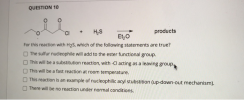 QUESTION 10 + CI HAS products Et, For this reaction with H2S, which of the following statements are true? The sulfur nucleophile will add to the ester functional group. This will be a substitution reaction, with -Cl acting as a leaving group, This will be a fast reaction at room temperature. This reaction is an example of nucleophilic acyl stubstition (up-down-out mechanism). There will be no reaction under normal conditions.
Please, make the answer clear and reable. BrEtOH a OEt Hace H2C Alkyl halides undergo nucleophilic...
 Please, make the answer clear
and reable.
BrEtOH a OEt Hace H2C Alkyl halides undergo nucleophilic substitution and elimination reactions. When the kinetics of the reaction are measured, if the rate of the reaction is found to be dependent only upon the concentration of the alkyl halide the reaction is first order. The substitution reaction is thus termed ction is termed E1. These reactions are unimolecular and occur in two steps. The first step is rate-limiting and involves the loss...
Please, make the answer clear
and reable.
BrEtOH a OEt Hace H2C Alkyl halides undergo nucleophilic substitution and elimination reactions. When the kinetics of the reaction are measured, if the rate of the reaction is found to be dependent only upon the concentration of the alkyl halide the reaction is first order. The substitution reaction is thus termed ction is termed E1. These reactions are unimolecular and occur in two steps. The first step is rate-limiting and involves the loss...
For the following reaction, please answer the following questions: A) Which type of substitution reaction would...
 For the following reaction, please answer the following
questions:
A) Which type of substitution reaction would it take place, SN1
or SN2?
B) Does it have a good leaving group? How do you know?
C) What is the intermediate?
D) Show electron move using arrows.
E) Show product structure. Indicate stereochemistry of the
product comparing to the reactant.
OH + I-
For the following reaction, please answer the following
questions:
A) Which type of substitution reaction would it take place, SN1
or SN2?
B) Does it have a good leaving group? How do you know?
C) What is the intermediate?
D) Show electron move using arrows.
E) Show product structure. Indicate stereochemistry of the
product comparing to the reactant.
OH + I-
 I nucleophile substitution. 7.8 Which is the better leaving group in each pair? a a, b, NH, NH, C. HẠO, HAS 7.9 Which molecules contain good leaving groups? a. CH CH.CH,Br b . CH,CH,CH,OH . CH.CH,OH, d. CH.CH Does the equilibrium favor the reactants or products in each substitution reaction? a. CH,CH-NH, + Br -- CH,CHBr + NH b. n + ON ~ ON + r 7.6 Identify the nucleophile and leaving group and draw the products of each reaction...
 The two reactants shown below are combined to bring about a nucleophilic substitution reaction. Which letter designates the electrophilic carbon at which substitution occurs? (If no reaction occurs enter the letter corresponding to "none.") Which letter corresponds to the leaving group? Which letter designates the nucleophile?
 For the nucleophilic-substitution
part (The second part. First part is the Diels-Alder Reaction)
indicate which is the nucleophile (by putting a circle around it)
and which is the electrophilic part (by putting a square around it)
and which part is a leaving group (by putting oval shape around
it.)
Diels-Alder Reaction + Intramolecular Nucleophilic Acyl Substitution : A Huge Increase in Molecular Complexity in One Reaction Flask no heat $$$=(3- no solvent H * (and enantiomer) CO2H
For the nucleophilic-substitution
part (The second part. First part is the Diels-Alder Reaction)
indicate which is the nucleophile (by putting a circle around it)
and which is the electrophilic part (by putting a square around it)
and which part is a leaving group (by putting oval shape around
it.)
Diels-Alder Reaction + Intramolecular Nucleophilic Acyl Substitution : A Huge Increase in Molecular Complexity in One Reaction Flask no heat $$$=(3- no solvent H * (and enantiomer) CO2H
 The two reactants shown below are combined to bring about a nucleophilic substitution reaction. F + Nal IT g. HI h. Nat i. none f. HF Which letter designates the electrophilic carbon at which substitution occurs? (If no reaction occurs enter the letter corresponding to "none.") Which letter corresponds to the leaving group? Which letter designates the nucleophile? Submit Answer Try Another Version 1 item attempt remaining
 Paragraph Styles 6. ... 7 1. Why is an ester less reactive to nucleophilic acyl substitution than an acid chloride? A) Chloride is a better leaving group B) Oxygen is better at donating electron density into the carbonyl with added resonance stability. C) Chloride is a better leaving group and compared to chlorine, oxygen is better at donating electron density into the carbonyl with added resonance stability D) The alkoxy anion is less basic than the chloride anion. 2. What...
 The two reactants shown below are combined to bring about a nucleophilic substitution reaction. CH3 + H2O Otos i. H30+ e. "OTos f. OH g. H2O h. "OS j. CH3OH k. none Which letter designates the electrophilic carbon at which substitution occurs? (If no reaction occurs enter the letter corresponding to "none.") Which letter corresponds to the leaving group? 1:1 1 .deicotill 1:1.00 Which letter corresponds to the leaving group? O Which letter designates the nucleophile?
 Questions 2-10 please!!
1) A substitution reaction is: [2] a) A reaction during which an OH group of a molecule is replaced by a halogen. b) A reaction during which water is the leaving group. c) A reaction during which a functional group of a molecule is replaced by an electrophile. d) A reaction during which a functional group of a molecule is replaced by another functional group. V 12 2) Substitution reactions are classified either as electrophilic or nucleophilic...
Questions 2-10 please!!
1) A substitution reaction is: [2] a) A reaction during which an OH group of a molecule is replaced by a halogen. b) A reaction during which water is the leaving group. c) A reaction during which a functional group of a molecule is replaced by an electrophile. d) A reaction during which a functional group of a molecule is replaced by another functional group. V 12 2) Substitution reactions are classified either as electrophilic or nucleophilic...
 QUESTION 10 + CI HAS products Et, For this reaction with H2S, which of the following statements are true? The sulfur nucleophile will add to the ester functional group. This will be a substitution reaction, with -Cl acting as a leaving group, This will be a fast reaction at room temperature. This reaction is an example of nucleophilic acyl stubstition (up-down-out mechanism). There will be no reaction under normal conditions.
 Please, make the answer clear
and reable.
BrEtOH a OEt Hace H2C Alkyl halides undergo nucleophilic substitution and elimination reactions. When the kinetics of the reaction are measured, if the rate of the reaction is found to be dependent only upon the concentration of the alkyl halide the reaction is first order. The substitution reaction is thus termed ction is termed E1. These reactions are unimolecular and occur in two steps. The first step is rate-limiting and involves the loss...
Please, make the answer clear
and reable.
BrEtOH a OEt Hace H2C Alkyl halides undergo nucleophilic substitution and elimination reactions. When the kinetics of the reaction are measured, if the rate of the reaction is found to be dependent only upon the concentration of the alkyl halide the reaction is first order. The substitution reaction is thus termed ction is termed E1. These reactions are unimolecular and occur in two steps. The first step is rate-limiting and involves the loss...
 For the following reaction, please answer the following
questions:
A) Which type of substitution reaction would it take place, SN1
or SN2?
B) Does it have a good leaving group? How do you know?
C) What is the intermediate?
D) Show electron move using arrows.
E) Show product structure. Indicate stereochemistry of the
product comparing to the reactant.
OH + I-
For the following reaction, please answer the following
questions:
A) Which type of substitution reaction would it take place, SN1
or SN2?
B) Does it have a good leaving group? How do you know?
C) What is the intermediate?
D) Show electron move using arrows.
E) Show product structure. Indicate stereochemistry of the
product comparing to the reactant.
OH + I-
Most questions answered within 3 hours.
-
Where is the error in this code sequence?
String s1 = "Hello";
String s2 = "ello";...
asked 10 months ago -
Financial data for Joel de Paris, Inc., for last year
follow:
Joel de Paris, Inc.
Balance...
asked 10 months ago -
Consider this reaction:
Al2(SO4)3 (aq)+ BaCl3
(aq) Al2Cl6 (aq)- +
3BaSO4(s) . What is the...
asked 10 months ago -
Suppose that Savneet is considering increasing her
recent random sample from 20 car rentals to 40...
asked 10 months ago -
Trucks arrive at an unloading terminal at an average rate of 120
per hour.
Trucks arrive...
asked 10 months ago -
Why are methanol and ethanol completely soluble in water while
octanol is not very little soluble....
asked 10 months ago -
A facilities manager at a university reads in a research report
that the mean amount of...
asked 10 months ago -
When the CuSO4 is rehydrated by adding water to the anhydrous
compound, is this an endothermic...
asked 10 months ago -
A ray of sunlight is passing from diamond into crown glass; the
angle of incidence is...
asked 10 months ago -
A block of mass 0.249 kg is placed on top of a light, vertical
spring of...
asked 10 months ago -
how do the kidneys compensate in the presences of acidosis
a) trigger hyperventilate
b) reserve acid...
asked 10 months ago -
Question 501 pts
The rental rate of capital to the firm increases. Which of the
following...
asked 10 months ago